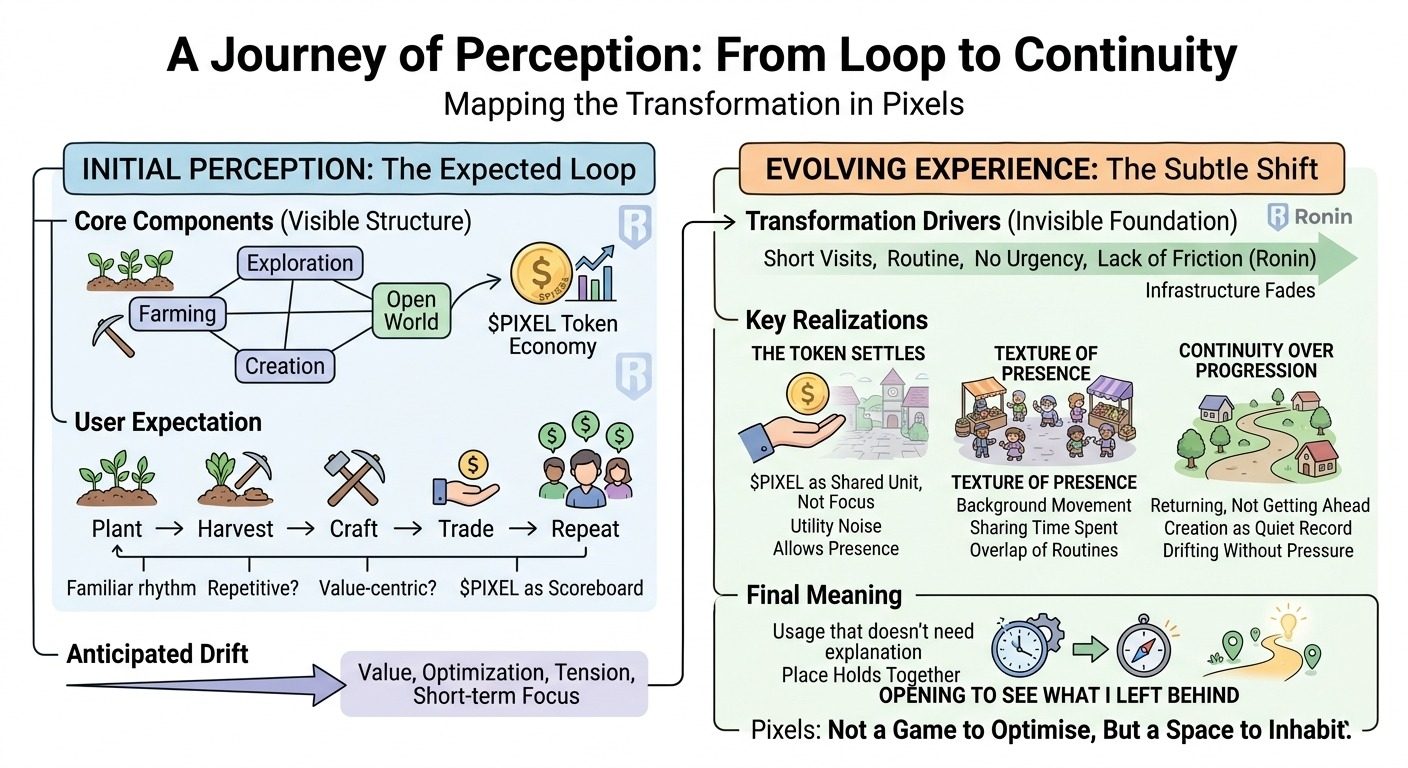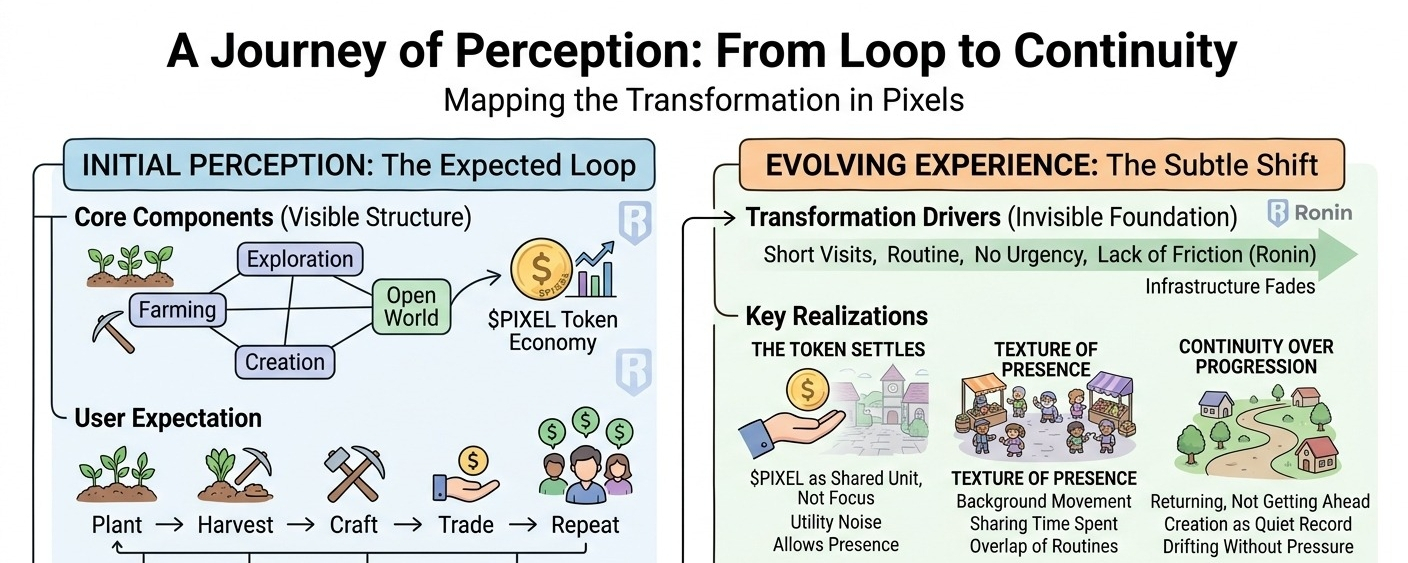
When I first opened Pixels, I thought I understood it immediately. A social casual Web3 game on Ronin, with farming, exploration, and creation stitched together into an open world. And then $PIXEL, sitting there like a quiet reminder that there’s an economy underneath it all. I assumed the loop would be the point. Plant, harvest, craft, trade. The familiar rhythm, with a token giving it weight.
I didn’t expect to stay long. These kinds of games often feel clear at the start and repetitive soon after. I also expected the token to become the center of attention, even if it wasn’t obvious at first. That’s usually where things drift—toward value, toward optimization, toward a slightly tense way of playing.
But the shift didn’t happen in a single session. It happened because I kept coming back without really deciding to. Short visits. A few minutes here and there. I’d check on crops, finish something small, walk around without urgency. The world didn’t demand a lot from me, and that changed how I paid attention. I wasn’t trying to “get ahead.” I was just there.
After a while, I started noticing the texture of other people’s presence. Not in a dramatic way. More like background movement. Someone asking where to find something. Someone answering without turning it into a lecture. Small trades happening without feeling like events. Even when people showed their farms or creations, it didn’t always feel like they were proving anything. It felt more like they were sharing something they’d spent time on.
That’s when $PIXEL began to feel different to me. I thought it would dominate the experience, like a scoreboard I couldn’t ignore. Instead, it stayed quiet. It showed up when it needed to—when trading or crafting required a shared unit—but it didn’t constantly pull my attention toward value. It didn’t make every action feel like a decision with consequences outside the game. It just existed, doing its job without asking to be the focus.
Ronin, too, became something I noticed only indirectly. Things worked smoothly enough that I stopped thinking about the system underneath. And that lack of friction changed my behavior. I didn’t hesitate before doing something small. I didn’t feel like I had to justify each action. I tried things, helped when it was easy, and moved on without thinking too much about it.
Underneath the farming, exploration, and creation, Pixels seems to be about continuity. Not progression in a dramatic sense, but the kind that comes from returning. The open world isn’t just space—it’s overlap. Your routine meets someone else’s routine. Farming gives you a reason to come back. Exploration gives you a way to drift without pressure. Creation becomes a quiet record of time spent, not a statement.
That difference matters more than I expected. Web3 often revolves around visibility—things that can be explained, tracked, and shared. Pixels feels more like it revolves around usage that doesn’t need explanation. The infrastructure fades. The token settles into the background. What’s left is whether the place holds together when nothing is happening.
I’m still not sure what that means long term. But I’ve noticed something small. I don’t open Pixels to check $PIXEL. I open it to see what I left behind. And I wonder how many projects are trying to build that feeling, instead of just the system around it.