
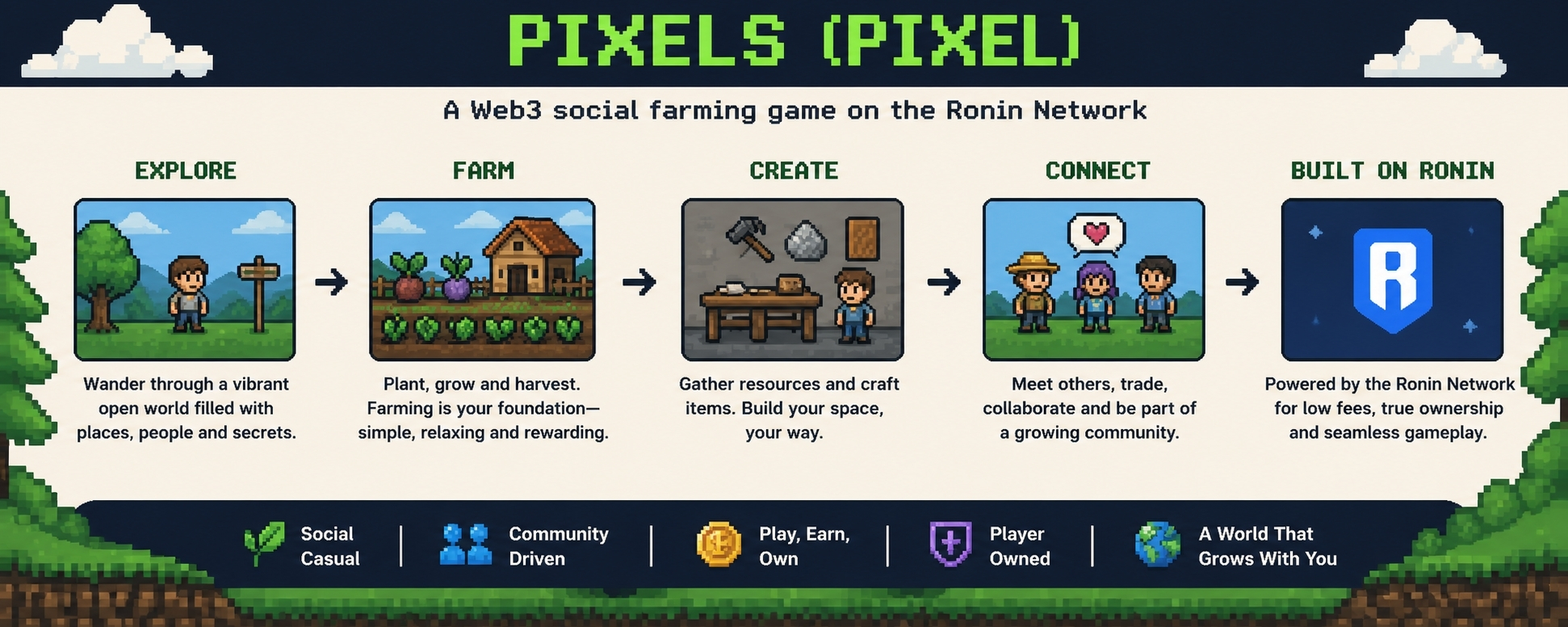

I didn’t pay much attention to Pixels when I first saw it. It looked like something I already understood, and not in a way that made me curious. Farming, a soft open world, simple loops—those pieces have shown up enough times in Web3 that they don’t really signal anything anymore. If anything, they make me more cautious. I’ve seen too many projects start with something that feels familiar and comfortable, only to slowly lose direction once the initial attention fades.
So I left it alone.
What brought me back wasn’t a big moment or some strong recommendation. It was just the fact that it didn’t disappear. It stayed around quietly, without forcing itself into the conversation. That’s a small thing, but it matters more than people admit. In this space, most things don’t last long enough to even be evaluated properly.
When I finally spent time with Pixels, it didn’t try to win me over. That stood out more than anything. There was no pressure to see it as special. It just existed as it was—simple actions, repeated over time. You plant, you gather, you move around, you come back later and do it again. At first, it almost feels like there’s not enough there.
But after sitting with it, I started to notice what it might actually be trying to do.
Most Web3 games are built around momentum. They need growth to feel alive. More players, more transactions, more attention. The systems are designed to work best when everything is expanding. But that also means they become fragile the moment things slow down. And things always slow down.
Pixels still carries that risk. It’s not separate from the usual structure. There’s still a token involved, still an economy that needs to hold together over time. That doesn’t magically fix itself just because the gameplay feels calm.
But the way it’s put together feels a little different.
The core loop doesn’t rely on excitement. It’s not trying to constantly push you forward or make you feel like you’re missing out. It’s something you can return to without much thought. That kind of design sounds unimportant until you’ve seen what happens when everything depends on intensity. When the energy drops, those systems fall apart quickly.
Pixels feels like it’s trying to avoid that kind of collapse. Not by removing incentives, but by not making them the only reason to stay.
Its connection to the Ronin Network plays into this in a quiet way. Ronin has already been through its own problems. It’s not new or untouched. It has a history of things going wrong and being rebuilt. That doesn’t guarantee anything, but it does mean Pixels isn’t building on something naïve. There’s already some understanding of where pressure points exist.
Still, the real question isn’t how it looks right now. It’s what happens later.
What happens when growth slows? When fewer new players arrive? When rewards don’t feel as strong as they once did? That’s the phase where most projects reveal what they really are.
From what I’ve seen, Pixels might handle that moment better than others. The simplicity gives it some stability. It doesn’t need constant updates to stay functional. It doesn’t break just because nothing new is happening.
But that doesn’t mean it’s safe.
There are still familiar issues sitting underneath it. The economy can still become uneven. Early players can still end up too far ahead. And once that gap becomes visible, it changes how new players see the system. I’ve seen that pattern repeat enough times to know how quickly it can shift perception.
There’s also a limit to how far simplicity can go. Repetition can feel grounding at first, but over time it can start to feel empty if nothing evolves. What feels calm in the beginning can turn into something that feels like routine without meaning. And when that happens, people don’t usually complain—they just stop showing up.
Pixels hasn’t reached that point from what I can tell. But it also hasn’t proven it won’t.
So I don’t really focus on what it says about itself or what’s coming next. I pay more attention to smaller things. Whether people keep returning when there’s no clear reason to. Whether the world still feels intact when attention shifts somewhere else. Whether it can exist without needing constant reinforcement.
That’s usually where the truth shows up.
I don’t see Pixels as something trying to change everything. It feels more like a small correction—someone recognizing what hasn’t worked before and adjusting slightly, without claiming they’ve solved it.
That approach is easy to overlook. It doesn’t create excitement, and it doesn’t give you a clear story to hold onto.
But it also feels more honest.
For now, I’m still just watching it. Not with expectations, but with a kind of quiet curiosity. The kind that only really settles when something has been around long enough to show how it behaves when things aren’t going well. And that part hasn’t happened yet.