
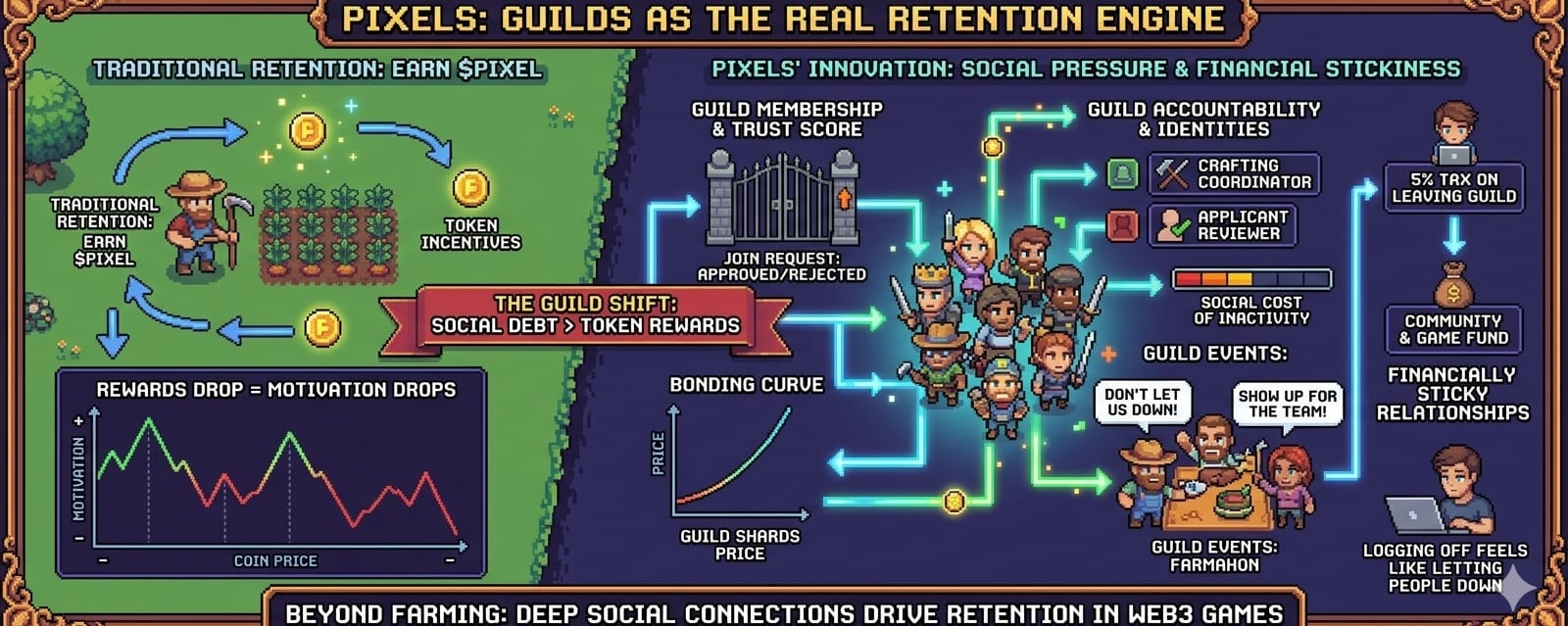
I didn't expect to feel guilty about a farming game. But there I was, closing my laptop on a Tuesday night thinking about the people in my Guild who were still online, still farming, probably wondering where I went.
That's when I realised @Pixels had done something to me that no token reward ever managed to do.
Most Web3 games try to keep you playing with money. Daily quest, staking reward, reason to open the app tomorrow. It works for a while. Then it doesn't. The moment the numbers get less interesting, the motivation goes with them. I've watched that cycle play out enough times in this space that I stopped being surprised by it.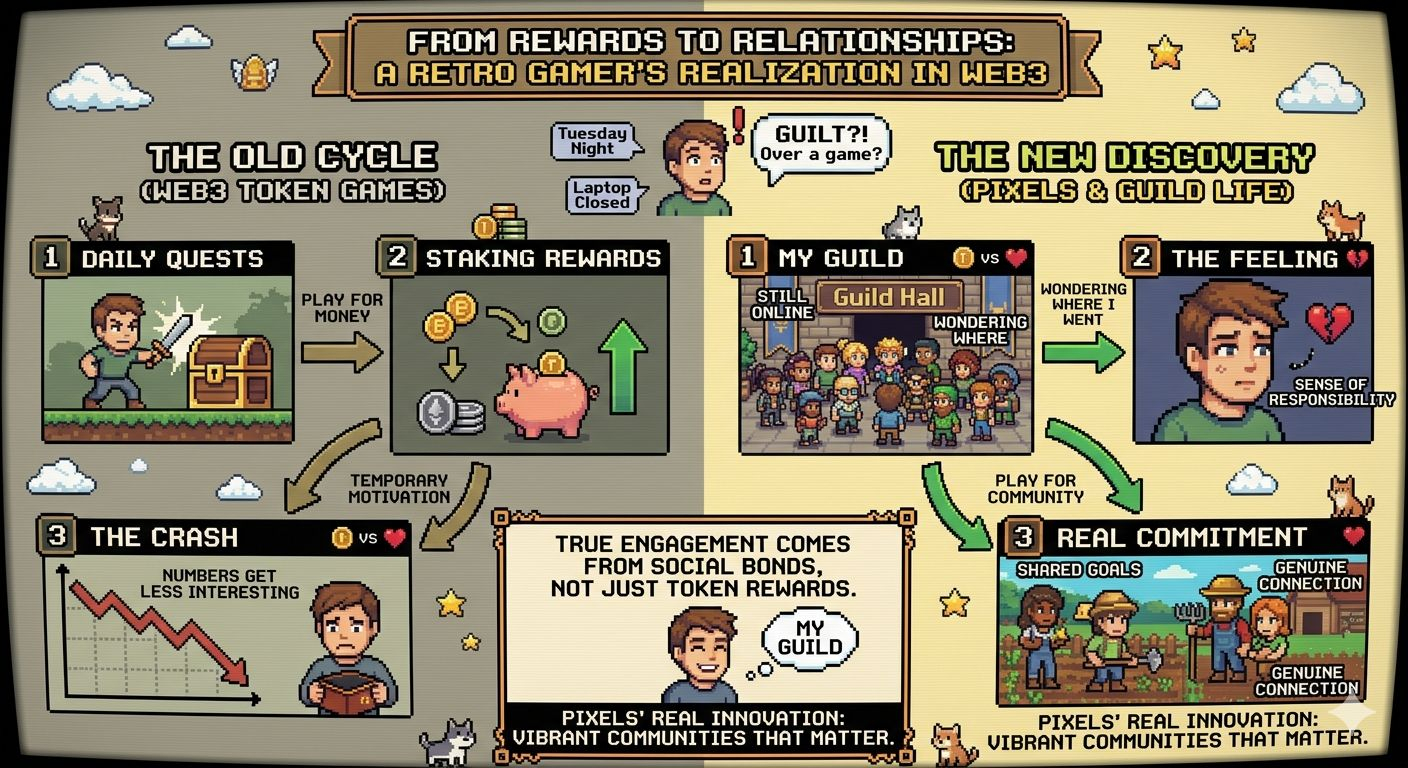
Pixels found a different lever. It kept me logging back in because specific people were expecting me to show up.
When Pixels launched Guilds they were open about where the inspiration came from, pointing directly to FriendTech and Stars Arena. Most people heard that comparison and thought about the social networking angle. What I think actually matters is the financial angle. FriendTech wasn't really about connecting people. It was about giving your social relationships a market price. Pixels took that same idea and dropped it inside a farming game, then wrapped it in enough pixel art and crop timers that most players never noticed what was actually happening underneath.
To create a Guild you need a Trust Score of 1950 and a fee of 15 $PIXEL. Guild Shards are the membership currency and their price moves on a bonding curve based on supply and demand. Joining isn't automatic either. You submit a request and the Guild leader decides whether to approve or reject you. That approval step is doing something quiet but important to how players feel about the game. Being accepted into a Guild feels like it means something. Being rejected actually stings. And once you're inside, being the inactive member has a social cost that no token penalty comes close to replicating.
I watched this play out during a Guild Farmathon in my network. No mandatory participation. No punishment for skipping. But almost everyone showed up. The extra XP and token prizes from pooled Guild events are real but not huge. People showed up because not showing up meant being the person who didn't show up. That specific kind of pressure is invisible in any whitepaper and it's more powerful for retention than almost anything else I've seen used in this space.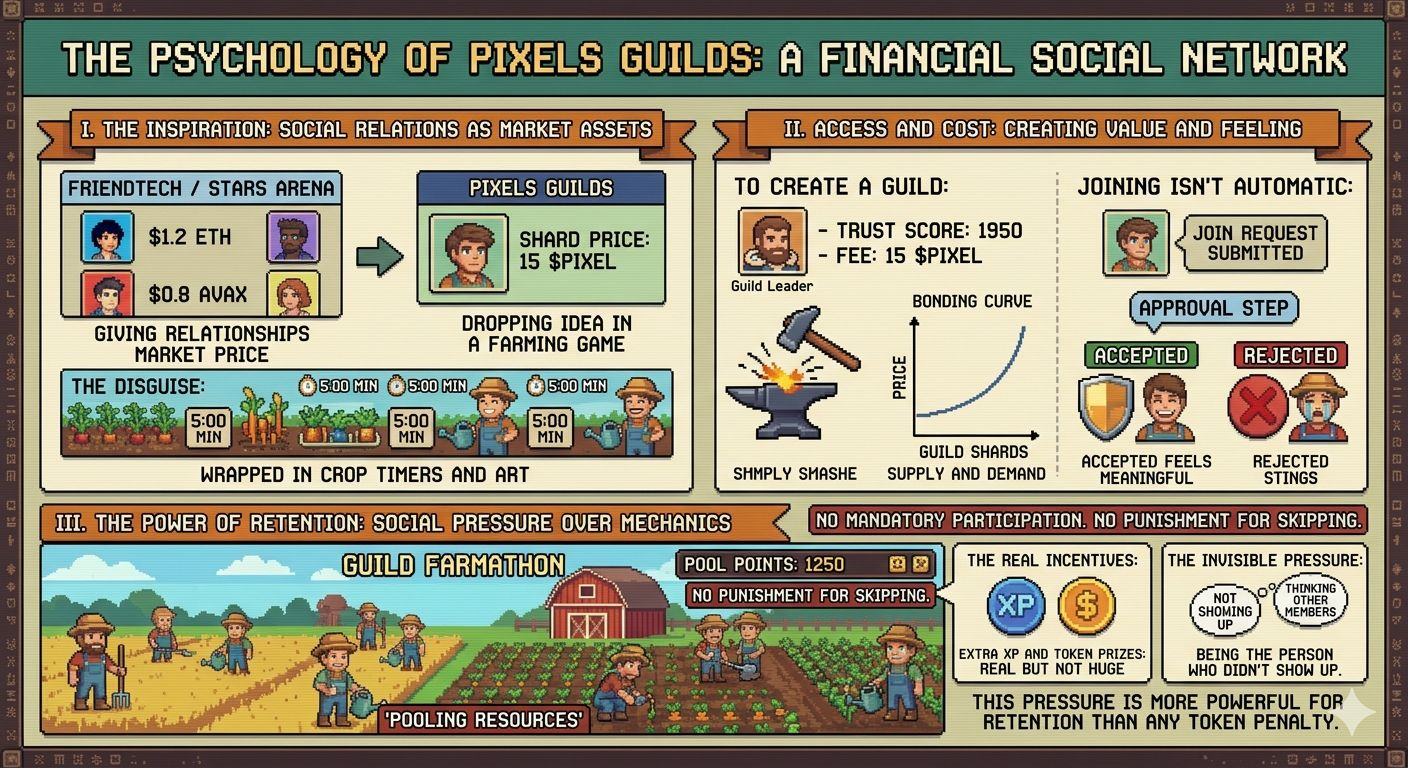
Guild memberships can be sold back but they carry a 5% tax that gets split between the Guild and Pixels. So leaving costs you something real. Part of what you pay on exit goes back to the community you're walking away from. Your social connections inside the game aren't just emotionally sticky. They are financially sticky in a way that shows up in your actual wallet balance every time you think about leaving.
I've been following Web3 projects long enough to have a pretty clear picture of what separates the ones that survive bear markets from the ones that don't. It is almost never the tokenomics. It is whether logging off feels like letting someone down. Axie Infinity had millions of players at its peak and almost none of them felt that way about each other. Scholars played for managers. Managers played for yield. When rewards dropped there was nothing holding anyone there and the whole thing came apart faster than anyone wanted to admit.
Guilds in Pixels have internal hierarchies with ranks, delegated roles, and governance structures that turn them into communities with real accountability rather than just groups with a shared name attached. That internal structure gives players a position to maintain, not just a reward to collect. You're not just a member. You're the person who coordinates crafting runs, or handles new applications, or the one people rely on during big events. That kind of identity inside a group compounds every week you stay and gets harder to walk away from over time.
Some landowners generate consistent $PIXEL income from community activity on their land without farming manually every day, because their relationships with active players produce returns even when they're offline. That's social capital with a yield attached to it. The player with the most trusted relationships inside the ecosystem earns from those relationships passively. In my view that's something genuinely new in Web3 gaming and most people are still describing Pixels like it's just a farming sim.
The farming loop is fun. I'm not dismissing it. But I don't think it's why people stay past the first month.
What I keep coming back to is something much simpler than any tokenomics model. The game made me feel like my presence mattered to real people. And in a space full of projects trying to buy loyalty with APY numbers, that might honestly be the most durable thing Pixels has built.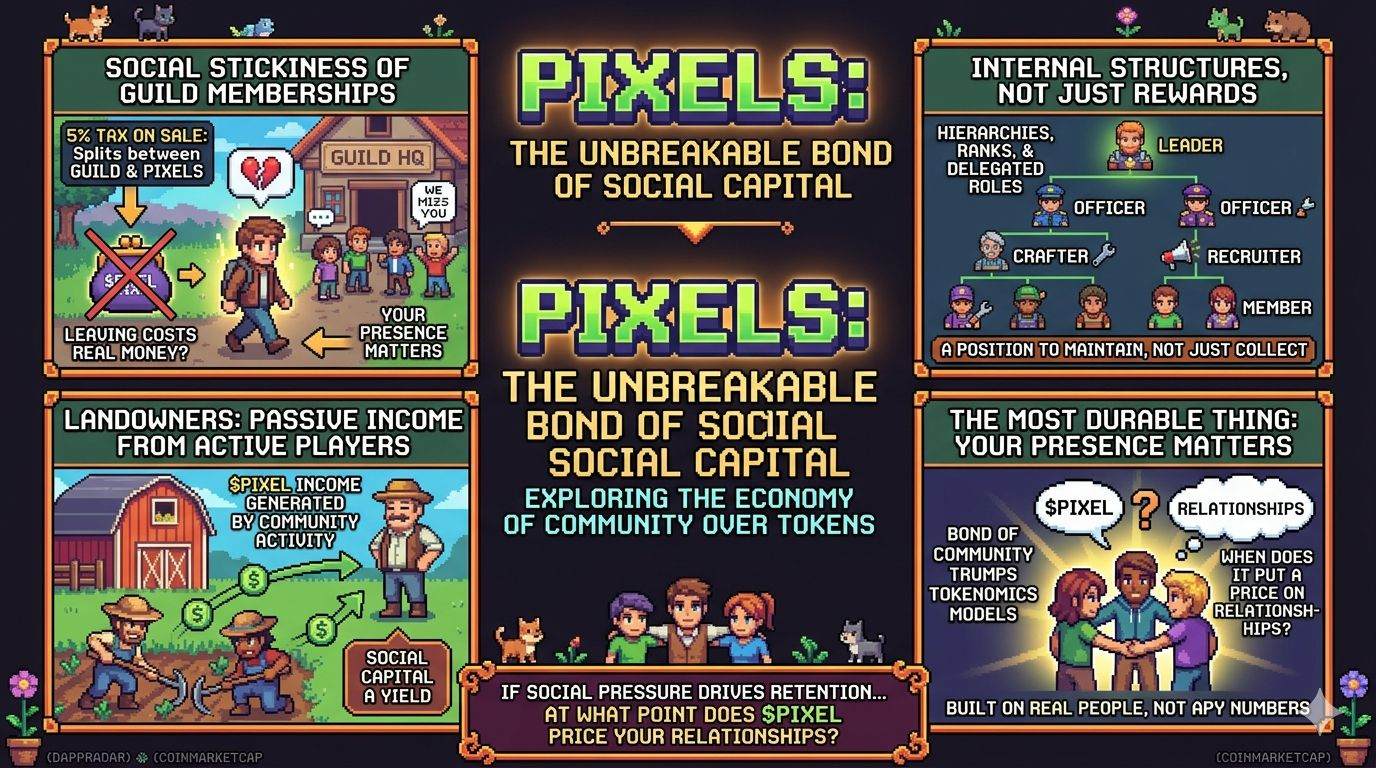
So here's the question I can't stop sitting with: if the social pressure inside Pixels is already doing more retention work than the token rewards, at what point does $PIXEL stop being a gaming currency and start being the thing that puts a price on your relationships?
