
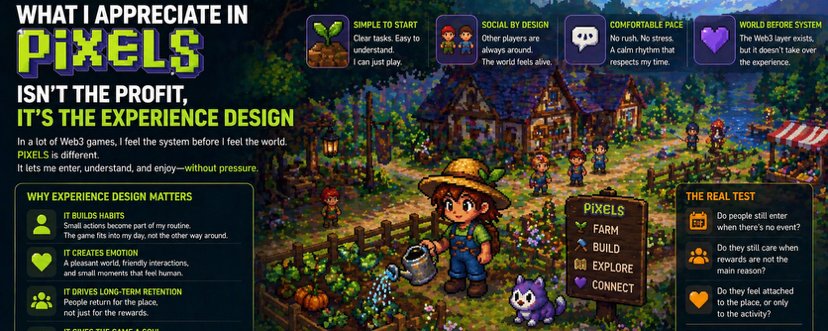
I remember opening PIXELS once when I was not in the mood to “play seriously.” I was just tired, a bit bored, and honestly not looking for another Web3 product to understand. I only wanted to do something light for a few minutes. So I entered, walked around, checked a few tasks, saw other players moving, and somehow stayed longer than planned.
That small moment is why I do not judge PIXELS mainly through profit. For me, the more interesting part is its experience design.
A lot of Web3 games still feel like they are built from the economy outward. First comes the token, then the asset logic, then the marketplace, then the game is placed around it. I understand why that happens. Web3 needs systems. But as a user, I usually feel the structure before I feel the world. And when that happens, I get tired quickly.
PIXELS feels different in a quiet way. It does not remove the Web3 layer, but it does not force it into my face all the time. I can enter and understand what to do without feeling like I need to study a whole system first. Plant something. Collect something. Talk to someone. Move around. Small actions, but clear enough.
That simplicity matters.
Not because simple means shallow. Sometimes simple means the user does not have to fight the interface before reaching the feeling. In PIXELS, the first emotion is not pressure. It is familiarity. The world looks soft, the rhythm is slow, and the tasks are not trying too hard to impress me. Maybe that sounds small, but in Web3 gaming, that is actually rare.
I also like that the social feeling is built into the space. Seeing other players around changes the mood. Even if I do not interact deeply, their presence makes the world feel less mechanical. It reminds me that a game does not always need huge systems to feel alive. Sometimes it just needs enough people doing small things in the same place.
Still, I do not want to romanticize it too much.
A comfortable experience can become repetitive. If the daily loop does not evolve, users may slowly leave. If the community becomes quiet, the world may feel empty. And if the game depends too much on rewards to bring people back, then the experience design is not strong enough yet. That is the part I keep questioning.
There is also a difference between looking active and feeling alive. A project can have numbers, campaigns, and attention, but the real test is normal days. Do people still enter when nothing big is happening? Do they still care when rewards are not the main reason? Do they feel attached to the place, or only to the activity?
For now, what I appreciate in PIXELS is that it tries to answer those questions through feeling, not just incentives.
It gives users a place before asking them to care about the system. It lets routine become part of the experience. It treats the world as something people might want to return to, not only something they can extract from.
I do not know if that is enough for long-term success. Maybe it is only the beginning. Maybe the design still needs more depth, more memory, more reasons to stay.
But I respect the direction.
Because in Web3 gaming, profit can bring attention. Experience is what might make people come back.
