

What is Storm Video?! Young people today probably don’t even know anymore—just like LeEco back then, it used to be so dazzling. Who would’ve thought it would be forgotten so quickly.
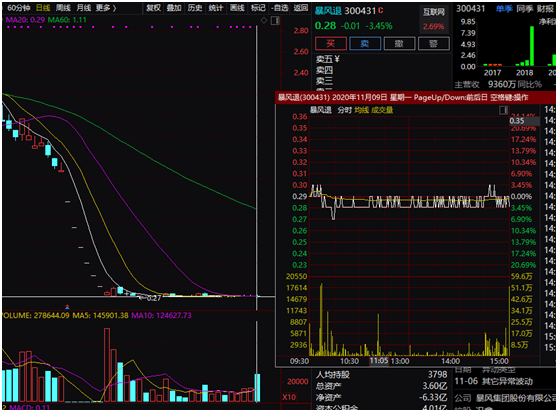
Today the curtain falls after a 99.78% plunge! An entire stock king is delisted. It surged 45 times in just two months, and the founder is now in custody.
If, back then, Feng Xin had sold Storm Video to Alibaba, he might have become the most decent winner in China’s internet industry. But he didn’t—because the A-share market opened up. Feng Xin thought, “I’ve waited for so many years. Finally, it’s Storm Video’s turn to get a seat at the table. If I sell it now, won’t I lose big?”
Sure enough, in 2015, Storm Technology went public. It hit 37 consecutive daily limit-ups, and its market value once surged to 40 billion. Within the company, 1 billionaires sprang up—10 of them, along with 31 ten-millionaire-level individuals and 66 millionaires. At that moment, Feng Xin truly won big.
But nobody could have imagined that these 37 consecutive daily limit-up gains were not a lifesaving medicine for Storm—rather, they marked the beginning of Storm’s final disastrous defeat. Within just a few short years, Storm was delisted, and Feng Xin was taken into compulsory measures. A player that had once been installed on 300 million computers ended up trapping even its boss in a dead end.
Isn’t this bizarre? But when you look back, everything was already planted early on. Why was Storm Video so strong back then? Because it ate up the fattest piece of the PC era: the video player market. At that time, people had to download videos first; even after downloading, they might not be able to play, and all kinds of formats could drive people crazy. When ordinary players couldn’t open the files, Storm Video could play them right away.
So for many people, their computers might not need antivirus software, but they can’t do without Storm Video. At its peak, Storm Video had more than 300 million users, and its daily online users exceeded 10 million. In 2007, Storm’s capital chain ran into problems. Feng Xin saw an opportunity.
He had previously worked with Lei Jun at Kingsoft, and also with Zhou Hongyi at Yahoo China. He had seen the internet’s world of intrigue and competition. He knew building a player from scratch would be too slow; it was better to buy the big brother directly. So Feng Xin acquired Storm Video, and the acquisition brought him onto the main stage of the table. He effectively got himself brought to the negotiating table.
More importantly, Feng Xin made a very practical judgment at the time. Around 2010, the video industry started a copyright war. Platforms like Youku, Tudou, and Cool6 burned money just to grab TV dramas and movies, and the spending was so extreme it made people’s eyes red. Back then, copyrights were cheap. Later, one episode could cost over a million, and everyone believed: whoever has the content will be the future. Feng Xin didn’t see it that way.
He believed users wouldn’t run to more than a dozen websites just to watch different videos. So Storm didn’t buy copyrights with heavy investment—it instead did aggregation. You want to watch what, and I’ll line it up for you. You download whatever format, and I’ll open it for you. If you can’t find the entry point, I’ll be the entry point. This strategy worked well in the PC era. While others burned money buying copyrights and losing money, Storm relied on the player and ads, becoming one of the few alternative businesses in the video industry that could actually make money.
But the problem also lies here. What is really valuable about Storm isn’t the content—it’s the entry point. As long as people still watch videos on their computers, it feels great. But once people stop watching videos on computers, Storm’s entry point becomes worthless. After 2010, mobile internet arrived, and the way users watch videos changed completely. Storm became awkward overnight.
You say it’s a video website—it doesn’t have exclusive content like Youku and Tencent. You say it’s a platform—it doesn’t have a strong membership system. You say it’s an entry point—but users have already moved to mobile phone apps. PC users got diverted, and ad revenue followed the decline. Storm used to be a national software; now it slowly turned into an outdated tool.
At this point, when Alibaba came to make the acquisition, it was actually Feng Xin’s best chance to cash out and leave. But once the IPO and market frenzy hit A-shares, Feng Xin didn’t want to step off the table anymore—he wanted to sit as the boss himself. In March 2015, Storm Technology listed on the ChiNext board, and the capital markets practically lifted him onto the sky. Feng Xin also got dizzy from the spectacle. He started to believe Storm wasn’t just a player—Storm was an ecosystem.
So he made a high-profile proposal for a global-first DT big entertainment strategy: VR to be developed, TV to be made, livestreaming to be done, cultural-and-entertainment to be done, and sports to be done as well. Does that sound familiar? Yes—it's the same taste as LeEco. In those years, Jia Yeting talked about ecosystems as if he could fly; he wanted to make phones, TVs, sports, cars—everything. The capital markets loved it too. Feng Xin saw it and thought: if Old Jia could talk about building an ecosystem, and if he could do it, then why couldn’t I? Why couldn’t Storm?
But the problem is: talking about an ecosystem doesn’t cost anything; building an ecosystem truly burns money. Storm’s VR rode a wave of hype, but at the time VR wasn’t even mature. The excitement didn’t last, and it was hard to sell. Storm TV was even worse off. The TV market was already crowded and cutthroat—there were Xiaomi and LeEco in front, and a whole bunch of traditional TV manufacturers behind. After Storm entered, they sold one unit and lost money on each one. If you didn’t sell the story, you couldn’t keep going; but if you sold cash flow, it couldn’t be carried.
Feng Xin had it extremely hard, to say the least. As for content, that goes without saying. Youku and Tencent have copyrights, memberships, and resources from big enterprises. What did Storm have? That same old player’s foundation. So although Storm looked highly valued, its real days only got tighter and tighter, and Feng Xin could only keep telling stories while scrambling for money.
And what truly pushed Storm into the deep pit was a content acquisition. In 2016, a fund called Jinxin Fund, under Feng Xin’s control, took part in the acquisition of the international sports copyright company MPS. This company sounded formidable—there were top-event resources such as the Premier League, Serie A, and the European Cup. Feng Xin thought, isn’t this the ticket for Storm Sports? With sports copyrights, Storm would be more than just a player: it could talk sports, livestream, and do big entertainment.
But this deal wasn’t a small one. Behind it was a merger-and-acquisition fund on the scale of tens of billions. Feng Xin and Storm themselves didn’t provide the most—most of the money came from financial institutions. And that’s dangerous: using a small amount of money to leverage a large position is great if you win, but if you lose, the bill won’t be small either.
The result was that MPS really ran into trouble. After the acquisition, the core copyrights of MPS expired one after another. The management didn’t even think about renewing the contracts—this was really strange. Everyone knows that for a sports copyright company, the most valuable thing is the copyrights. Once the copyrights are gone, MPS instantly turns from a high-priced asset into a hot potato. In 2018, a UK court ordered MPS to go bankrupt and liquidate—this blew up the entire chain.
At first, the money that came in for the acquisition of MPS had to have someone responsible. Later, lawsuits and accountability followed one after another. Storm couldn't hold on, and neither could Feng Xin. In 2019, Feng Xin was taken into compulsory measures by the public security authorities on suspicion of offering bribes to non-state functionaries and embezzlement of duty-related funds; later, he was arrested. After that, Storm was delisted. The national software that once had 300 million users became nothing more than a memory of an era, and the internet world of power and intrigue never heard from Feng Xin again. $BAOS.US