

Most crypto games aren’t really games. They’re spreadsheets with better graphics. You log in, click around, harvest some token, and mentally calculate how fast you can dump it before everyone else does. That’s the loop. Dress it up however you want—it’s still extraction.
Pixels doesn’t completely escape that gravity. But it’s trying to fight it. And honestly? That alone makes it worth paying attention to.
Here’s the core issue nobody likes to admit: you can’t build a real economy on top of a game if the game itself isn’t worth playing. Sounds obvious, right? Yet most projects flipped the priority. They built the economy first, then stapled gameplay on top like an afterthought. The result? Players show up for yield, not for fun. And when the yield drops, so do the players.
Pixels seems to have looked at that mess and said, “Yeah, maybe let’s not do that again.”
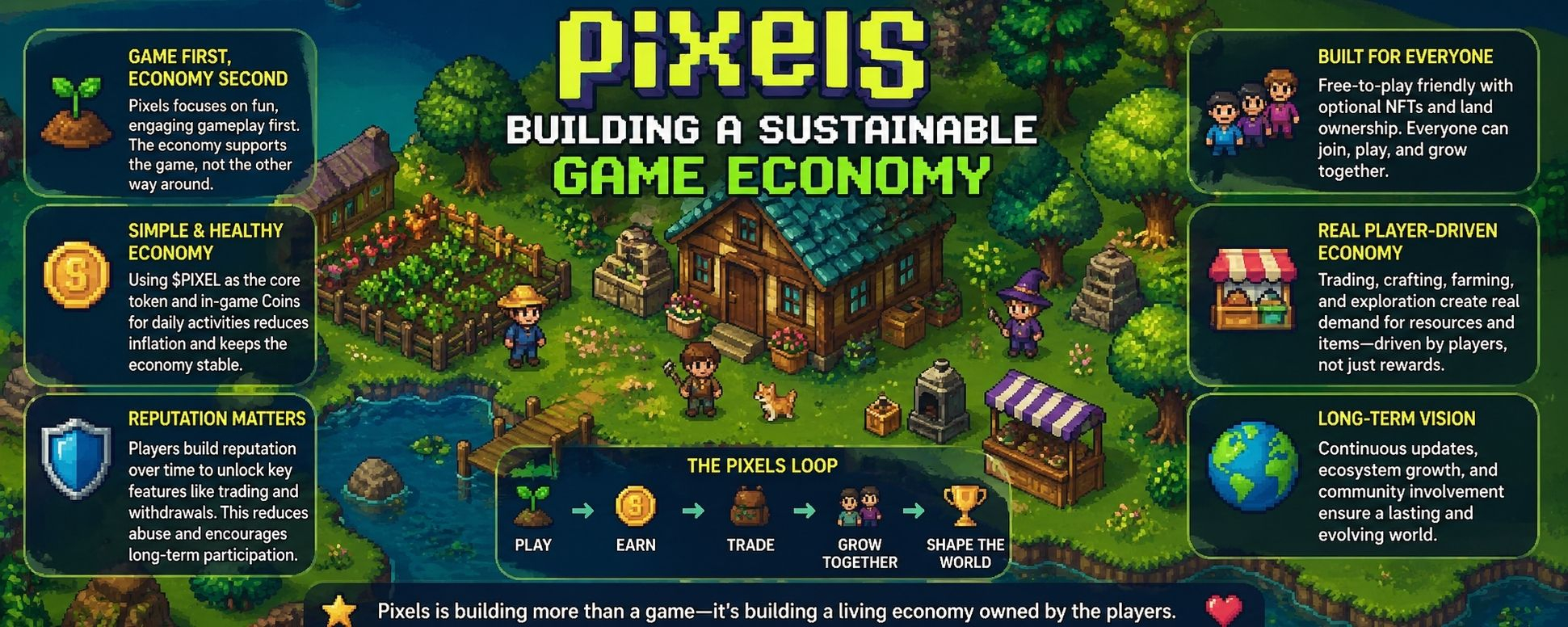
The game itself is simple on the surface—farming, gathering, crafting, social stuff. Nothing groundbreaking. You’ve seen versions of this before. But the structure underneath is where things get interesting. Instead of turning every action into a token payout, Pixels splits things up. There’s a clear attempt to separate “playing the game” from “extracting value.”
And that matters more than people think.
Because once every single action ties directly to money, players stop behaving like players. They behave like traders. Or worse—like bots with better branding. Efficiency becomes everything. Fun becomes irrelevant. That’s when things start to rot.
Pixels pushes back on that by introducing friction. Not the annoying kind. The necessary kind.
Take their currency setup. Most projects go wild here—multiple tokens, confusing loops, weird incentives stacked on top of each other. Pixels is actually simplifying things. One main token gets the spotlight, while everyday gameplay leans on an off-chain currency. Translation? Not everything you do needs to hit the blockchain. Not every carrot you pick needs to have a market price.
It’s a small shift, but it changes behavior.
You’re not constantly thinking, “What’s this worth?” Sometimes you’re just… playing. Weird concept, I know.
Then there’s the reputation system. This is where things get a bit more serious. You don’t just jump in and start draining value immediately. Certain actions—like trading freely or withdrawing—require you to build up reputation first.
At first glance, it feels restrictive. Like, why gate people at all? Shouldn’t open economies be… open?
But let’s be real. Completely open systems get abused. Fast.
Without some kind of barrier, the most efficient strategy becomes hit-and-run farming. Create accounts, extract value, leave. Repeat. It’s not even malicious—it’s just logical. Pixels is trying to slow that down. Force players to stick around. Build history. Be part of something instead of just passing through.
Does it fix everything? Of course not. People will still game the system. They always do. But it raises the cost of being purely opportunistic. That’s a step in the right direction.
Now, zoom out for a second.
The bigger bet Pixels is making isn’t about tokens or mechanics. It’s about player behavior. Specifically, it’s betting that if you give people a reason to care—actual reasons, not just financial ones—they’ll stick around longer and act differently.
That’s a risky bet in crypto.
Because let’s be honest, a huge chunk of this space is here for the money. You see it in every cycle. New project launches, hype builds, early players cash out, late players hold the bag. Rinse and repeat. Expecting that crowd to suddenly care about farming crops and building reputation? That’s… ambitious.
But here’s the thing.
Not everyone is like that.
There’s a quieter group of players who actually want a game. Not a yield farm. Not a flipping opportunity. A game. Something they can log into without immediately thinking about exit liquidity. Pixels seems to be targeting that group first, even if it means growing slower.
And yeah, that’s probably the only way this works long term.
Because if your entire economy depends on constant new players buying in, you don’t have an economy. You have a treadmill.
Pixels is trying to step off that treadmill. Slowly. Carefully. Maybe even awkwardly at times.
It’s not perfect. Far from it.
There are still open questions. Big ones.
Will the simplified economy hold up under real pressure? What happens when player numbers spike and everyone tries to cash out at once? Does reputation actually stop abuse, or just delay it? And here’s the uncomfortable one—can a game like this stay fun once the financial incentives become less aggressive?
No easy answers.
But at least Pixels is asking the right questions. That already puts it ahead of most of the field.
What I find most interesting is how… unexciting some of their decisions are. No wild promises. No insane APYs. No “this changes everything” energy. Just steady adjustments—reduce inflation here, tighten access there, shift incentives, test, repeat.
It doesn’t grab headlines. It doesn’t go viral.
But it might actually work.
And honestly, maybe that’s the point.
Because the games that survive aren’t the ones that explode overnight. They’re the ones people keep coming back to when nobody’s paying them to show up.
So yeah, Pixels isn’t perfect. It’s still figuring things out. It’ll probably mess up a few times along the way.
But for once, it feels like a project that understands something basic—and crucial:
If the game isn’t worth playing, the economy doesn’t matter.
Everything else is just noise.