
A few weeks ago, I did something that felt completely ordinary.
I asked AI to help me organize a complicated task. Within seconds, it gave me a detailed plan. I followed most of its suggestions without thinking twice.
Later that evening, I caught myself wondering why.
Why had I trusted a machine so easily?
The answer wasn't difficult to find. AI had quietly become part of my daily routine. It helped me write, learn, research, and solve problems faster than ever before. Somewhere along the way, trust became automatic.
Then another thought appeared.
What happens when AI stops helping us... and starts acting for us?
Imagine waking up one morning to discover that an AI agent had already managed your digital wallet, interacted with decentralized applications, claimed rewards, completed transactions, and optimized your portfolio while you were asleep.
If everything worked perfectly, you would probably never notice.
But if one decision seemed unusual, one question would immediately matter more than anything else:
How do I know exactly what happened?
That moment completely changed the way I think about artificial intelligence.
For years, the conversation has focused on making AI smarter, faster, and more capable. Those achievements are remarkable, but they solve only half of the challenge.
The other half is trust.
Not trust built on marketing.
Not trust built on reputation.
Trust built on transparency and accountability.
The more responsibility we give AI, the more important it becomes to understand and verify its actions. In finance, accountability matters. In business, accountability matters. In software, accountability matters.
Why should autonomous AI be any different?
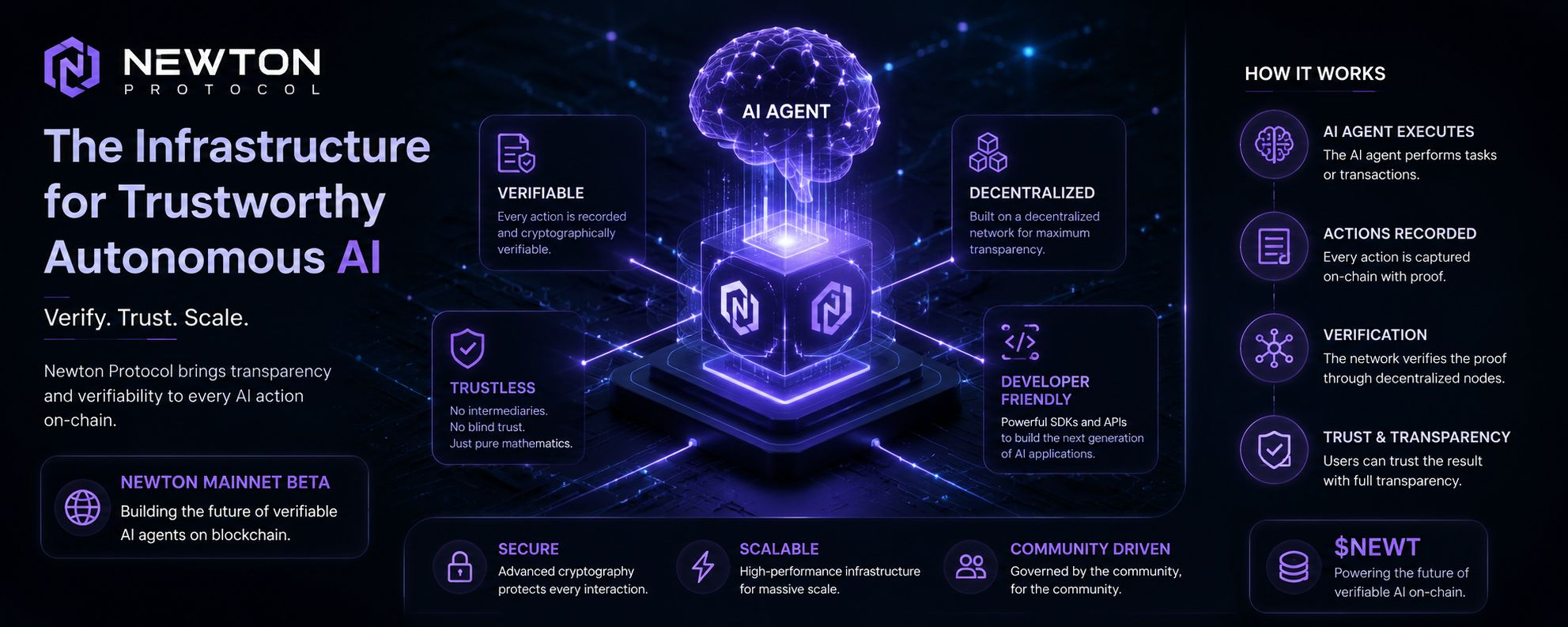
While thinking about these questions, I started reading about @undefined and the Newton Mainnet Beta.
What interested me wasn't simply another blockchain announcement.
It was the broader idea behind it.
The Mainnet Beta represents an opportunity for developers to experiment with infrastructure designed for a future where AI agents can operate in environments that prioritize transparency and verifiable execution. That idea feels increasingly relevant as autonomous systems continue to evolve.
I like beta networks because they reveal something announcements never can.
Reality.
Ideas leave presentation slides and begin interacting with real developers, real communities, and real feedback. Weaknesses become opportunities for improvement. Builders learn what works, what doesn't, and what still needs refinement.
Every successful technology has gone through this process.
The internet did.
Smartphones did.
Blockchain did.
AI infrastructure will too.
One lesson history keeps teaching us is that technology usually moves faster than human confidence. Innovation can happen overnight, but trust is earned over time through consistency, openness, and accountability.
That is why I believe conversations around trustworthy AI deserve much more attention.
Tomorrow's users won't simply ask whether an AI can complete a task.
They will ask whether every important action can be understood, reviewed, and trusted.
For me, that's where the discussion becomes truly exciting.
The future of AI won't be shaped only by larger models or faster responses.
It will also be shaped by the infrastructure that gives people confidence to rely on autonomous systems in meaningful situations.
That's one reason I'm following @NewtonProtocol and the progress of the Newton Mainnet Beta with genuine interest. Exploring ideas that bring greater transparency and accountability to AI feels like an important direction for the broader Web3 ecosystem.
Years from now, we may not remember which AI model generated the cleverest response.
We may remember the technologies that helped people trust autonomous intelligence when it mattered most.
Perhaps that will be the real milestone of this new era—not teaching AI to think faster, but building systems that help humans trust its actions with confidence.