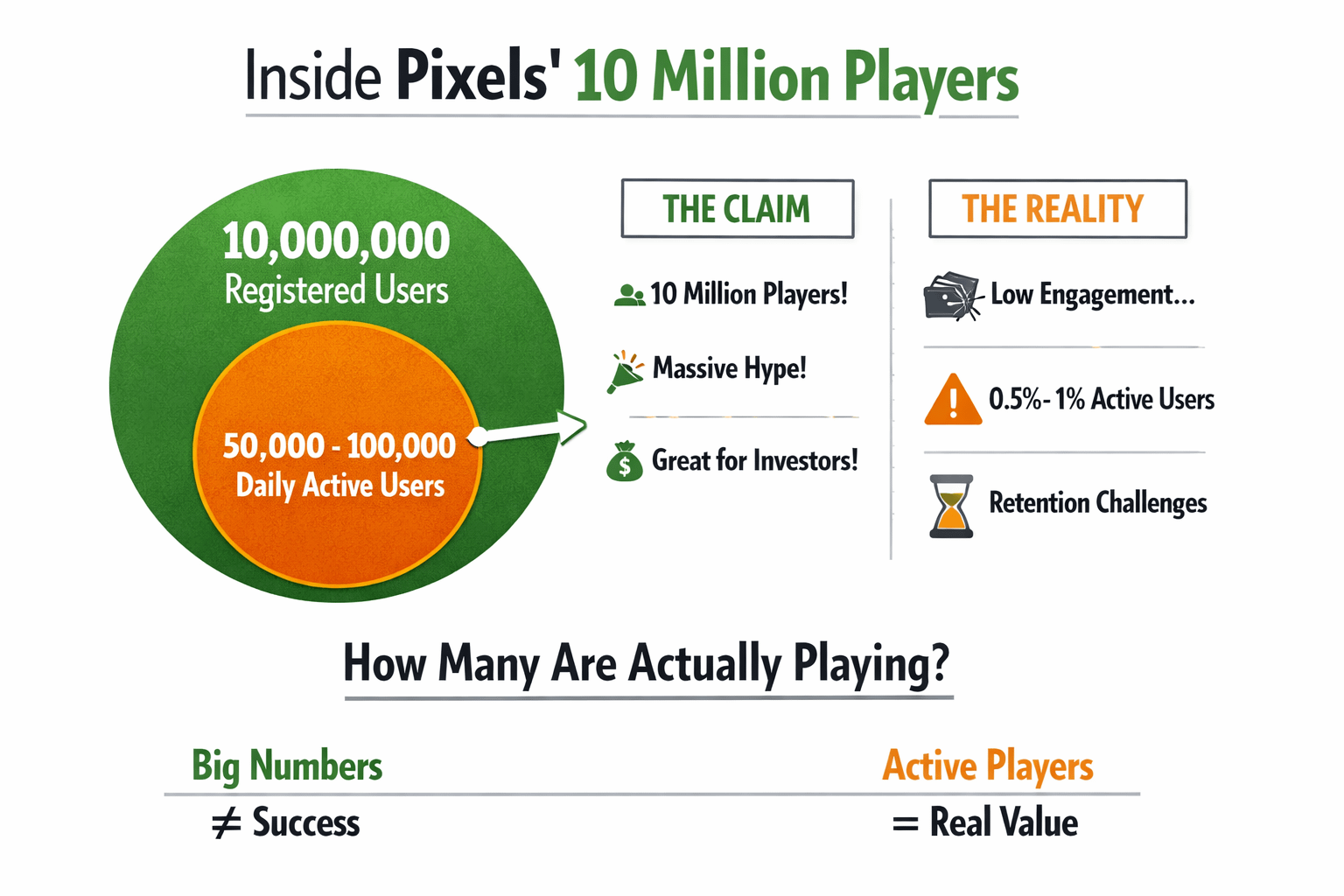
Honestly, I once walked into a restaurant because of the crowd outside. Later I realized everyone was just sitting there for the AC, not the food. When I saw Pixels' 10 million player figure, that exact memory came back to me.
Ten million people on a platform...that's not a small thing. But I paused. 🤔 Because a number and actual activity are not the same thing, and projects tend to blur that distinction when they present themselves. The real question isn't how many people showed up. It's how many are genuinely playing.
That's exactly what I went looking for with Pixels. And what I found, I might as well say out loud.
The first thing I did was look at on-chain data. Wallet activity. Transaction frequency. Of those 10 million, the number who made at least one meaningful transaction in the last 30 days is significantly smaller. This isn't a failure specific to Pixels.....it's a structural problem across Web3 gaming. Registration is easy. Retention is hard. If someone connects their wallet once and disappears, they still technically count toward that 10 million.
So the question becomes: who is this number actually useful for?
For investors, it's a narrative. "10 million players" looks great on a VC crowd..... But as an ordinary token holder, that number only means something to me if those players are actually participating in the in-game economy...earning BERRY tokens, spending them, trading with each other. If that's not happening, 10 million is a marketing figure and nothing more.
That said, I'm not dismissing Pixels entirely.
What caught my attention is that their gameplay loop feels more organic than most Web3 games. Farm, collect resources, craft, trade. That loop is meaningfully different from the old play-to-earn model where the entire game was grind and dump tokens. Pixels is at least trying to build an actual game experience.
But trying and succeeding are not the same thing.
What I'm tracking is DAU.....daily active users. If only 50,000 to 100,000 out of 10 million are active on any given day, the conversion rate sits between 0.5 and 1 percent. A sustainable economy can't run on that. In-game token demand doesn't build from that. And without demand, holding a token price becomes very difficult.
That's where my biggest question sits.
Does Pixels know this gap exists? Or do they also treat that 10 million figure as proof of success? Because a project only feels credible to me when it's the first to admit that registered users and active players are not the same thing. That honesty is what earns trust.
Getting excited by numbers is easy. Looking at what's actually inside those numbers is the real work. Just like you shouldn't walk into a restaurant because of the crowd you check the menu first. The same applies to Pixels.
Ten million players doesn't equal success... The real question is how many of those 10 million are actually playing.@Pixels #pixel $PIXEL