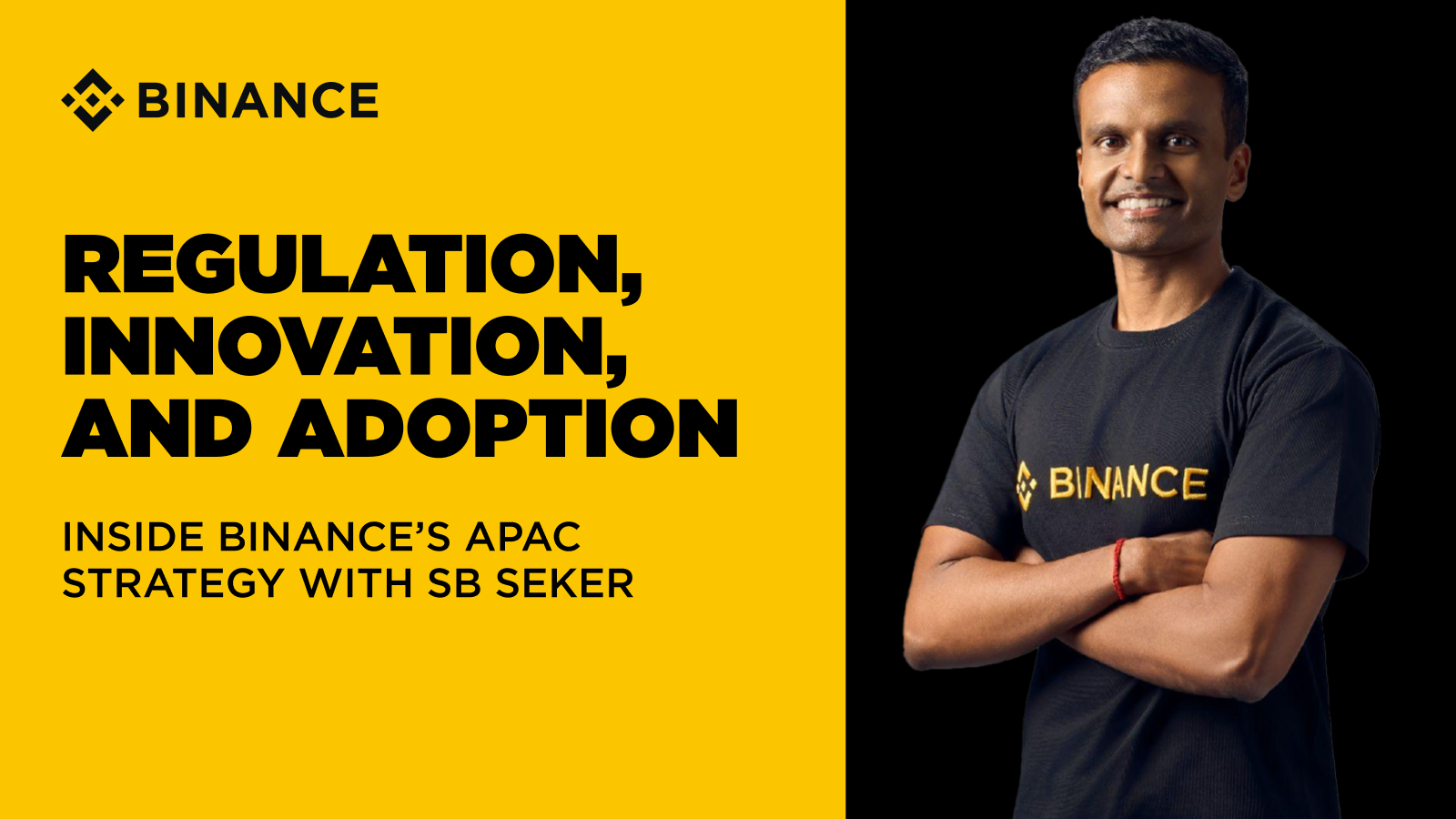
In a recent interview, Binance’s new APAC Head SB Seker highlighted how regulatory frameworks across the region, from Thailand’s licensing regime to the Philippines’ sandbox model, are shaping the future of crypto adoption.
Stablecoins and real-world asset tokenization are emerging as the two strongest trends set to define the next 1–2 years of crypto development in APAC.
Localization, education, and collaboration with regulators will be the key success factors for crypto in Southeast Asia and the broader APAC region.
Asia-Pacific (APAC) is one of the most dynamic regions in terms of crypto adoption, and it is also incredibly diverse. To shed light on how regulation, innovation, and market demand are evolving, SB Seker, Binance’s new Head of APAC, sat down for a Binance TH by Gulf Binance Yellow Sofa series interview. With a career spanning central banking, financial services, and crypto law, Seker brings a unique perspective on how the region is shaping the future of digital assets.
As he put it: “Reaching out to the community and ecosystem is a crucial part of what we do at Binance. APAC is where some of the most exciting developments are happening.”
Please note that the interview transcript has been edited for length and clarity.
Seker’s journey into crypto was gradual but inevitable. From reading the Bitcoin whitepaper early in his career to working on blockchain-related legal frameworks, he realized that crypto represented the most powerful application of blockchain technology.
“There wasn’t one single click moment, but a series of them,” he explained. “The logic of it appealed to me. Over time, I saw how crypto assets could transform financial services, and I wanted to be part of that.”
Having worked in central banking and regulation, Seker emphasized the importance of transparency and collaboration with financial leaders. “Open conversations with regulators are critical,” he said. “This is still financial services at the core, and over time it will become more regulated. We need to define the scope and scale of this industry together.”
This perspective shapes how Binance APAC navigates one of the region’s most complex realities: diverse and fragmented regulatory frameworks.
Across the Asia-Pacific region, various regulatory models are taking shape.
Thailand exemplifies the full licensing approach, requiring exchanges to localize their operations and function within a clearly defined regulatory framework. In contrast, other countries adopt a sandbox model, allowing companies to experiment under close regulatory supervision before transitioning to full licensing. Meanwhile, several other markets remain in “grey zones,” where crypto services are permitted but not yet formally regulated.
As Seker noted, there is no one-size-fits-all model. The long-term trend is clear to him: more and more markets are moving toward sandboxes first, then building licensing frameworks once they’ve understood the risks and benefits.
When asked about future product trends, Seker opined: “Stablecoins and real asset tokenization are the twin engines of growth for the next one to two years.”
Stablecoins, he explained, are increasingly used for liquidity management, portfolio positioning, and merchant payments, blurring the line between crypto and traditional electronic payments. At the same time, tokenization of real-world assets, from property titles to gold, is beginning to take root in markets like the UAE and could soon spread across APAC.
“This is where we need new talent,” he added. “Not just engineers, but also industry specialists who can marry deep sector knowledge of the underlying asset class with crypto’s optimization potential.”
The rise of tokenization, in particular, demands new expertise. Seker highlighted the need for project managers, compliance professionals, and lawyers who understand both existing regulatory systems and digital-asset technology.
“We need people who can think carefully about how industries operate today, and design tokenized models that optimize without disrupting current workflows,” he explained. “It’s about careful, transparent innovation rather than overnight changes.”
Looking ahead to 2026, Seker sees localization, education, and regulatory collaboration as the pillars of success for Binance in APAC.
“Localization is becoming the standard,” he said. “Countries want infrastructure and governance within their borders. At Binance, our job is to adapt and comply in a transparent, commercially viable way.”
Education will be equally important: “It’s about empowering people to understand how crypto works, and how they can take control of their own financial futures.”
Asked about Thailand specifically, Seker praised its thriving community and advanced regulatory framework. “Thailand has a strong regulatory relationship and one of the most enthusiastic crypto communities in the region. When good frameworks meet real demand, you get momentum. That’s why Thailand is a key market for us.”
He also pointed to Thailand’s potential leadership in asset tokenization. “In APAC, tokenization uptake is still behind some other parts of the world, but Thailand has the potential and a demonstrated willingness to lead on that front.”
As Seker concluded, APAC’s diversity makes it both a challenge and an opportunity: “Our mission is to grow adoption safely, scale reliably, and work hand-in-hand with regulators and communities. That’s what success looks like.”
With stablecoins, tokenization, and localized regulatory models all gaining traction, Binance is committed to supporting the region’s path toward a safer, more inclusive, and more innovative crypto future.