
Yi Hailun Coin writes each analysis article with a responsible, focused, and sincere attitude, with distinctive features, not pretentious or exaggerated!
Daily market interpretation, I am digital currency analyst Yi Hailun Coin!
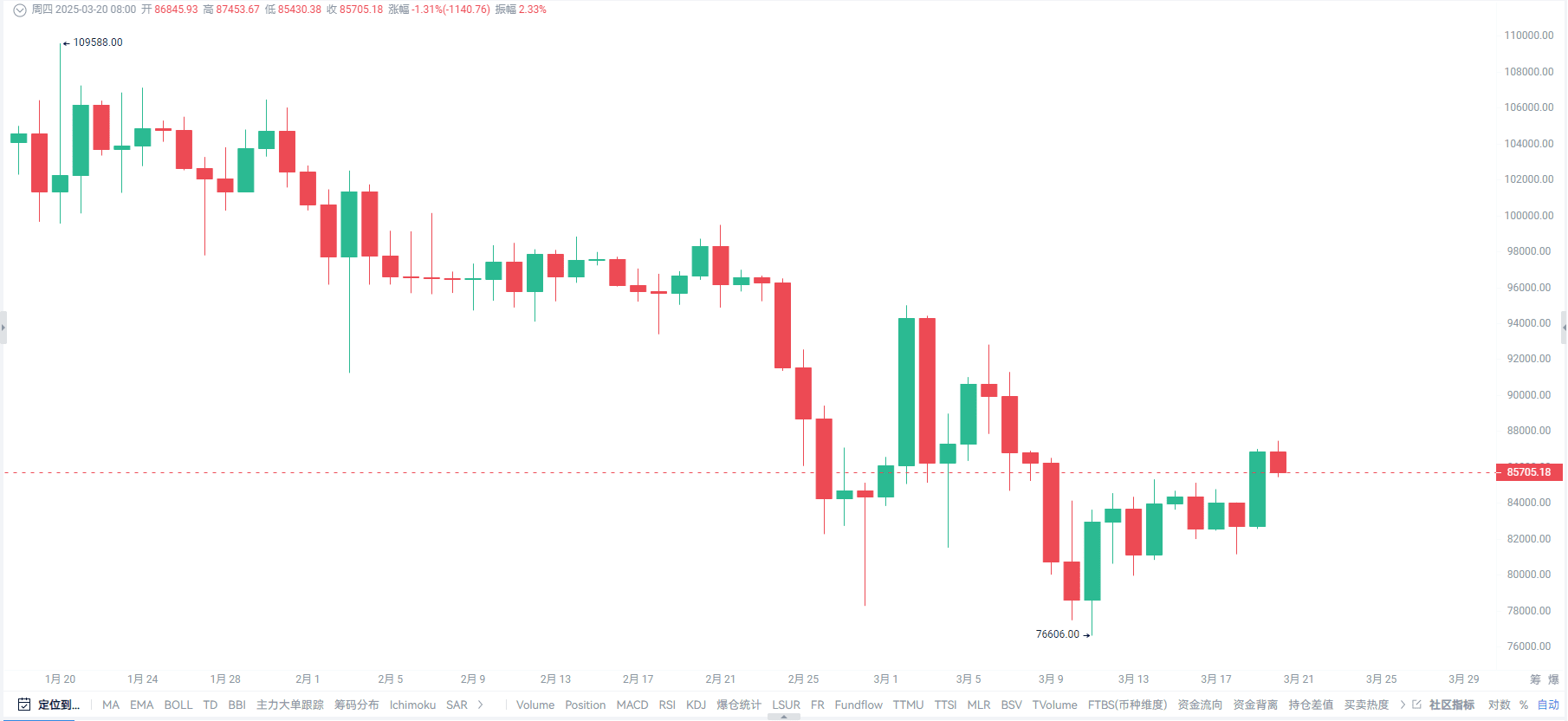
#美联储3月利率决议 The Federal Reserve meeting has concluded. This time, maintaining the current interest rate was expected, but from the Federal Reserve's dot plot, it seems there will be two more rate cuts this year, indicating Powell's relatively dovish remarks. One of the biggest highlights of this meeting is that starting in April, the Federal Reserve will significantly reduce the monthly redemption limit for U.S. debt from $25 billion to $5 billion, which was mentioned yesterday as a suspension of quantitative tightening (QT). This means the Federal Reserve will maintain a large balance sheet for a longer period to reduce its impact on market liquidity. During Powell's speech, the market reacted accordingly: the Nasdaq rose by 1.41%, the Dow Jones increased by 0.92%, and gold also reached a new historical high, peaking at $3057.25. $BTC BTC also surged above $87500 but then retraced again, currently oscillating near $85000. The previous CME gap has been completely filled. The subsequent trend is still subject to the battle between bulls and bears. Regarding the issues of concern, from Old Yi's perspective, let’s take a look at the development of events.
At the global macro level, yesterday the Bank of Japan announced its interest rate decision, maintaining the interest rate at 0.5%, which is relatively low globally, and Japan has maintained a low interest rate level for many years. Tomorrow, we will also see Japan release the latest inflation data. The previous round of inflation rate recorded 4%, and the market predicts it may rise to 4.2% this time, which is clearly a high inflation level. Currently, the market is generally concerned about whether Japan will adjust its monetary strategy in the future. The mention of Japan is because BTC may be affected by yen arbitrage trading to some extent. Many friends may not fully understand the logic of yen arbitrage trading. Due to the low interest rates maintained by the Bank of Japan in recent years, borrowing costs in Japan have been very low, almost close to zero interest. Funds can be borrowed from Japan and then invested in higher-yielding assets, especially in the American market. In recent years, the high yield of U.S. debt has naturally made it a favored asset for investors, using funds borrowed at low interest rates from Japan to invest in U.S. debt. This operation has almost no risk and can generate considerable profits after paying off the interest in Japan. However, if the Bank of Japan starts raising interest rates, the cost of borrowing for investors from Japan will increase. At the same time, the yield of U.S. debt is currently also seen to be decreasing, and the profits from arbitrage trading are gradually decreasing. Investors will naturally choose to exit early, which will not only sell U.S. debt but also may close out other related assets, further intensifying market volatility. In early August last year, the forced closure of yen arbitrage trading led BTC to fall below $50,000. Although the current market seems relatively mild regarding the Bank of Japan's future rate cut stance, considering the persistent rise in Japanese inflation pressure, this yen arbitrage trading strategy may change in the future.
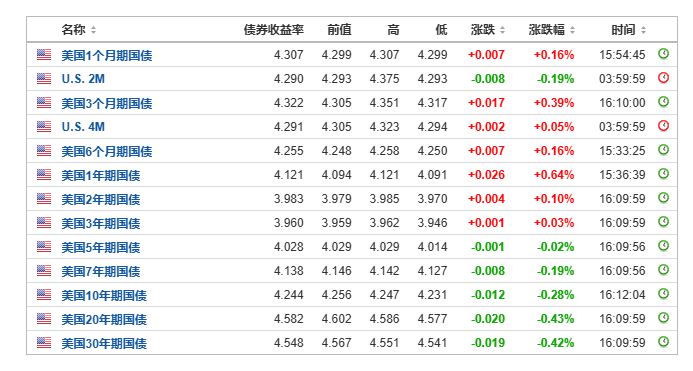
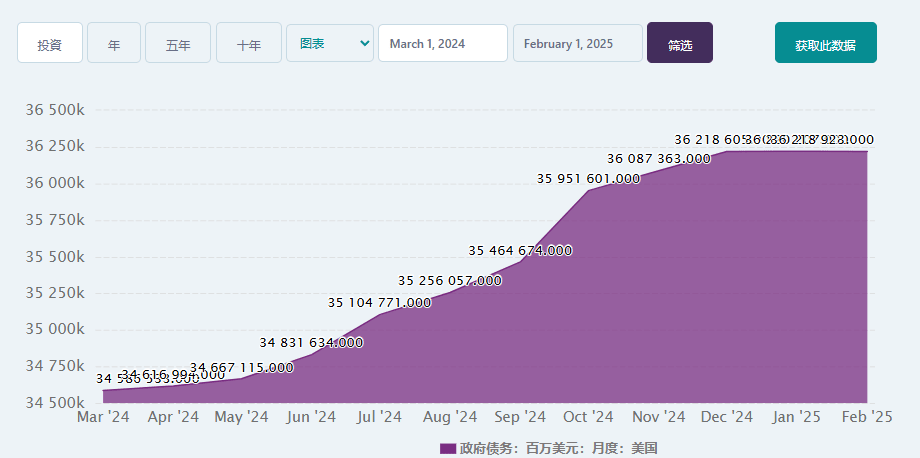
Although there is no Federal Reserve meeting in April, it will begin to slow down quantitative tightening (QT), with the next interest rate decision in May. From the market's expectations, the probability of the Federal Reserve cutting rates in May is only 16.6%. For the $36 trillion U.S. debt, a rate cut is also what Trump currently hopes to see, as he wants to reduce future debt financing costs by lowering U.S. debt yields, thereby alleviating fiscal expenditure pressure. The American team not only needs to pay existing U.S. debt interest but also faces two important factors. One is the strategy of printing U.S. dollars and lowering interest rates during the pandemic, which led to a sharp increase in debt scale. The other stems from the interest rate hikes by the Federal Reserve over the past few years, which have raised overall financing costs. In the past year, the interest expenditure on U.S. debt has reached $1.2 trillion. This expenditure is not new debt or principal repayment, but merely maintaining existing debt interest payments. Meanwhile, U.S. defense spending during the same period is reported to be about $900 billion. One can understand that the current interest expenditure of the U.S. exceeds its defense budget. If the interest rate remains at the current level, by the end of the year, interest expenditure may further increase to $1.5 trillion, nearly doubling compared to four years ago. Even if the Federal Reserve cuts rates by 100 basis points, the U.S. annual interest expenditure will still remain around $1.3 trillion. This is one reason why Trump's series of actions are forcing the Federal Reserve to cut rates.
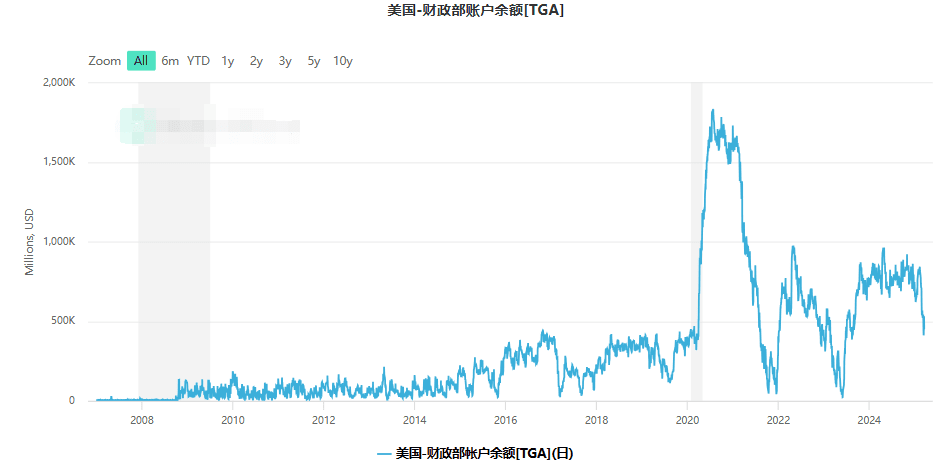
Of course, the above analysis by Old Yi is from a trend perspective. Although Trump's current tariff strategy continues to affect the market, the TGA account funds of the Americans are steadily decreasing, mainly due to the debt ceiling issue. The Trump team needs to withdraw funds from the TGA account, which, to some extent, has also provided extra liquidity to the market. Furthermore, starting next month, the Federal Reserve will significantly slow down quantitative tightening (QT), and two rate cuts are expected in the second half of the year. BTC will gain more liquidity, and with the global M2 money supply reaching a new high in recent days, from Old Yi's perspective, BTC's surge to 120,000 this year is not too difficult. Old Yi remains a firm believer and holds the same view: each round of correction will be seen as the best opportunity to enter the market. In the short term, the market is currently only improving its expectations for future liquidity. In the short term, we must return to the most fundamental question: where does the capital come from? The points mentioned above can indeed be seen as positive, but when the market knows it will rise in the future, retail investors often end up getting liquidated. As for when to start pushing the price up, that is something the market makers should consider. Based on the current market situation, we can conclude that BTC's support level is getting higher, market sentiment is also recovering to some extent, and MA200 has been broken, but it has failed multiple times when facing MA30. Even if there were one or two brief breakthroughs, they were quickly retracted in the form of spikes.
From the data, it seems there has been some improvement. BTC spot ETF has recorded net capital inflows for three consecutive days. Although the capital amount is not particularly large, it seems to indicate a recovery of investor confidence to some extent. However, overall, a relatively cautious attitude is maintained. Currently, BTC has successfully broken through $85,000, and if it can maintain this level above, it will be more beneficial for market confidence recovery. At the same time, market makers know that liquidity will bring benefits to BTC, so the support level has been reaffirmed and will not allow relatively lower chips to be given to opponents. Therefore, as long as Trump does not have new strategic changes or we do not see new macro events occurring, it will relatively maintain certain positive trends. Currently observed price increases followed by pullbacks are also a normal trend.
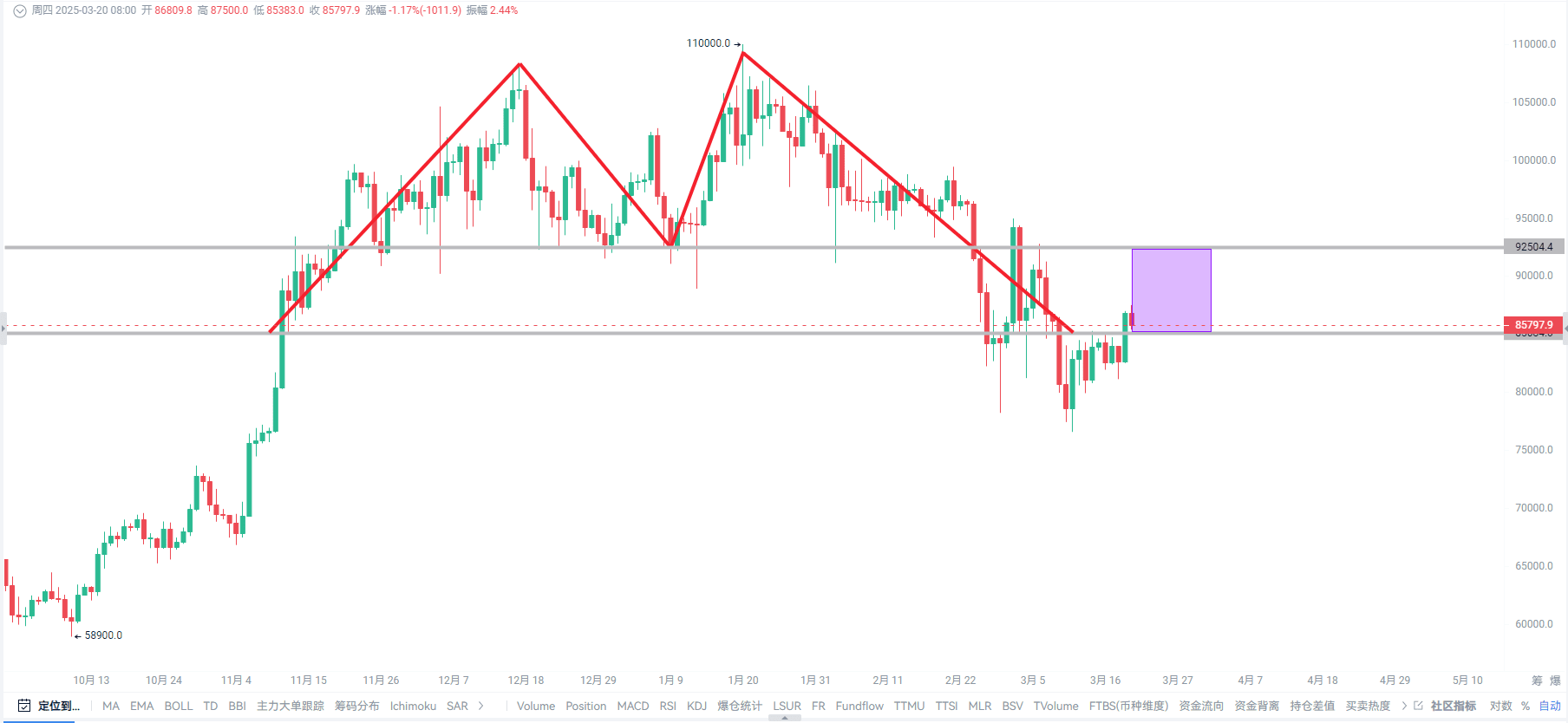
In the short term, Trump's uncertainty continues to affect the market. Coupled with only the increase in liquidity expectations, there are still certain variables. Therefore, the previous bearish trend can be appropriately exited at this stage. Currently, everyone can observe the changes. If BTC stabilizes around $85,000 and continues to oscillate upwards, the upper area can look towards the middle position of the BTC top, which will be presented in the image, namely the $85,000 to $92,000 range, where the battle between bulls and bears is still dominated by bulls. Everyone should try to choose one direction to attack; if BTC tests and falls below $85,000 again, it is likely to undergo a longer period of consolidation. Under the uncertain macroeconomic conditions, the larger trend has become relatively clear, but the real-time dynamics of the above areas still need to be monitored. The article is only a reference for everyone. In actual operations, everyone still needs to consider position control. In such an environment, it is still not the time to strike heavily. If considering an attack, it is advisable to communicate with Old Yi beforehand and then make plans. If there are any uncertainties, timely communication is welcomed as we wait for the bull market to arrive!

Yi Hailun Coin: The success of investment not only depends on selecting good targets but also on when to buy and sell. Preserving capital and properly allocating assets are essential for steady progress in the ocean of investment. Life is like a long river flowing into the sea; the determining factor of victory and defeat is never the gains and losses at any one pass or moment but the vastness accumulated from a hundred rivers!
The article is only a personal opinion and does not constitute any buy or sell advice. The cryptocurrency market has risks; investment needs caution!
