

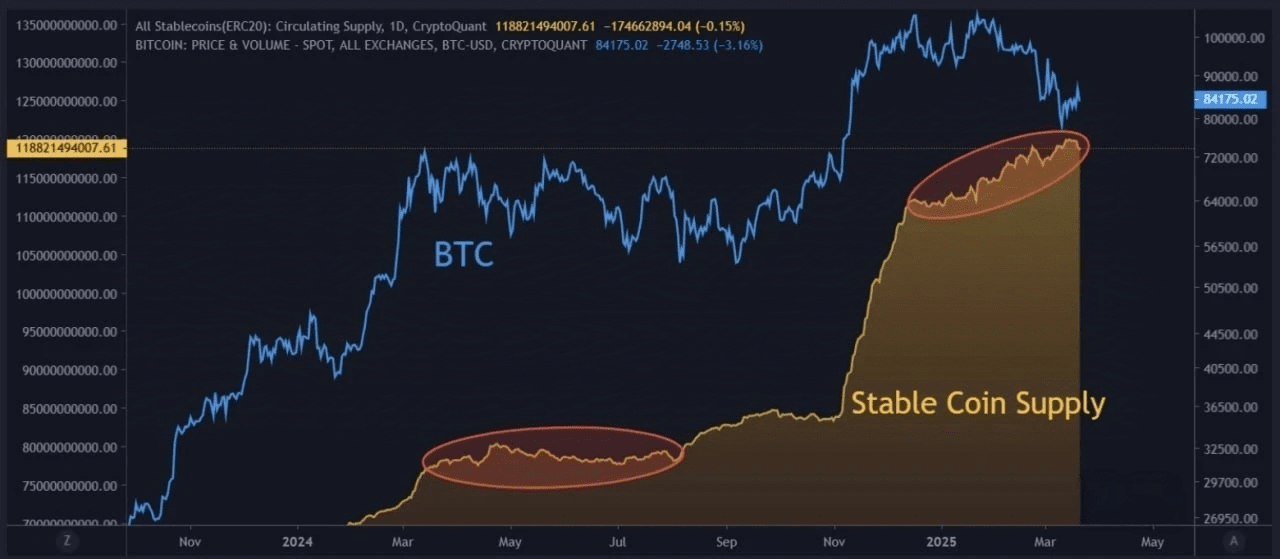
1. Comparison of changes in stablecoin supply and market significance
· March 2024: Stablecoin supply stagnates, the market lacks incremental funds, Bitcoin faces liquidity bottlenecks, and price correction pressure is significant.
· March 2025 (current): The total supply of stablecoins has reached a historical high since November 2023, indicating that new capital is continuously entering, providing potential purchasing power support for Bitcoin.
· Key difference: The current market has more abundant liquidity, but the flow of funds is differentiated—large amounts of stablecoins are flowing into the derivatives market (such as futures and options), rather than being directly used for spot purchases. This may lead to the accumulation of leverage risk rather than purely driving up prices.
2. Risks of high leverage in the derivatives market
· Data shows that the open interest (OI) in the derivatives market reached a historical peak of $70 billion in January 2025, currently falling back to $52 billion but still at a high level.
· Leverage trading dominates the short-term use scenarios of stablecoins, for example:
o Expectations for Fed interest rate cuts (after the March 2025 FOMC meeting: currently, the outlook for rate cuts is not optimistic) drive traders to increase high-leverage positions, and Bitcoin's estimated leverage ratio (ELR) rises rapidly.
o The inflow of funds into the derivatives market (e.g., $120 million USDT in a single day) contrasts with the outflow of funds from the spot market, indicating that speculative sentiment far exceeds actual holding demand.
· Risk points: If market volatility intensifies, concentrated liquidations of high-leverage positions may trigger severe price corrections (e.g., recently, Bitcoin has struggled to hold above $90,000).
3. Potential catalysts and paths for upward movement
· Liquidity conversion conditions: If stablecoins flow back from the derivatives market to spot trading (e.g., institutional funds entering, continuous net inflow of ETFs), Bitcoin may quickly break through key resistance levels.
· Technical support: If Bitcoin's price holds in the $85,000 to $90,000 range, combined with the issuance of stablecoins, it is expected to form a 'liquidity + sentiment' dual-driven upward structure.
4. Investor strategy recommendations
· Short-term: Pay attention to the funding trends in the derivatives market (e.g., changes in OI, perpetual contract funding rates), and be wary of the risk of double liquidation under high volatility.
· Medium to long-term: If the net inflow of stablecoins in spot exchanges continues to rise (needs to break through the current weakness), it can be regarded as a confirmation signal for a trend upward.
The current surge in stablecoin supply provides underlying liquidity support for Bitcoin, but excessive leverage in the derivatives market may delay the pace of price increases. The market needs to wait for the 'conversion of derivative funds to spot' or external macroeconomic benefits to achieve a breakthrough upward movement.
