
The market seems to have entered a new round of consolidation after experiencing several large fluctuations. At this stage, the small fluctuations have led some friends to feel relatively bored. Yesterday's bears were looking for an exit, even though some friends only started attacking at the $80,000 position, with a space of 1,500 points below. It seems that latecomers are feeling more anxious. In fact, looking back at Lao Yi's strategy, he mentioned in yesterday's article before the attack that once some bearish signals are out, we can directly align with the bears. Many new friends have come to Lao Yi and expressed that following the articles can yield considerable returns. But Lao Yi wants to remind everyone that many times the articles have a lag and the updates in the news cannot completely align with market changes. Therefore, he has always reminded everyone that if an attack is needed, it is essential to communicate with Lao Yi in advance to avoid unnecessary losses due to sudden events. In addition, I saw a new friend's question yesterday; taking yesterday's market distance, the overall fluctuation of BTC was 4,000 points, which is clearly a bearish signal. Why wait for the market to show some movement before choosing to attack? I don't know if everyone has this doubt. To clarify: psychologically, no one can control the point at the highest and the lowest. Lao Yi's duty is to maximize profits in gains and minimize risks in losses, not to be a gambler. A 4,000-point fluctuation allows you to conduct market research; this can already outperform the vast majority of people in the market. Always adhere to a cautious approach. If some friends believe the market is relatively clear, they can choose to act independently or ask other analysts. If choosing Lao Yi, there is an additional responsibility.
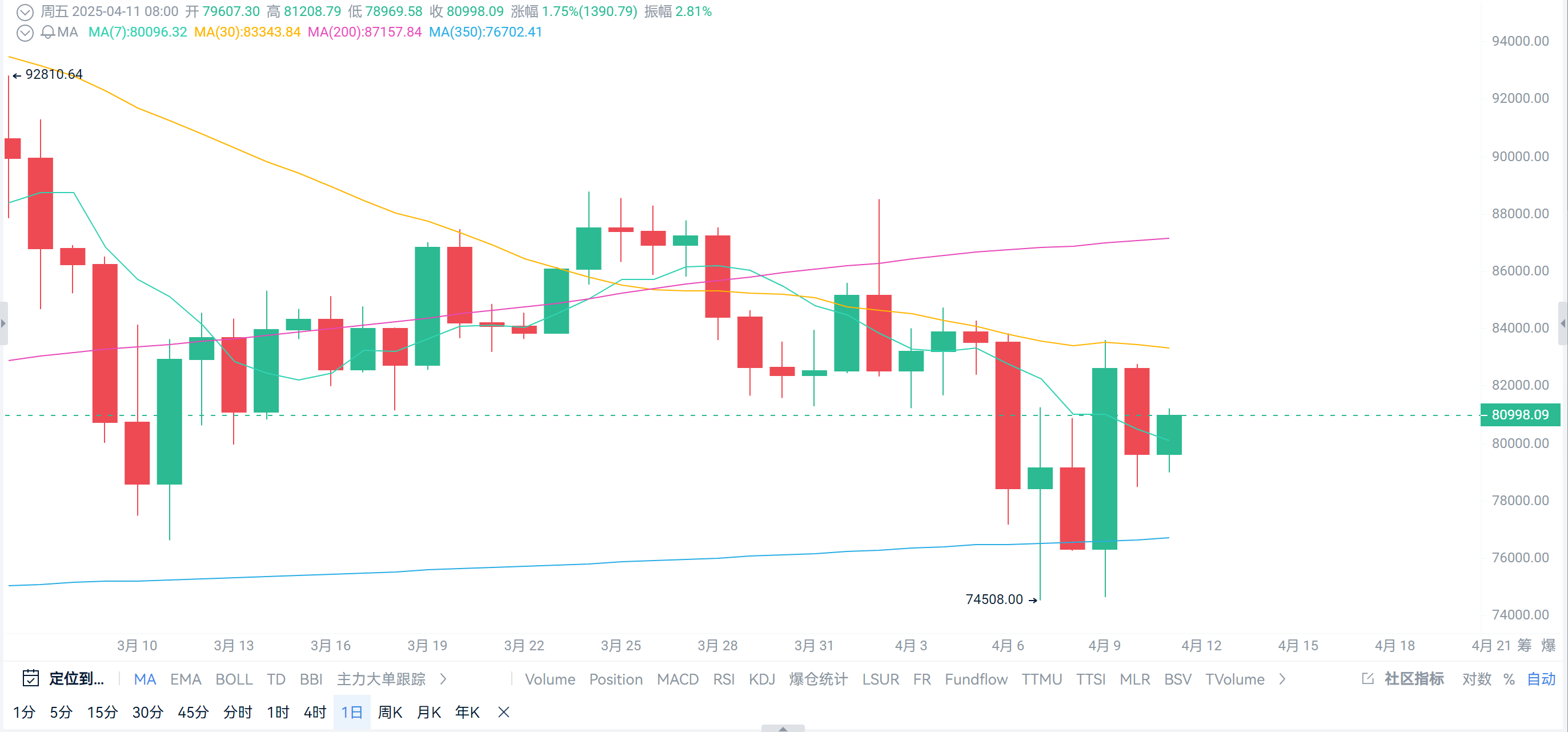
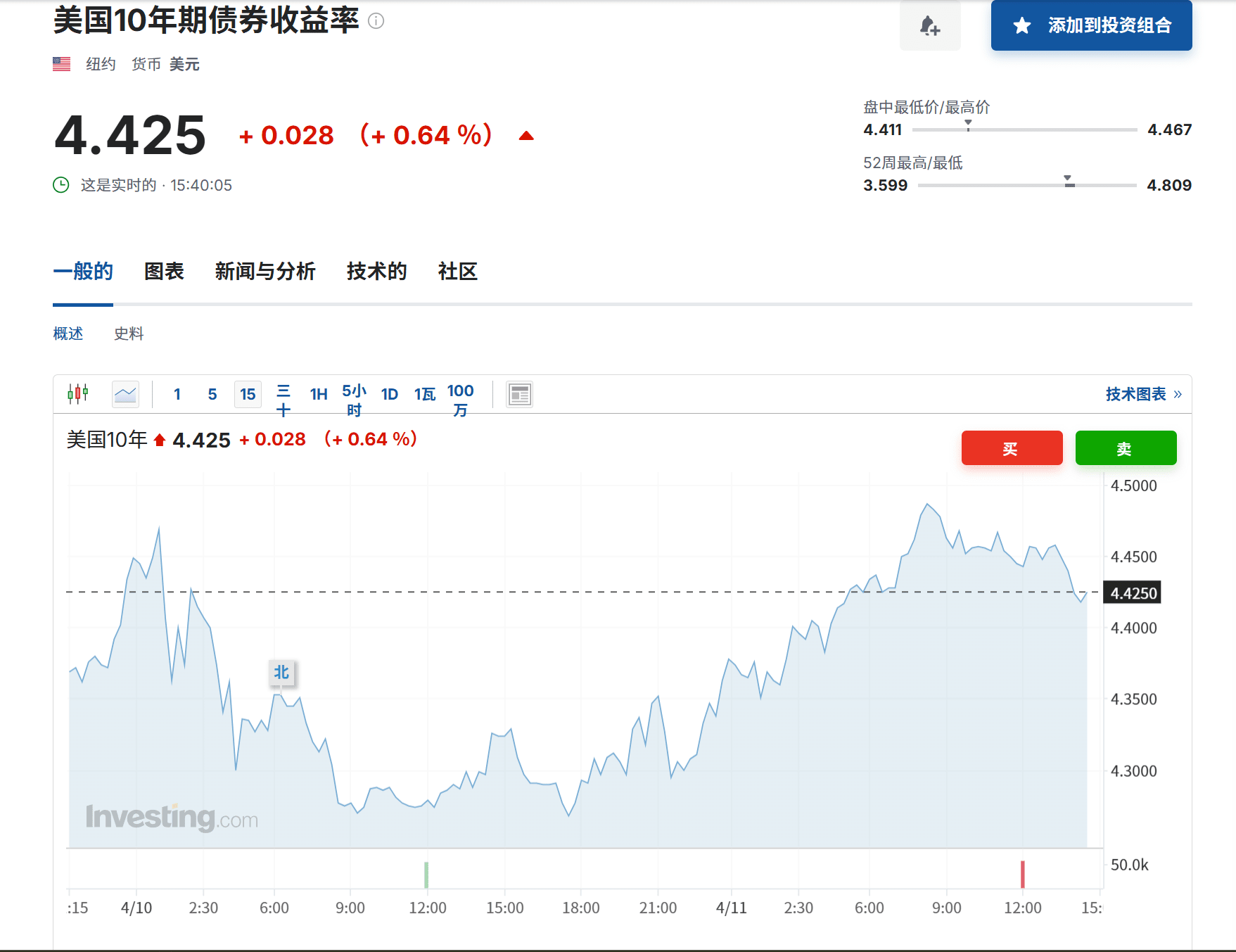
Back to the market, let’s first look at the inflation data released by the US yesterday for March. The CPI rose 2.4% year-on-year, the lowest level in seven months, which is lower than the forecast data we saw earlier; secondly, the core CPI rose 2.8% year-on-year, marking a decline for the second consecutive month, and lower than the expected 3%. It is evident that the inflation data is a positive for BTC, but the market has not seen an upward movement. US stocks, US debt, and the dollar have all fallen sharply, and capital is accelerating its exit from the US. Gold has once again reached a historical high. Our trade war with the US is still ongoing, and yesterday's actions seem to have not stopped. The yield on the 10-year US Treasury bond continues to rise. Previously, we saw US stocks fall, and US debt prices rise, meaning US debt yields would fall. But this is no longer the case; funds are no longer treating US debt as a safe haven, while gold prices have once again reached a historical high. This also indicates that the global demand for safe assets is collectively shifting towards gold. On the other hand, in June this year, a large number of US debts will mature, and there will be a need for refinancing to repay these debts, most of which are short-term US debts. Under the influence of Trump's tariff strategy, the market is increasingly worried about the US fiscal situation. US debts have also seen massive sell-offs, maintaining high yields, which means that refinancing costs are higher, directly contradicting Trump's strategy.
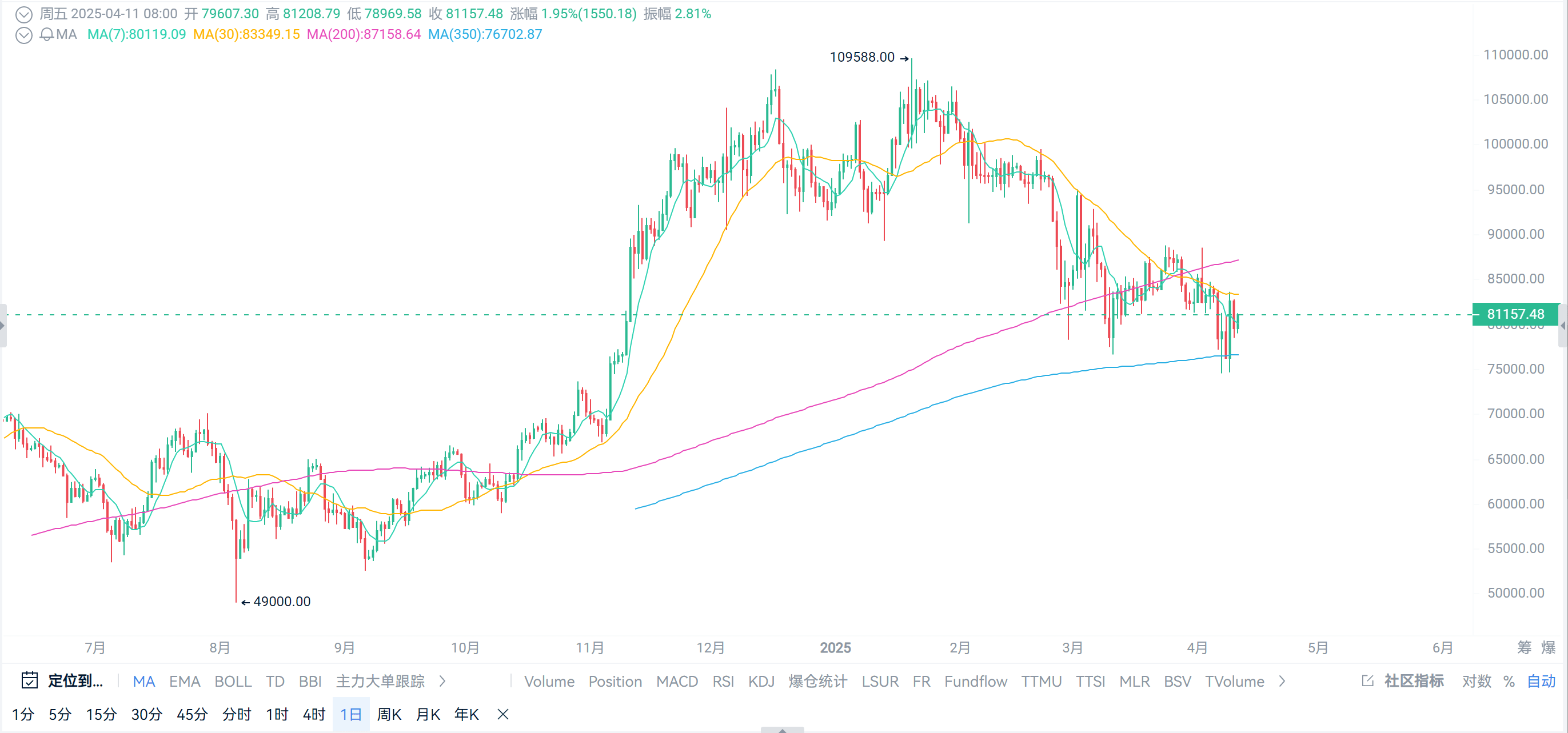
Everyone knows that Lao Yi is still optimistic about BTC's future trend, but many friends have expressed that trends have been validated. Is there a direction worth referencing in technical indicators? Currently, it is still maintained above the 365-day moving average. As long as it does not fall below $76,000, BTC is still in a bull market phase, but currently it is below the 111-day moving average and the 200-day moving average; Looking at the US stock indices, they are currently below the one-year moving average. After Trump’s tariff pause for 90 days, US stocks broke through the one-year moving average in the short term, but the rebound in US stocks has seen more sales. Capital is still accelerating its exit from the US. Whether in the US stock market or the BTC market, both need to reclaim the 200-day moving average to establish further upward momentum, which means BTC needs to stand above $87,000. In recent days, BTC has formed a death cross on the daily chart, with the 50-day moving average crossing downwards with the 200-day moving average. The last time this happened was in early August last year, triggered by the yen arbitrage that led to the market crash. At that time, BTC fell below $50,000, testing the one-year average, and then experienced several months of consolidation until the end of October when a golden cross was seen. This time seems to be similar; BTC may once again enter a period of consolidation. The range of $81,300 to $83,500 needs to turn back into a solid support level for BTC to see a more positive upward pace afterward, but currently, this short-term rebound has not successfully occupied a new range.
On the other hand, a large number of short-term holders currently have an overall cost price higher than the current price. Lao Yi will not enumerate the data one by one, which means that many short-term holders are still in a state of floating losses, but the extent of losses has narrowed. Some investors will ultimately choose to exit at break-even, and the short-term still needs new buying power to digest these selling pressures. However, at this stage, there is still a lack of retail investor interest. From the search heat on several platforms, it is significantly less than previous bull markets, which indeed relates to the market's maturity. A large portion of investors have already gained a certain understanding of BTC, especially after BTC launched its ETF. However, the overall impact is relatively small, and there are still many retail investors who have not participated. From Lao Yi's perspective, it is more inclined to believe that new retail investors do not understand enough, but their emotions have not been completely ignited. This is indeed related to the long-term slump of altcoins. Many retail investors prefer altcoins, and the current cycle of the altcoin market is indeed unsatisfactory. However, there will definitely be participation from altcoins in BTC's subsequent rise, but it is still not within Lao Yi's consideration, as fleeting moments do not align with Lao Yi's investment philosophy.

Speaking of this, many friends may still feel relatively vague. To recap, last month’s expectations for this month’s liquidity were relatively optimistic, but at this stage, due to macroeconomic uncertainties caused by tariffs, BTC has not performed particularly well, which is also normal. Funds are choosing to wait and see or turn to safer assets, all of which have become obstacles to BTC's price increase. But overall, the Federal Reserve has paused its quantitative tightening (QT) pace, and the cryptocurrency market is in a better liquidity situation compared to before. In the short term, both bulls and bears seem to be in a stalemate, and the market will be reclaimed by big players washing positions. Long-term holders are still continuously increasing their holdings, which does provide some support, but from the perspective of the entire cycle, a major bull market will still need a period of healthy consolidation before it can take over the market again. Lao Yi's estimate won't take too long. The long-term trend does not need to be emphasized further. Recently, many new friends have just entered the crypto space. Upon entering, they immediately want to engage in BTC spot and contracts. Although they have indeed made the right choice in the race, whether for learning or investment, no one wants to see their losses. Two suggestions: First, you can review Lao Yi's previous articles to have a basic understanding of the crypto space and blockchain. If there are places you really don't understand, you can also ask Lao Yi individually; secondly, learn to face losses first, then review the process, and find a trusted industry insider to help summarize. After experiencing so many new friends, Lao Yi sincerely feels that he can provide technical assistance, but it is indeed very difficult to maintain a completely consistent mindset during the process. Everyone can face the issue of averaging down in losses themselves; trust is the most indispensable quality in trading. Finally, talking about the market, the big players' position washing is also a test of human nature and does not mean that the offensive area is restricted. On the contrary, it is seen as an opportunity by some people. Lao Yi will layout in advance, and friends who understand what Lao Yi is expressing can communicate with Lao Yi in advance!