
Yi Hai Lun Bi writes every analysis article with a responsible, focused and sincere attitude, with distinctive features, without being artificial or exaggerated!
Daily market analysis, I am digital currency analyst Yi Hai Lun Bi!
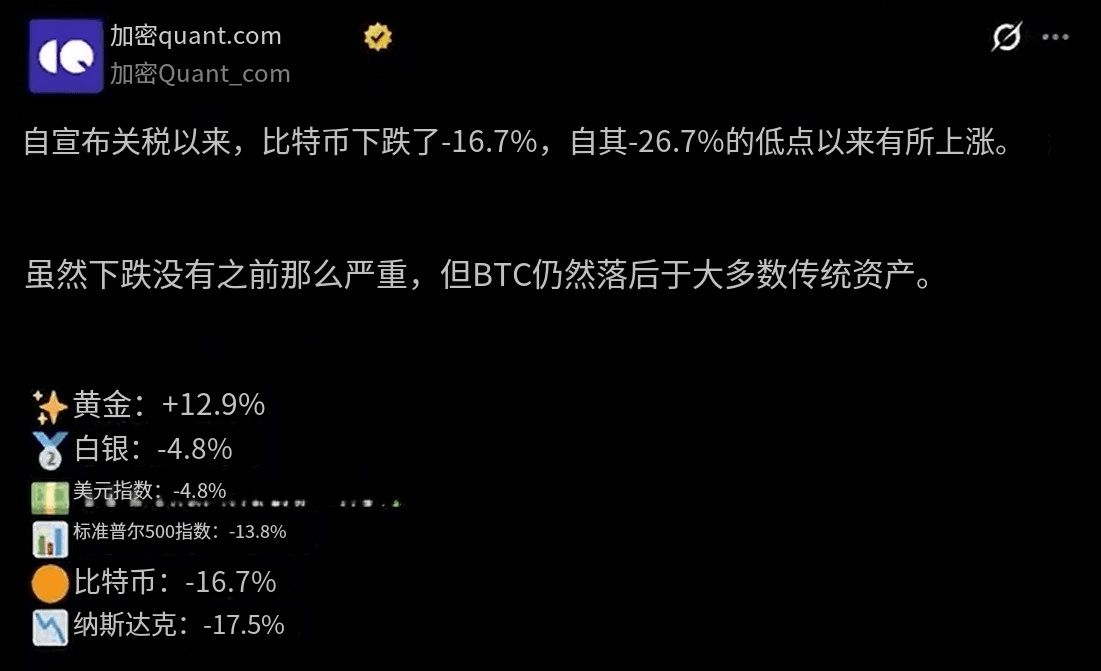
Follow the trend, even if there are certain obstacles at present, as long as the position is properly controlled, there will be light sooner or later. Friends who attacked the bulls yesterday once again ended perfectly. At present, it is still fighting at the key position of $85,000. The pin after Powell's speech on the hourly chart is now almost completely filled, and it has returned to the starting point again, and it seems that there are certain signs of recovery. According to data, since the United States announced a new round of tariff strategies, BTC has fallen by 16.7% in total. Although it has rebounded from the lowest point of 26.7%, the overall performance is still behind most traditional assets. In the same period, gold rose by 12.9%, and Nasdaq fell by 17.5%. BTC is currently in a rise between the two, but it does not have a clear safe-haven attribute. Powell's remarks yesterday tended to be hawkish. He believed that the market's expectations for the Fed's rescue were too high. This not only hit market sentiment, causing U.S. stocks and cryptocurrency circles to fall, but also the expectation of a rate cut in June seemed to be affected. The probability of no rate cut rose to 38%. The Fed's previous dot plot showed that there would be two rate cuts this year, and the market had more optimistic expectations for rate cuts.
Trump recently tweeted again to call out Powell for not taking decisive action at a critical moment, saying that the European Central Bank cut interest rates by 25 basis points yesterday, lowering the deposit rate to 2.25%, the seventh rate cut, while the Fed has been slow to act. Trump believes that the current market environment does not justify maintaining high interest rates, oil prices have fallen sharply, and overall inflationary pressure has eased. In particular, Trump said that Powell's term of office needs to end as soon as possible, and there are still many uncertainties in this regard. We have also seen a lot of voices recently about liquidity. The net liquidity of the Federal Reserve is equivalent to the Federal Reserve's balance sheet minus the RRP and TGA balances. Recently, there has been some passive recovery trends. The scale of the Federal Reserve's overnight reverse repurchase agreement, that is, the use of RRP operations, has fallen back to the low point in recent years after a sharp rise in mid-2021. RRP is essentially a tool for the Federal Reserve to absorb short-term liquidity. When interest rates are high and there is excess funds in the market, financial institutions deposit idle funds with the Federal Reserve through RRP in exchange for short-term U.S. Treasury bonds or mortgage securities, and obtain risk-free interest. This mechanism has been widely used in the past few years. With the continued advancement of the Federal Reserve's quantitative tightening QT, the Federal Reserve's continuous reduction of its balance sheet TGA balance and other factors, free liquidity in the market has gradually dried up, and financial institutions no longer need to deposit cash through RRP, which directly leads to a sharp decline in the RRP balance.

I mentioned before that the TGA account of the U.S. Treasury is like a checking account of American organizations, which is used to collect taxes, issue bonds and pay fiscal expenses. When the TGA balance rises, it means that the Treasury is absorbing liquidity, and when the TGA balance drops sharply, it means that cash is being released back into the market. Over the past period of time, the TGA balance has fallen rapidly from a high level, which can be understood as the U.S. Treasury is passively injecting funds into the market to maintain organizational operations and pay expenses. In April, the Federal Reserve began to slow down the pace of quantitative tightening QT. Combined with these, many market speculations believe that the Federal Reserve will start a new round of quantitative easing QE. After all, the continued sharp decline in RRP may suggest that the marginal liquidity of the market is gradually returning to a tight balance from an excess state, becoming a precursor to potential water shortages, and QE is the Fed's official opening of the floodgates. If the Fed wants to avoid systemic risks, it must start flooding the market with money at some point in time, that is, expanding the Fed's balance sheet. However, as mentioned in yesterday's article, the Fed has given a prerequisite that it will not restart quantitative easing (QE) until the federal benchmark interest rate drops to zero, and the inflation risk brought about by tariffs seems to be more serious than expected. These are all market uncertainties, and the risky asset market still depends on the Fed's actions.

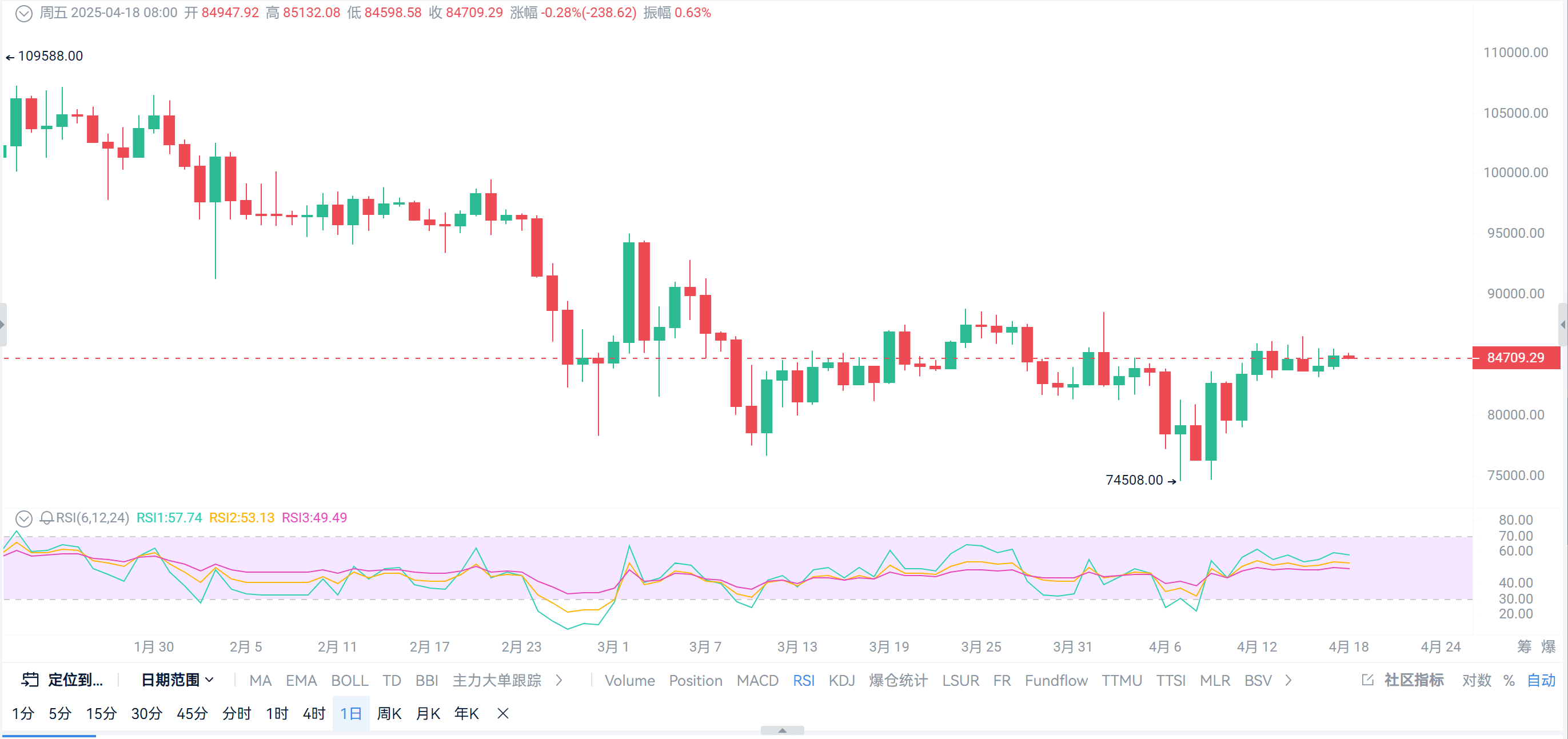
BTC is not bad. Even in the context of the Fed's continued interest rate hikes, BTC is still setting a stage high. However, this cycle lacks a more relaxed environment. Coupled with the listing of BTC spot ETFs, this cycle is relatively tortuous, and the overall performance of altcoins is unclear due to liquidity tightening. After BTC briefly fell below $75,000 twice, it completed the test of the short-term bottom. The BTC relative strength index RSI, especially the indicator based on the 14-day average, has previously hit lows similar to the three key adjustments in November 2022, August 2023, and August 2024. It usually also indicates a potential market reversal. In the past three situations, BTC rebounded. Of course, the technical indicators themselves are not certain, and they need to be combined with the macro level. At present, the trade war continues to escalate. Lao Yi has reminded everyone before that even if BTC has gone through structural repair, it is likely to see more time for consolidation.
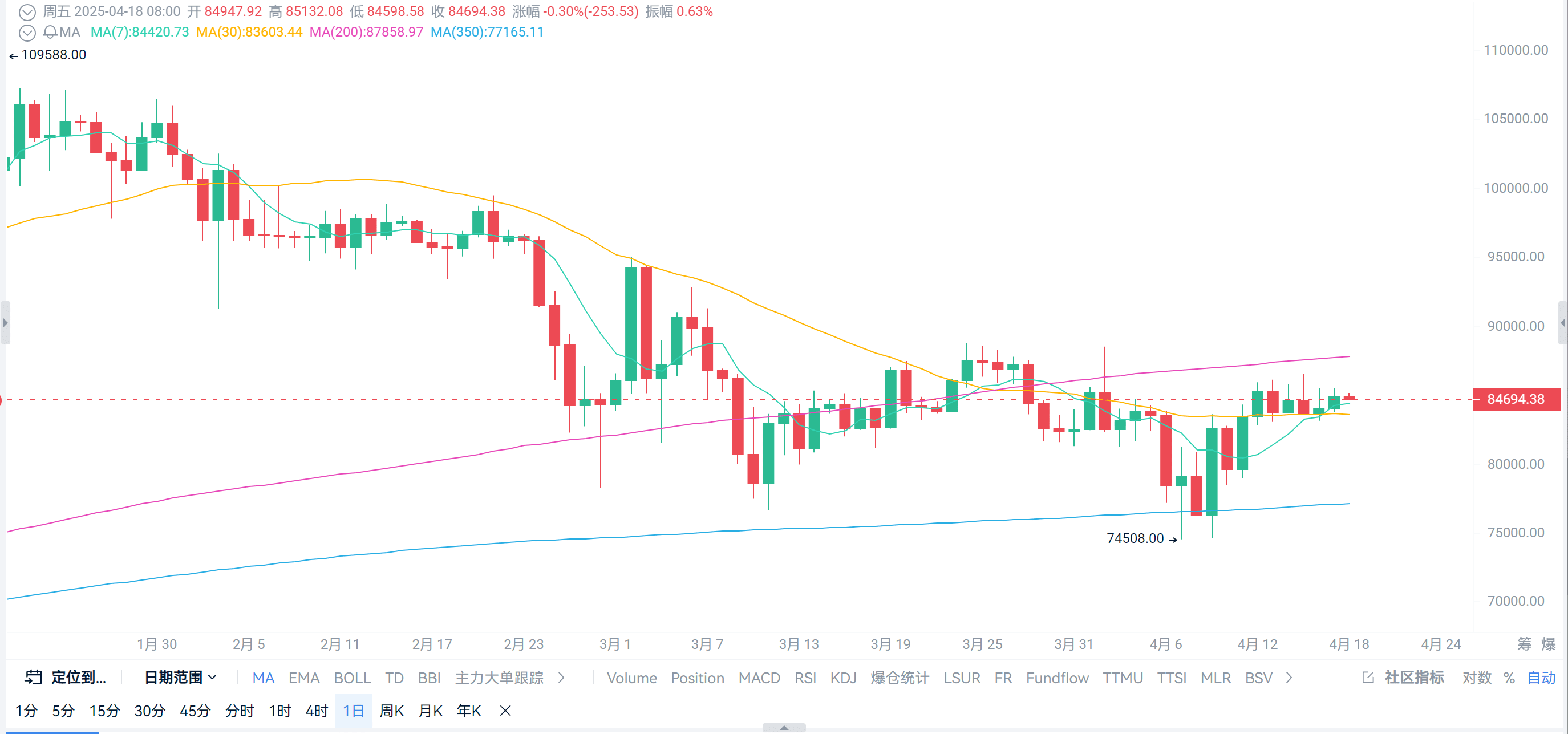
Currently, BTC's 365-day moving average is at $76,600, while its 200-day moving average is at $87,800. It still fluctuates in this range, especially in the consolidation in recent days. Many friends expressed their powerlessness, but from the results level, they still obtained relatively considerable returns. Judging from the 4-hour trend, BTC remains above the MA200 moving average. In the falling market for several months, more chips have been transferred back to the hands of long-term funds. In terms of investor behavior structure, selling pressure is still concentrated in the short-term holder group. Investors who hold less than 1 BTC are the main source of current selling pressure. In contrast, long-term holders have stopped selling and turned to accumulation, which has provided support to the market to a certain extent. Even investors who have been chasing highs due to FOMO since early November, as long as they have not sold BTC due to panic during the continuous decline, 155 days have passed since April 9. They will gradually be included in the long-term investor group, which means that the proportion of long-term holders' supply will continue to rise during this period of consolidation until a certain critical point appears and long-term holders begin to distribute chips. This also requires the market's buying to keep up with the rhythm and see some favorable catalysts to re-stimulate the FOMO sentiment of short-term funds.
Everyone should know that the sovereign fiat currencies, led by the US dollar, continue to rely on central bank money printing and fiscal deficits to maintain the operation of the system, which is bound to continue to reduce the purchasing power of fiat currencies. As long as the world operates in this cycle of expanding currency and debt, the logic of BTC's rise will not end. However, against the backdrop of rising global risk aversion, gold is attracting large-scale capital inflows. On the one hand, it is due to market concerns about runaway inflation, especially the weakening of actual purchasing power that may be caused by monetary expansion, and on the other hand, it stems from comprehensive concerns about the global geopolitical situation, trade disputes and the stability of the monetary system. Goldman Sachs expects that core PCE inflation may exceed 3.5% this year. In the absence of additional tariff stimulus, inflation had the opportunity to gradually decline. However, the turmoil caused by policy uncertainty is becoming a new driving force for inflation. Trump's strategy is very clear. By creating uncertainty to guide the market's risk aversion, capital is forced to flow into U.S. bonds, pushing down long-term U.S. bond interest rates and reducing the financing costs of federal organizations. This has also strengthened the market demand for gold, but it has also suppressed the valuation of high-risk assets. The three major U.S. stock indexes have all fallen in recent days, and it is difficult for BTC to break out of an independent market.

There is a time lag of about 100 to 150 days between BTC and gold, which stems from the iterative mechanism of capital structure. Against the backdrop of expected rising inflation or intensified monetary expansion, funds are first allocated to gold. As macro expectations are fulfilled and the premium of traditional safe-haven assets is saturated, funds will migrate to cryptocurrency assets with greater flexibility and growth potential. Therefore, the current continued rise in gold prices also means that BTC has stronger upside potential in the medium and long term. At this point, everyone should be relatively clear. We have talked too much about the trend. Friends who know how to layout have already started to attack. The biggest problem at present is time. Even if there are new uncertainties, the lag of various favorable factors will gradually emerge in the future to form a hedge, driving market sentiment to a higher high, but before that, the continued volatility will be normalized. The $85,000 level on the disk has always lacked a certain momentum. Next, we need to pay attention to finding a breakthrough at a smaller level. The hourly line is still oscillating in the negative K after Powell’s speech, that is, the negative K at 1 a.m. on April 17 is still fluctuating within a range. After the signal is clear, you can start a small position to attack with empty positions and narrow the scope of attack. The upper pressure is at 85,500. There will be some repair in the short term, and the force will not be too great. Grasp the short-term trend and control the position in advance. If you are unclear, communicate with Lao Yi again!
Yihai Talks about Coins: The success of investment depends not only on choosing a good target, but also on when to buy and sell. Only by protecting the principal and making good asset allocation can we move forward steadily in the ocean of investment. Life is like a long river flowing into the sea. What determines victory or defeat is never the gains and losses of a pass or a loss or profit at a certain time and place, but the abundant flow of hundreds of rivers!
The article only contains personal opinions and does not constitute any buying or selling advice. The cryptocurrency world is risky, so be cautious when investing!
