
Yi Hai Lun Bi writes each analysis article with a responsible, focused, and sincere attitude, with distinct characteristics, not pretentious or exaggerated!
Daily market interpretation, I am digital currency analyst Yi Hai Lun Bi!
Recently, due to having a large number of users on hand and traveling around the country, article updates will be somewhat delayed. Reflecting on the rhythm of the previous text, let’s take another look at the current market. The trend still continues. Lao Yi has received various messages from new friends who have been caught in short positions. Speculative psychology seems to always yield returns that are contrary to expectations. Looking at the current market, BTC seems to be slightly hindered on its upward path, with the tug-of-war between bulls and bears becoming increasingly obvious. Fortunately, it managed to hold temporarily at $91,500. Recently, BTC has climbed to a high of $95,758, but the risk has not completely dissipated. The CME gap below has still not been fully filled, but it is clear that the time taken to fill this gap has been significantly extended, which also increases the market's further judgment. Even though the trend is clear, there is still a certain amount of risk in the short term. At the same time, BTC is about to close its weekly line. Previously, the 50-week moving average was briefly lost, and at that time market sentiment was extremely pessimistic, with discussions of a bear market widespread. However, within less than three weeks, the fear and greed index has returned to the greed zone, but it seems still insufficient. Although BTC has returned to $95,000, the market remains very quiet, similar to the situation a few months ago.

Looking back at the data aspect, the chip distribution map mentioned earlier shows that many chips were exchanged at $93,200, which is also the cost line for short-term holders. The turnover also represents that previous investors chose to retreat to protect their capital, but soon new investors took over, so the price was not hindered. Therefore, Lao Yi also sees this position as an important support level at present. And before the CME gap around $92,000 is completely filled, we still need to be cautious about the sustainability of BTC's rise. On Thursday of this week, the spot price of BTC dropped to $91,660, and after that, BTC quickly rebounded. Many friends came to Lao Yi saying the CME gap was filled, but it has not been fully filled, which also means BTC will come back to meet again. The price trend of BTC has clearly decoupled from traditional macro assets; BTC has continuously outperformed U.S. stocks in recent weeks after adjusting for risks, and this trend seems to have become increasingly evident after Trump publicly expressed dissatisfaction with Powell. At that time, U.S. stocks experienced a certain retreat, while BTC remained relatively stable. Now the market is once again filled with familiar voices, focusing on BTC retracing to $88,000 or $80,000, claiming these positions are the best places to buy and bottom out. But clearly, when BTC actually reaches these positions, this group will again feel panic, thinking BTC will continue to dive and abandon their current expectations, which is the real situation everyone faces.

Due to the continuous depreciation of the dollar, looking at the current situation a month later, the trend now appears more positive than before. Based on last year's response to liquidity, this time's BTC rise is not particularly convoluted compared to Lao Yi's expectations at the beginning of the year; ultimately reaching $150,000 will also be accomplished. Of course, one should not be completely misled by liquidity, but it is clear that BTC will refresh its historical highs. What needs to be done now is to continue to hold rather than chase highs. Lao Yi respects the decisions of some friends who have exited, as only a very few can reach the end, but only those who have experienced it understand the challenges that lie ahead. In every cycle of dollar depreciation, we have almost always seen a large influx of capital into risk assets. A decline in the dollar index means that BTC will ultimately benefit. Although this feedback may not be immediate, the importance of the trend has always been emphasized by Lao Yi. Over the past month, Lao Yi has mentioned the expansion of global M2 money supply the most, which will ultimately drive BTC to higher levels. Currently, we see an increase in money supply year-on-year, accompanied by a decline in the dollar index, but BTC cannot benefit immediately as it did in the 2017 and 2020 cycles. The key factors driving the dollar depreciation now include expectations of monetary supply expansion, as well as geopolitical tensions and uncertainties regarding tariff strategies. The rapid adjustment of Trump's tariff conflicts is an important variable not seen in past cycles, or rather, Trump's actions this time are much swifter and more decisive than during his first term.
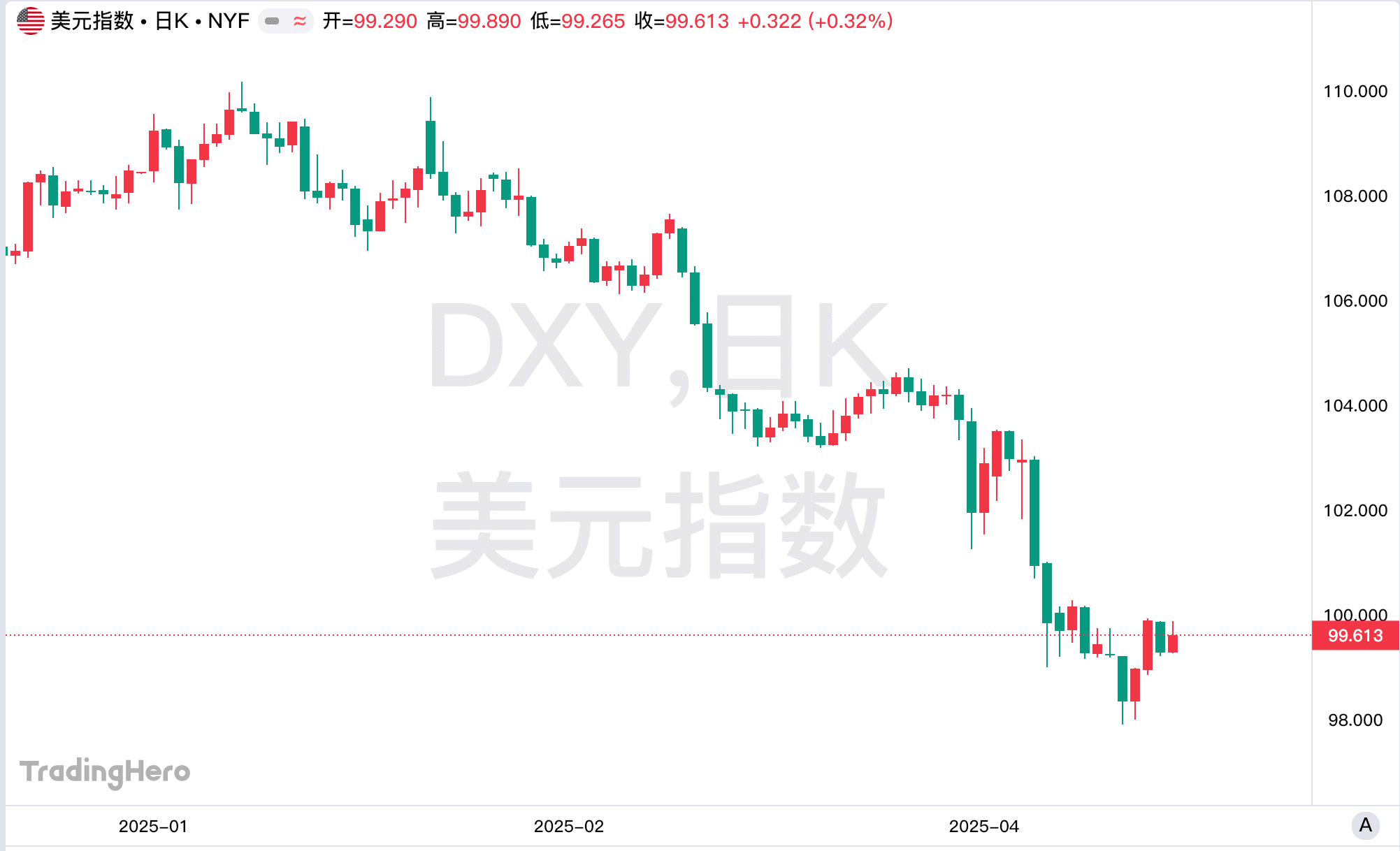
Historically, when the market expects an increase in money supply, it usually also expects corporate profitability to rise simultaneously, thereby driving up corporate valuations and the overall performance of U.S. stocks. However, the current situation is different. Due to significant adjustments in tariff strategies, corporate profit expectations face major uncertainties. Many people, even if they realize the depreciation trend of the dollar, do not dare to easily place funds directly into risk assets, especially the current U.S. stocks. If in the future, due to changes in tariff strategies, companies are forced to relocate low-cost production lines from overseas to the U.S., production costs will inevitably rise, thus compressing profit margins. Even large companies will naturally face pressure on their stock prices, and the entire manufacturing sector may encounter difficulties. Although the market generally recognizes that the dollar will continue to decline, it simultaneously realizes that traditional corporate assets could be severely impacted by strategic changes. In such a case, risk aversion becomes the preferred direction for capital, and gold, as a neutral value storage tool not reliant on central banks, again becomes a safe haven. From market behavior, gold responds directly to changes in the dollar index; once the dollar index drops, gold prices will quickly rise. BTC theoretically also has the potential for value storage, but due to the immature market recognition, it often exhibits a significant lag in response to dollar depreciation. This is also because investors need time to assess the macro logic behind the initial decline in the dollar index and re-evaluate the best asset allocation strategy to ensure the safety of their funds.
Traditional safe-haven assets like gold benefit first, while BTC only has the opportunity to rise further as market recognition gradually strengthens. Once the macro environment stabilizes, the large liquidity in safe assets will become potential driving force for a new round of increases. Moreover, since the beginning of this month, the Federal Reserve has slowed down its quantitative tightening pace. Over the past few years, the Federal Reserve has withdrawn more than $2 trillion in liquidity from the market through quantitative tightening measures, and this slowdown has been reflected in the overnight reverse repurchase agreement (RRP) tool since early April. During the post-pandemic period of quantitative easing, the Federal Reserve's massive purchase of U.S. Treasury bonds rapidly expanded its balance sheet, leading to a surge in market liquidity. Banks and money market funds faced a surplus of cash with nowhere to invest, resulting in substantial funds pouring into RRP, reflecting liquidity recovery. As the quantitative tightening strategy is implemented, the Federal Reserve's balance sheet gradually shrinks, liquidity decreases, and the size of RRP also falls in tandem. If the RRP fund pool continues to dry up, the previously accumulated excess liquidity will have been mostly absorbed. The tightening of liquidity over the past two years by the Federal Reserve has basically been completed, so the decision to slow down QT is logically inevitable. The slowing pace of liquidity tightening indicates a reduced amount of funds withdrawn from the market, which in turn decreases the pressure on the capital market.

At the same time, this also suggests that the geopolitical risk cycle may be approaching a turning point. If the liquidity buffer is completely exhausted, the Federal Reserve will either lose the ability to tighten further or will have to inject liquidity again. Either scenario constitutes a potential benefit for risk assets. Moreover, Trump's intention to push for interest rate cuts has further strengthened expectations for a more accommodative monetary strategy. A low-interest-rate environment makes capital acquisition cheaper, thereby rapidly increasing the money supply, injecting strong upward momentum into the market. However, to truly trigger a comprehensive market turnaround, a key issue needs to be addressed - the loss of confidence caused by a lack of predictability. The global geopolitical situation and economic outlook are highly uncertain, with many choosing to hold onto assets rather than actively attack. The market needs a clear signal, that is, future trends must be predictable, and no one can accurately predict this, whether it’s the progress of tariff negotiations with Trump or broader global economic stability; no one can accurately foresee the future. For long-term holders of BTC, even if this four-year cycle is broken and it may take another year, as long as the expected returns can be achieved, Lao Yi believes this waiting is still worthwhile, but the premise is that the asset being allocated is BTC.

The article concludes with a discussion of recent plans. The number of users I have is already full. Since Lao Yi works one-on-one, it is indeed difficult to manage. For some novice users, if they have basic questions, they can refer to Lao Yi's previous articles. If it's still unclear, they can directly ask Lao Yi, and I will respond to everyone! The updates on the article will be slower recently, as I have a full roster of users and will be going to Singapore for a while, making it truly hard to balance. I apologize to friends who have supported Lao Yi for a long time, but it won't be too long, and I will return after finishing my current tasks. I hope everyone can maintain a stable mindset during this round of market fluctuations and avoid chasing highs. For now, holding and watching the changes is the best return BTC can offer. As for altcoins, many friends have already let go of their obsessions, which is very gratifying from Lao Yi's perspective. From the results, it looks like a win-win situation. I hope to climb to the top together with everyone in the future bull market. Those with questions can leave a message for Lao Yi, and I will respond to everyone!
Yi Hai Lun Bi: The success of investment depends not only on choosing good targets but also on when to buy and sell. Preserving principal and doing proper asset allocation is the only way to navigate steadily through the ocean of investment. Life in this world is like a long river flowing into the sea; what determines victory or defeat has never been the gains and losses of a single pass or a single location, but the confluence of a hundred rivers!
This article is merely a personal opinion and does not constitute any buy/sell advice. The cryptocurrency market is risky, and investment should be approached with caution!
