
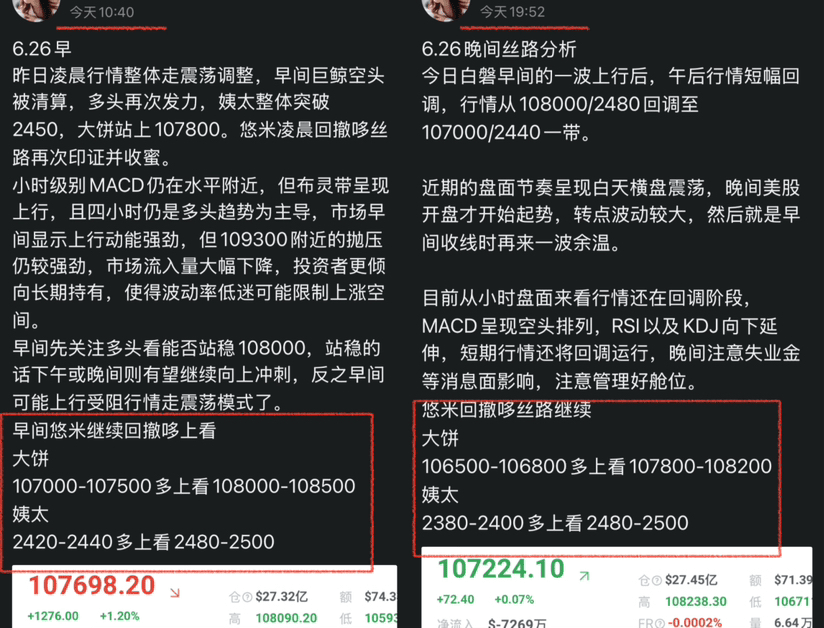
In recent days, the rhythm of BTC and ETH's market has primarily focused on the evening and early morning, with little change during the day. Yesterday, Bitcoin experienced overall upward fluctuations, while Ethereum mainly moved sideways. Although there was a bullish surge this morning, the price reached Yumi's target level for long positions, resulting in some gains, but the Bollinger Bands have gradually narrowed and stabilized, leading to increasing market lethargy. This is mainly due to long-term bullish sentiment from investors, which has caused a significant shrinkage in trading volume, resulting in low market volatility, with bulls lacking the momentum to break through and bears having no opportunities.

The Federal Reserve has two conflicting messages:
The Vice Chairman of the Federal Reserve has released dovish signals, suggesting more data is needed before deciding on a policy shift, leading to a sudden rise in market expectations for a rate cut in July. Risk assets have regained some breathing space.
Meanwhile, Old Powell is firmly defending the inflation line, with the June CPI becoming a critical point, and he has indicated that further observation is needed for the July rate cut, pushing the rate cut timeline further into the future.
Currently, it seems that only Waller and Bowman have shifted to a dovish stance, while Old Powell leans toward a hawkish position.
On the macro front
Geopolitical tensions have paused, and parties in the Middle East have reached a preliminary peace agreement, temporarily redirecting safe-haven funds back to gold and U.S. Treasuries while cautiously reinvesting in the crypto market.
More profound forces are coming from the thaw in regulation. The U.S. Senate is advancing the (GENIUS Stablecoin Act), and the EU's MiCA framework has completed revisions, clarifying the global crypto regulatory landscape. Policies are shifting from rigorous suppression to co-creating rules, injecting certainty into the industry.
Texas has allocated $10 million to establish a state-level Bitcoin reserve, becoming the first U.S. state government to bet on cryptocurrency with public funds.
The process of institutionalization is quietly accelerating, with on-chain data showing that long-term funds are flowing back into Bitcoin holdings.
The surface calm cannot hide the deep-seated crisis. Despite the price rebound, spot demand remains weak, and the willingness of new investors to enter is sluggish. Analysts view the 92,000 USD level as a key on-chain cost support position, and if it falls below this point, it may trigger a chain reaction of sell-offs targeting 81,000 USD.
The leverage frenzy in the derivatives market is waning. CryptoQuant data shows that the activity of derivatives trading has significantly declined, and some large holders (whales) have begun to reduce their positions. This puts pressure on Bitcoin's short-term breakthrough of key resistance levels. Volatility remains a double-edged sword.
The technical outlook reveals a glimmer of hope. Bitcoin has broken through the daily downward structure, and if it can hold above the resistance level of 108,000, the price may rise above 109,000.
MicroStrategy's holdings have an unrealized profit of over $23 billion, and asset management giants like BlackRock continue to increase their stakes in ETFs. Morgan Stanley predicts that by the second half of 2025, corporate allocation to Bitcoin will become mainstream. The ongoing conflict has instead validated the extreme value of Bitcoin.
Gaza is using Bitcoin mining machines to maintain battlefield communications, while Ukraine has raised $127 million in aid through cryptocurrency. When traditional financial infrastructure collapses, crypto technology reveals its resilience as a 'financial lifeline in wartime.'
Although Bitcoin has surged to 108,000 at the end of trading, appearing strong, the market still walks a tightrope.
Although institutional funds are flowing back, retail demand is weakening like a receding tide; the dawn of peace in the Middle East has emerged, but the Federal Reserve's decision on interest rate cuts remains undecided. The cost line at 92,000 has become a critical threshold; falling below this point could trigger a sell-off wave.
The recent fluctuations have not seen any significant breakthroughs, leading investors to question the market: after the ceasefire in the Middle East, will the rebound be a trap for the bulls or the beginning of a genuine upward trend?
To be honest, although the bulls have been making upward efforts recently, they have struggled to rise after reaching around 108,000. If there is no momentum to push higher in the future, then this will inevitably lead to a wave correction downwards.
On the Ethereum front, after breaking 2,500, it halted below 2,520, but the bulls quickly retreated without firmly standing their ground, with today's overall price fluctuating between 2,400 and 2,480.
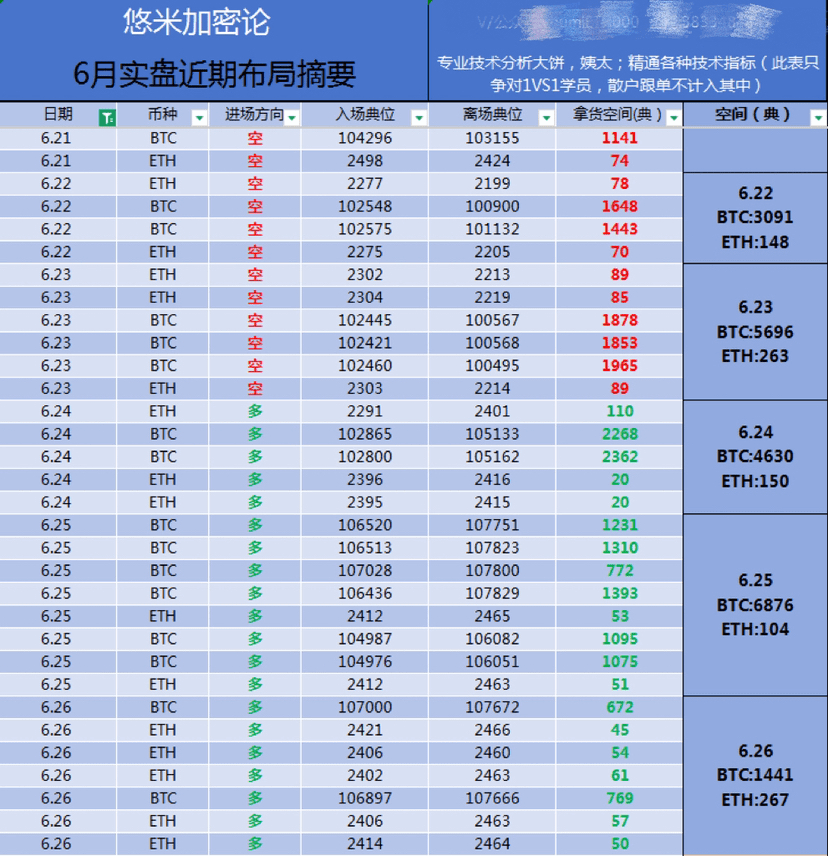
Yesterday and today, Yumi focused on retracing the Silk Road. After Yumi's analysis of positions and market trends, long positions reached Yumi's target level, allowing timely exits for significant profits. Over these two days, whether small-scale traders or long-term partners like Duodan have done very well, with Bitcoin earning 6876 points and Ethereum 371 points.


Following the release of negative unemployment claims news, the three major U.S. stock indexes all rose at the market open. Bitcoin and Ethereum showed little volatility.
Currently, the hourly chart for BTC shows two bearish candles, indicating short-term correction pressure, but the overall daily trend remains upward.
Tonight, caution is needed to observe the market, in case upward movements of the bulls are blocked and the bears sweep in again. Pay attention to short-term support at 106,200/2,380 and resistance at 109,300/2,530.

