
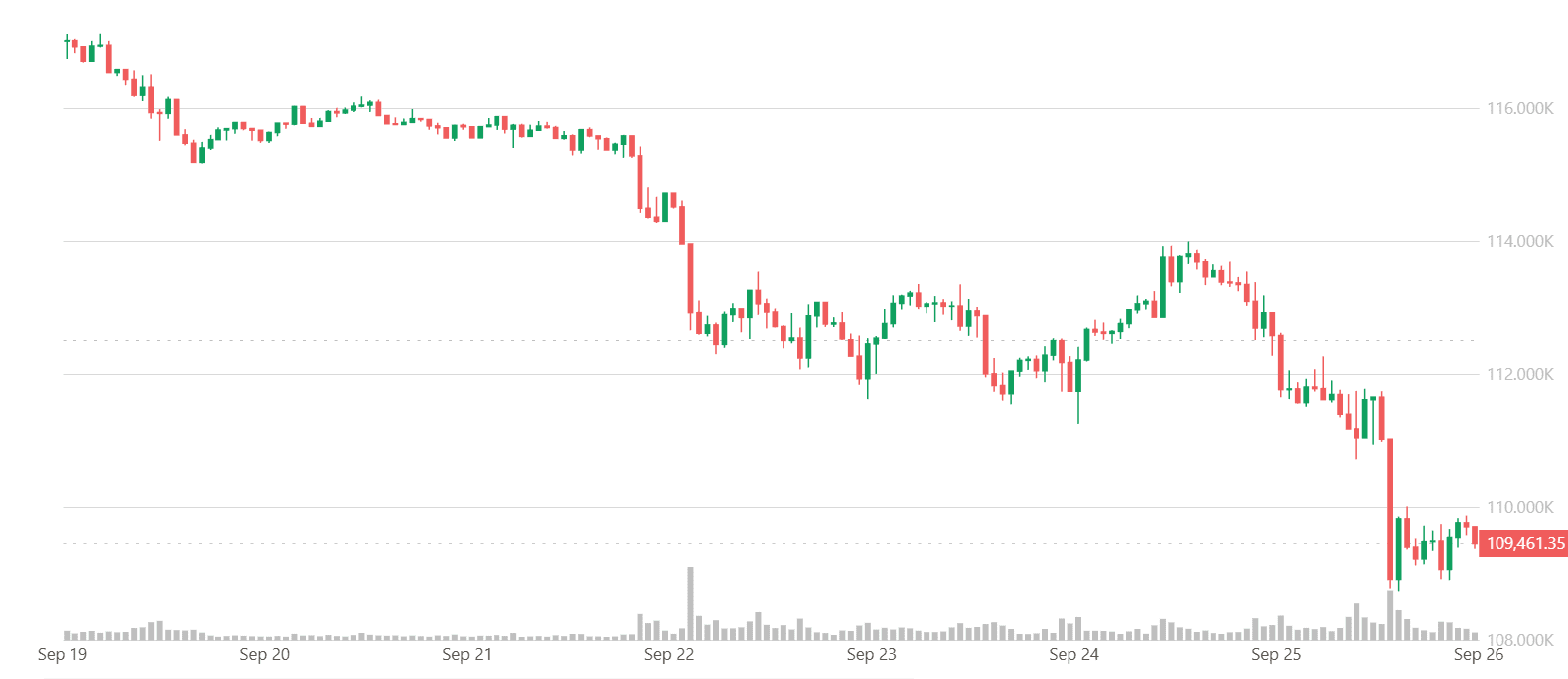
This week has been generally turbulent for the crypto market. On Friday (September 26), during the Asian market session, Bitcoin continued to consolidate at low levels, having lost the critical $110,000 support yesterday. Ethereum continues to struggle below $4,000. Today, the market is focused on the U.S. PCE data, while traders are questioning whether the upcoming $22 billion Bitcoin options expiring on Friday explain the drop below $109,000, and whether professional investors expect prices to fall further.
On Thursday, Bitcoin fell below $109,000, hitting the lowest price in nearly a month, while Ethereum dropped 8%, approaching $3,800.
Samer Hasn, senior market analyst at asset brokerage platform XS.com, wrote: "The persistent downward pressure stems from a lack of sufficient buying power to hold prices after this week's massive liquidation wave."
He added, "The new round of long liquidations further impacted market sentiment, while the stock market's pullback amplified the cautious atmosphere."
CoinGlass data shows that this sell-off triggered more than $1.1 billion in leveraged derivatives positions being liquidated, with Ethereum long positions suffering the heaviest losses, exceeding $400 million liquidated.
Crypto-related stocks also suffered significant declines, including Michael Saylor's MicroStrategy (MSTR), which fell as much as 10%, reaching a five-month low.
Meanwhile, the stock market also retreated from recent highs, with investors concerned about the excesses driven by the AI boom and the uncertainty of the Federal Reserve's interest rate policy path.
Strategists point out that September is often a month of significant seasonal volatility for the crypto market, while the last three months of the year typically bring tailwinds. Bulls also mentioned another source of pressure, the Treasury General Account (TGA), which is equivalent to the government's "checking account" at the Federal Reserve. The Treasury has recently supplemented this account by issuing government bonds and short-term Treasury bills, which is equivalent to pulling liquidity out of the market and could reduce demand for risk assets like Bitcoin.
The cryptocurrency market plummeted on Thursday.
The cryptocurrency market further deteriorated during the afternoon trading session in the US on Thursday, which was already subdued in the early hours. Bitcoin quickly fell below $109,000 from $109,554.94, reaching its lowest level in nearly a month. Ethereum plummeted 8% in the last 24 hours, rapidly approaching $3,800, erasing gains since early August, and is currently down 22% from last month's all-time high.
Solana (SOL), which was still above $250 two weeks ago, fell below $200, dropping another 8% on Thursday to report $196.87. The CoinDesk 20 index fell 6% overall.
This widespread crash has led to massive deleveraging in the derivatives market, with over $1.1 billion in leveraged positions liquidated in the past 24 hours. Among them, Ethereum longs suffered the most, with over $400 million in long positions wiped out, followed by Bitcoin's $265 million.
Crypto stocks were also hit hard. MicroStrategy (MSTR), the largest Bitcoin corporate holder, plunged up to 10% during trading to a five-month low. The stock is typically viewed as a leveraged bet on Bitcoin prices, having erased all gains for the year, down 1.5% year-to-date, while Bitcoin has still risen 16% in the same period.
Bitmine (BMNR) and Sharplink Gaming (SBET), which hold Ethereum inventories, fell by 7%-8%, and Bitcoin miners MARA Holdings (MARA) and Riot Platforms (RIOT) also experienced declines.
With Thursday's plunge, Bitcoin is on the verge of dropping below the low point from late August to early September, when prices just managed to hold above $107,000. CoinDesk cites analysis from Hyblock Capital, which reports that this price level may become a support level, at least in the short term, potentially facilitating a rebound, while the order book shows a concentration of liquidity in this range, which may absorb some of the selling pressure.
Bitcoin Options Expiration
In the Bitcoin monthly options expiring Friday at 8 AM UTC, the target range for put (sell) options is $95,000 to $110,000. If bulls fail to reclaim the $110,000 mark before expiration, put options will gain an advantage of $1 billion.
However, some analysts expect that selling pressure may ease after the options expiration. In recent weeks, the BTC derivatives market has shown some resilience, maintaining relatively stable open interest and funding rates even as prices have fallen.
Bitcoin's two-month futures maintain an annualized premium relative to spot at 5%, within a neutral range of 5%-10%. This indicates limited bullish interest, while shorts are also cautious, not aggressively betting on further declines. According to CoinGlass data, Bitcoin futures open interest remains at $79 billion, down only 3% in the past two days.
Traders' risk aversion sentiment is rising, especially due to concerns about a potential government shutdown in the US. According to Politico, a memo from the Office of Management and Budget (OMB) under President Donald Trump requires government agencies to revise contingency plans to address a potential discretionary funding lapse on October 1.
Bitcoin Technical Analysis
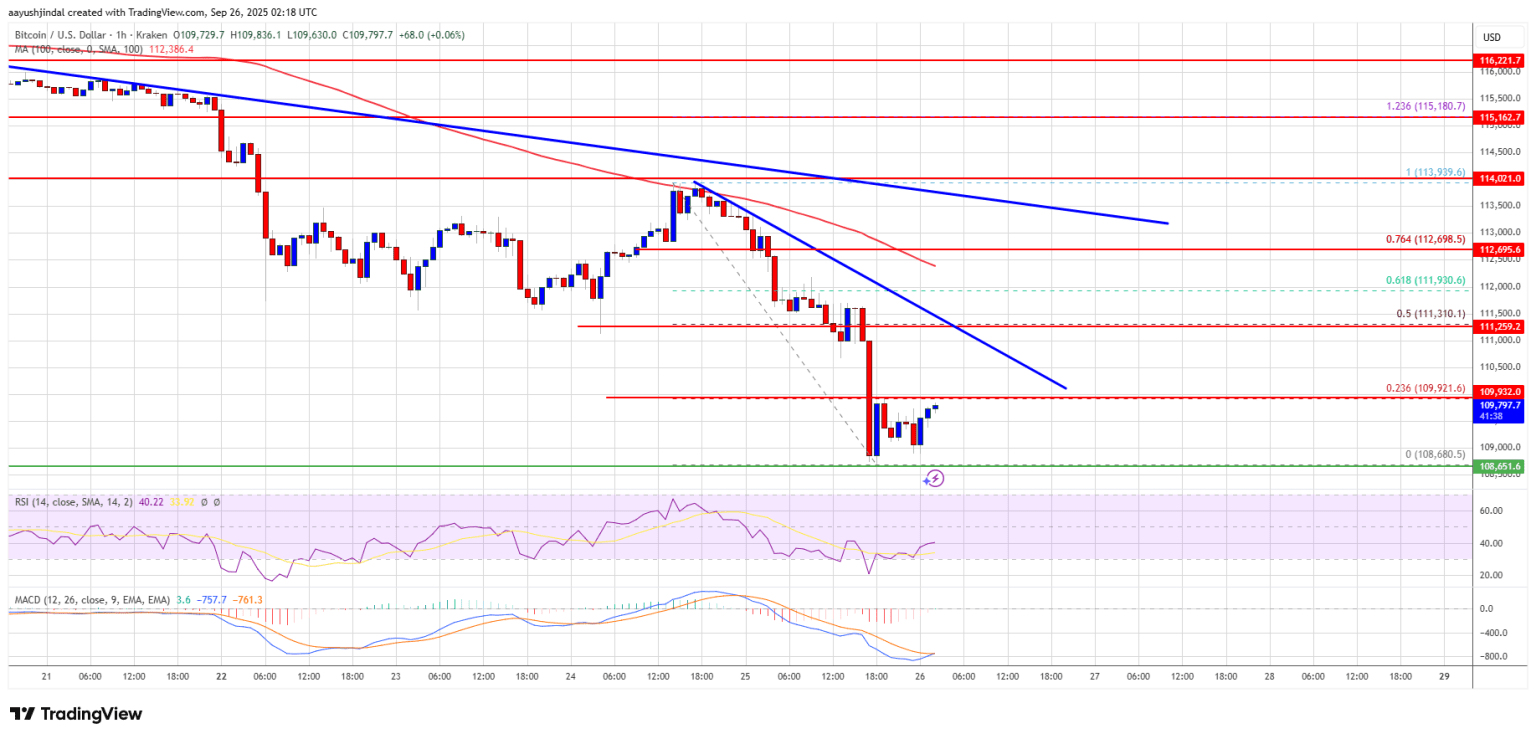
Bitcoin's price has failed to initiate a rebound and continues to hold below $114,000. Bitcoin broke below the support levels of $112,500 and $112,000, further entering a bearish zone. Prices accelerated downward below $111,500, forming a low of $108,680, and the price is currently consolidating its losses. The price has slightly rebounded to the 23.6% Fibonacci retracement level from the recent high of $113,939 to the low of $108,680.
Currently, Bitcoin is trading below $112,500 and also below the 100-hour simple moving average. Additionally, two bearish trend lines have formed on the chart, with resistance at $110,500 and $113,000.
On the upside, the current immediate resistance is around $109,920. The first key resistance is at $110,500, close to the trend line. The next resistance may appear at $111,300, or at the 50% Fibonacci retracement level from the recent high of $113,939 to the low of $108,680. If the price breaks through the resistance at $111,300, it may rise further. In that case, prices could increase and test the resistance at $112,500. Further gains could push prices close to $113,000. The next resistance in a bull market may be at $114,500.
Conversely, if Bitcoin fails to break through the resistance range of $110,500, it may begin a new downward trend. Immediate support is located around $108,800. The first major support level is around $108,200. The next support level is in the $107,500 range. If it falls further, prices may approach the support level of $106,400. Major support is below $105,500, and below this price, Bitcoin may struggle to recover in the short term.
Technical Indicators:
Hourly MACD: The MACD is currently accelerating downward within the bearish range.
Hourly RSI (Relative Strength Index): Bitcoin's RSI is now below 50.
Major support levels: $108,800, followed by $108,200.
Major resistance levels: $110,500, followed by $113,000.

