
I used to not believe it until I saw that scene:
The night of the LUNA+ crash, someone lost 1.2 million U in three days, leaving only enough for a breakfast.
True story, not exaggerated.
At that time, LUNA was still flourishing in the market. You had 10,000 LUNA in your account, which was worth 1 million U the night before. You were a little bit worried before going to bed.
Calmly: 'UST+ only dropped 10%, DoKwon+ will definitely save it, at worst, just hold on.'
As a result, when you woke up, there were only 700,000 left. You were a bit panicked, but you still thought to hold on: 'A 30% drop is normal volatility.'
Put down your phone and continue sleeping. When you wake up, there will only be 10,000 U left.
It's not that you didn't set a stop loss, but rather you never thought... it would go straight to zero.
You don’t believe in evil, you rush in with 200,000 USDT to bottom fish, and bought 200,000 LUNA, fantasizing that as long as it rebounds to 10 USDT, you will directly turn 10 times and come back to life!
You start being afraid to sleep, staring at the screen overnight, watching the price drop from $1 to $0.1, then to $0.01, and then to $0.0001.
Until the exchange directly delists.
In three days, 1.2 million USDT, now just a joke.
The person is not dead, but the heart has truly collapsed.
Don't think this kind of thing is far away from you.
In the coin circle, stories of liquidation are played out every day.
What kind of market is this?
7×24 hours around the clock, no breaks, no waiting.
There are no price limits; everything can soar or plummet at any time.
Leverage is rampant, sometimes reaching 10x, 20x.
The emotional intensity is off the charts; if someone shouts 'bearish', the entire market shakes.
Shanzai projects can tell a good story; even a shell can rise 3 times.
The clearing mechanism is open and transparent, whales dumping directly cut your large positions.
Don't say that just because you opened 5 times leverage, it's very stable.
You haven't experienced the feeling of a 20% drop in a day in the crypto market, dozens of times a year, every time feeling like a bone scrape.
ETH+ last round dropped from $4000 to $800.
It's not that the project is bad, but the on-chain liquidation prices are clearly marked.
Market makers know where to liquidate positions and where to 'pick up the corpses' cheaply.
So, don't fantasize that 'it won't fall anymore'!
Also, don't be superstitious about 'faith', 'value', or 'consensus'.
The real experts who can survive in the coin circle are never:
People who guess the market down every day.
But rather those who can endure, withstand, and know when to stop.
If you want to survive in the crypto circle, don't just listen to hype, and don't let the myth of getting rich quick cloud your judgment.
Real opportunities are always left for those who are sober, calm, and strategic.
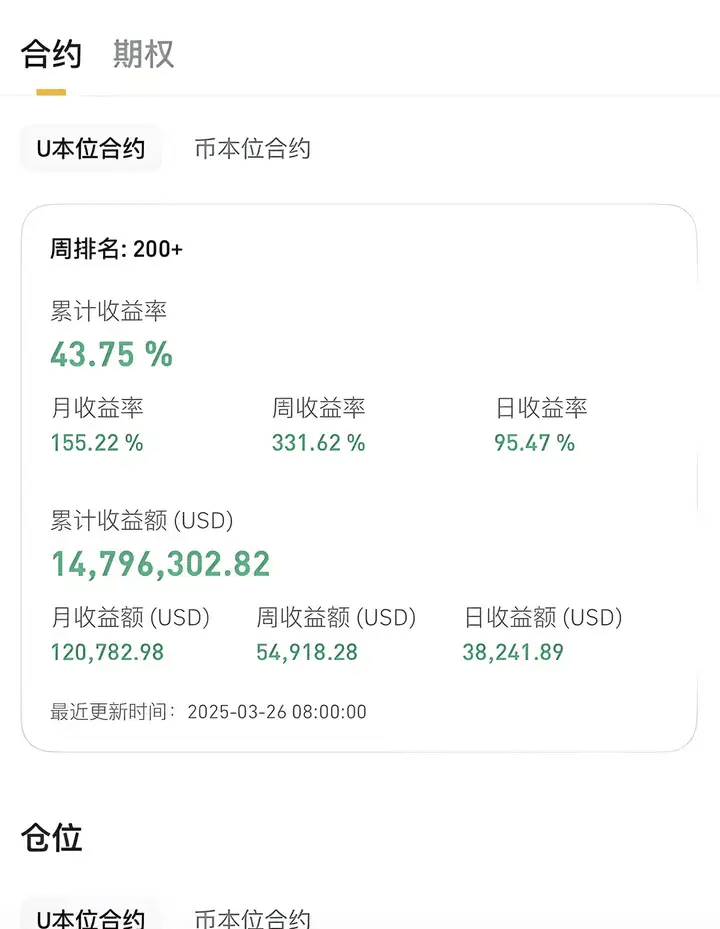
I have been trading coins for ten years, with a net worth of 150 million, of which about 130 million is earned from 'trading coins'!
Initially lost 80%, experienced various pressures, pains, and confusion, finally realized that simplifying trading techniques was the way, turning complexity into simplicity, and achieving a net worth of over 100 million, truly achieving living off trading coins!
In the first half of 2024, I earned about 15 million, with a capital increase of 50 times. If it weren't for two times withdrawing funds to buy houses, it should have increased 85 times.
I withdraw 100,000 yuan from the crypto circle every month, feel no impact at all, live leisurely, freely, without deceit or intrigue, living the life I want.
Currently, I have profited from one house in Shenzhen, one house in Guiyang, three cars, and some savings and assets. I am not exactly a top-notch crypto trader, just scraping by, and the so-called profits are merely the basic returns from correctly executing trading signals.
Thoughts on trading coins: mindset is greater than technique!
1. Bitcoin + is the 'father' of the coin circle.
If Bitcoin remains stagnant, there won't be any major movements in the crypto market. Strong coins like Ethereum occasionally exhibit independent trends, but most altcoins cannot escape the influence of Bitcoin.
The 'gravity' of special coins reminds you: understanding Bitcoin means you've won half!
2. The 'inverse secret' of USDT + Bitcoin.
USDT is rising? Bitcoin is likely to fall!
Bitcoin is rising? Hurry up and buy USDT!
This is the golden rule of capital flow; if you hit it right, your returns can double!
3. The 'earning' timing point.
Every day from 0:00 to 1:00, domestic crypto enthusiasts place a 'floor price' buy order and a 'ceiling price' sell order. You might just make a deal! Feels great~
6:00-8:00, this is a key moment to judge the day's trend; the rise and fall are revealed at this moment!
4. 'Friday Effect'? Don't be too nervous.
'Black Friday' indeed had significant drops, but there were also times of significant rises. The key is the news, don't be scared off by rumors!
5. 'Black Thursday'? Does not exist!
Unless you bought '1 coin' (a shitcoin), then patiently hold on; recovering capital is just a matter of time, short as 3-4 days, long as 1 month, in batches.
Average down quickly to recover capital! (I bought Dogecoin at 0.1, now it has increased 20 times!)
6. Spot holding VS frequent trading.
Long-term holding = huge profits, frequent trading = working for the exchange!
I have seen too many people trading every day, resulting in less and less capital, while I achieved financial freedom with just a few long-term holdings!
Playing in the crypto market is ultimately a contest between retail investors and market makers. If you don't have cutting-edge news or first-hand information, you can only get cut! If you want to layout together and harvest the market makers together, you can come find me! Welcome like-minded crypto enthusiasts to discuss together~
The key to trading coins lies in timing: when to buy and when to sell. Master these twenty-one buying and selling principles, and you will surpass 98% of people in the crypto space!
1. Each time you enter the market, the loss should not exceed one-tenth of your capital.
This way, even if you are wrong every time, there are still 10 chances to play. For example, some friends trade contracts, it's best to only use 1/10 leverage; as long as
There is a chance to turn 10 times, just to recover capital. Of course, the old bull still does not want newcomers to trade contracts.
2. Always set stop-loss levels to reduce losses that may occur from incorrect trades.
Stop-loss is very important, beginners may not feel deeply, stop-loss can prevent unnecessary massive losses caused by black swan events, such as the USDT crash which is completely unpredictable, almost everyone who shorted at that time got wiped out. Moreover, the crypto market operates 24 hours, without profit taking.
Losing money while running naked in the market is very dangerous; not being able to sleep, setting stop-losses, and knowing the maximum loss is much safer.
3. Never overtrade.
Trading frequency must be low; try to reduce it to once or twice a week. Beginners can train using demo funds or with very small amounts to accumulate experience, but for normal accounts, one must wait for the right opportunity. Trading opportunities are actually quite rare.
4. Never let held positions turn from profit to loss.
Many people have orders that turn from profit to loss, which is particularly regrettable. How to handle profitable orders to avoid turning into losses? It's simple, when profits reach a certain percentage, you must set a stop-loss to protect your capital. For example, if you buy at 10 and it rises to 13, you can set the stop-loss.
Set at 10 or 11, so even if the market reverses, it can protect the capital from losses.
5. Never trade against the market. When the market trend is unclear, it is better to observe from the sidelines.
Don't go against the trend; follow the trend. This trend is defined differently by everyone, depending on the trading cycle and reference indicators. Some might use the 20-day moving average on the daily chart, while others might use the 60 moving average on the hourly chart, it varies by individual. Only enter trades when the direction is clear, which greatly reduces the chance of errors.
6. If you have doubts, close your position. When entering the market, be decisive, and do not enter when hesitant.
This is something you have to understand by yourself. Because whether you can hold onto a position is crucially related to confidence and psychology in trading. If you can't sleep while holding a position, it's better not to trade.
7. Only buy and sell in active markets; do not trade in illiquid times.
This is a special reminder to trade mainstream coins; do not easily buy altcoins, as their depth and liquidity can be significantly lacking.
In terms of trading, when the market is very quiet, do not enlarge the funds; it is easy to get stuck.
8. Never set target prices for entering and exiting the market; avoid limit orders and only obey market trends.
Avoid subjective speculation on the market; this is the same principle as guessing the top and bottom. Trading is not analysis, and it is not prediction; you can predict that Bitcoin will rise to
100,000 US dollars, but when Bitcoin fell from 20,000 dollars to 3,000 dollars, it is still best to avoid it. The future is uncertain; reality is what you have to face.
9. Without appropriate reasons, do not close positions held, and use stop-profit levels to safeguard profits.
Same as 8, don't guess the top. Take profits in batches, a pyramid selling strategy can be tried.
10. After a series of market victories, you can extract part of your profits for emergencies.
This is what the old bull feels most deeply and painfully. Because everyone has times when they make money and times when they have big profits, this is the time when it is easiest to become arrogant.
Fantasizing, a little relaxation of thought will immediately teach you a lesson in the market; securing profits or the prospect theory is crucial. Money, when it's in hand.
That is considered money; otherwise, it's just a pile of numbers.
11. When buying stocks, avoid solely looking for dividends. (First earn the market price difference.)
This point is like many people buying coins, because of short-term benefits, in fact, it is not necessary, because the heat quickly passes, chasing the hotspots is very easy.
Standing guard, for example, last June, the favorable meeting for EOS, surged before the meeting, and directly peaked on the day of the meeting, many were standing guard.
12. When trading incurs losses, avoid gambler-style averaging down to reduce costs.
Do not add positions when losing; remember, never add leverage to a losing position, this is a dead end! Many have died in this game; buying more as the price falls is a dangerous mindset.
The premise of the theory is that you have enough money; no one's funds are unlimited, don't believe such words.
13. Do not enter the market out of impatience, nor close positions out of impatience.
Avoid emotional trading.
14. Willing to lose but not willing to win, cut off. Don't make trades that lose more than earn.
Many friends are calm when incurring losses, but when there is a small profit, they are eager to take profits. This needs attention; the risk-reward ratio should be reasonable, ideally the reward should be more than twice the risk.
15. Do not randomly cancel the stop-loss set when entering the market.
I don't understand too much yet.
16. The more you do, the more mistakes you make. Wait for opportunities to enter the market; do not trade too frequently.
The more you do, the easier it is to make mistakes. Reduce trading frequency.
17. Trade long and short freely, do not only trade in one direction.
This old bull often fails to do so, because it is a dead bull market, so it incurs losses during pullbacks. One must not have obsessions and must respect the market. Reality is the most important.
18. Do not accumulate just because the price is too low, nor short just because the price is too high.
Do not clear tops, do not clear tops, especially during violent rises or falls, do not rashly think you can short or go long here. You must have your own entry and exit principles.
19. Never hedge.
If you incur a loss on a trade, stop-loss! Do not lock positions; this is a big taboo.
20. Try to avoid pyramid adding positions at inappropriate times.
I don't have a deep understanding. It’s best to add positions in a pyramid when the trend is clearer. It’s not advisable to add positions during market fluctuations.
21. Avoid arbitrary changes to trading strategies without appropriate reasons.
What is an appropriate reason? I don't know! Trading strategies must be formulated in advance, such as entry signals, stop-loss, position sizes, exit signals, etc. Once formulated, do not easily change them due to dramatic market fluctuations.
Creating is not easy. Thank you for reading. If you want to exchange techniques together and layout to quality coins, you can give a like + follow.
Next, I will share a set of my own practical strategies that have achieved an average win rate of 80%, which is a quite rare achievement in the crypto trading world.
In trading, you don't always need an extremely complex or professional method to achieve success. Instead, you just need an effective strategy.
Strategy. Using one of the oldest and simplest trading tools—moving averages (Moving Averages) might be a good start.
If you are a scalper or use other short-term strategies, then using moving averages on the 15-minute chart is very worthwhile.
Recommended. Among them, the 20EMA (exponential moving average) is the best moving average on the 15-minute chart because it accurately follows the price movement in multi-day trends. In other words, you can easily identify the trend through it.
How does the 20EMA strategy work?
The main advantage of the 20EMA trading strategy is that even novice traders can easily grasp it. The only tool you need is the 20EMA, and it is applicable to any currency pair and any time frame.
In a downtrend, the price is generally expected to decline. But at some point, you will see the price change direction to test the 20EMA line. If the downtrend is strong enough, the 20EMA will push the price back down. This phenomenon is called a 'retracement,' and it may happen once or several times until the 20EMA is effectively broken.
Therefore, the core function of the 20EMA strategy is to act as the 'rebound line' of the K line. As a trader, you should wait for and take advantage of the moment when the price retreats to the 20EMA line.
There is a key detail to note: you only need to focus on one very specific K line—that is, the first K line that touches the EMA line after the price deviates from the 20EMA for a period of time. Remember, if the next K line continues to stick to the EMA line, that is not a good signal. Once you capture the correct signal, it is a good time to open a position.
Take an example:
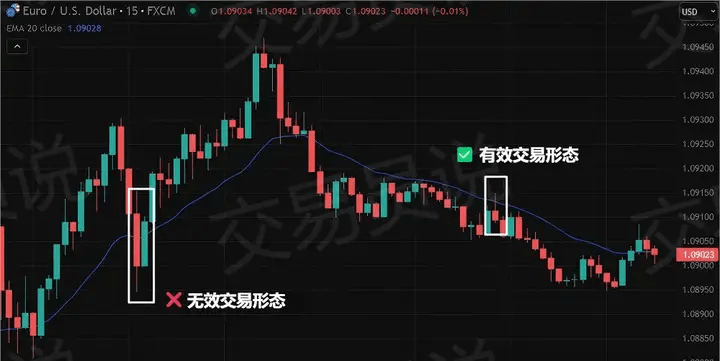
Under the basic principles of the 20EMA strategy:
When the price closes above the 20EMA, the market is in an uptrend; when the price closes below the 20EMA, the market is in a downtrend.
The first K line to touch the 20EMA after the trend changes direction is called the signal K line. You only need to focus on this K line because your entry position relies on the highest and lowest points of this signal K line.
In an uptrend, you should set buy stop-loss orders 1-2 points above the highest point of the signal K line. If the next K line does not trigger your order, you should cancel that order.
Conversely, in a downtrend, you should set sell stop-loss orders 1-2 points below the lowest point of the signal K line. If the next K line does not trigger the order, you should cancel that order.
In long trades, stop-loss should be set a few points below the lowest point of the signal K line (at least 5-10 points, depending on the time frame you use); in short trades, stop-loss should be set a few points above the highest point of the signal K line.
The following is an example of establishing a short position based on the previous chart:
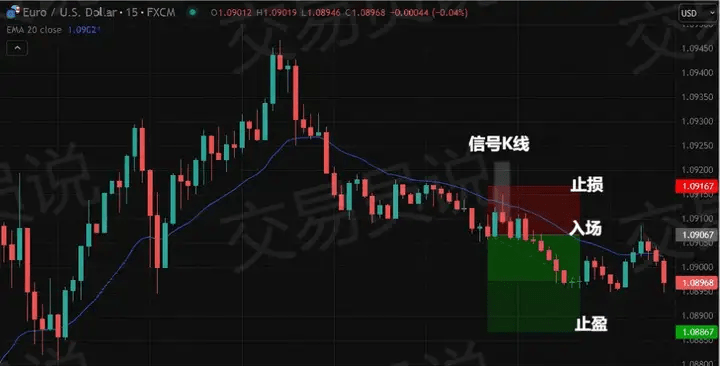
In the above chart, the lowest point of the signal K line on the Euro/USD 15-minute chart is 1.09087, so the sell stop-loss order is set below it.
At the position of 2 points, the next K line continues to fall, so the order at 1.09067 is triggered, according to the rules, the stop-loss is set at the signal K.
10 points above, which is 1.09167. As for profit taking, in this example, a 1:2 risk-reward ratio is used, so the take-profit is set below the entry price.
The position of 20 points, which is 1.08867.
Use daily charts to identify major trends.
You certainly don't want to rashly enter trades when the trend is unclear, risking losing money. This is why some traders choose to
Switching to other time frames to filter the market; they want to identify trends in advance and ensure that the trends are strong enough. Once they confirm the trend on the daily chart,
If the price direction is confirmed on the chart, then looking for entry opportunities on the 15-minute chart will be much easier.
What should be done?
First, to identify the trend, you need to set several rules on the chart, aimed at recognizing the direction of price movement. Don't worry, these rules apply to both upward and downward trends and are effective across different time frames.
● Ensure that the price has continuously risen or fallen for several days, and at least one higher low (HL) appears in an uptrend; in a downtrend,
In an uptrend, at least one lower high (LH) should appear.
In an uptrend, the 20EMA line should present an upward angle of 2 o'clock or steeper; in a downtrend, the 20EMA should present a downward angle of 4 o'clock.
In an uptrend, prices should significantly break through resistance; in a downtrend, prices should significantly break down through support.
After that, switch to the 15-minute chart and focus on the potential buying conditions under the following two uptrend scenarios:
1. Breakthrough of support/resistance on the daily chart.
If the price is clearly following the 20EMA, it means it is in an ideal trading position.
2. Significant fluctuations in support/resistance areas.
This situation is relatively safer because the price has confirmed its momentum and continues to operate in the expected direction. Therefore, when the price reaches and stabilizes near the 20EMA, it is a good time to enter.
How to use the 20EMA to find quality entry points.
Using the 20EMA (Exponential Moving Average) to determine a quality entry point is relatively simple. First, identify the trend, find support and resistance, and then enter when the price pulls back to these positions.
1. Identify the trend.
The process of using the 20EMA indicator to identify trends is quite straightforward. You only need to observe the EMA line relative to the current price movement.
If the EMA line is below the current price, it indicates an uptrend.
● Conversely, if the EMA line is above the current price, it indicates a downtrend.
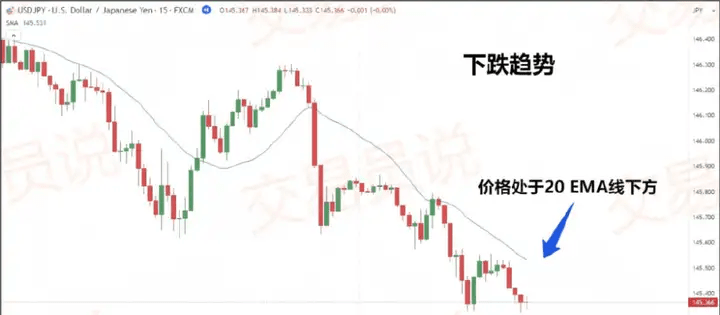
2. Look for support or resistance.
Once you determine the current trend, the next step is to identify important support or resistance levels. As previously emphasized, we focus on
It is the dynamic support and resistance from the 20EMA line.
● In a downtrend, the 20EMA line acts as a resistance level.
● Conversely, in an uptrend, the 20EMA line acts as a support level.
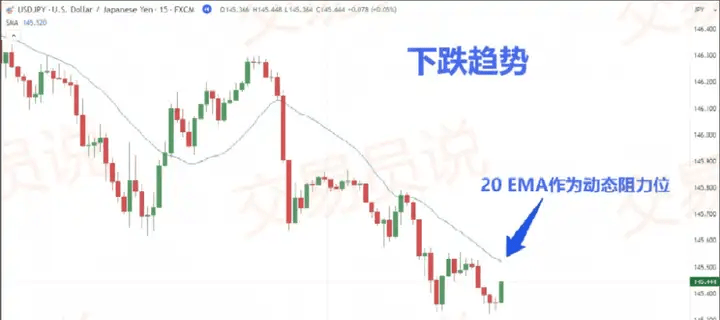
3. Wait for a pullback.
Next, you need to patiently wait for the price to pull back to the support or resistance levels or to near the 20EMA line.
This stage is very important and is often overlooked by many novice traders. They may think that once the trend direction is clear, they can
To enter the trade immediately.
However, in practical operation, even when the trend direction is very clear, we still need to patiently wait for a pullback. This waiting period is crucial for optimizing.
The risk-reward ratio set for trading is crucial.
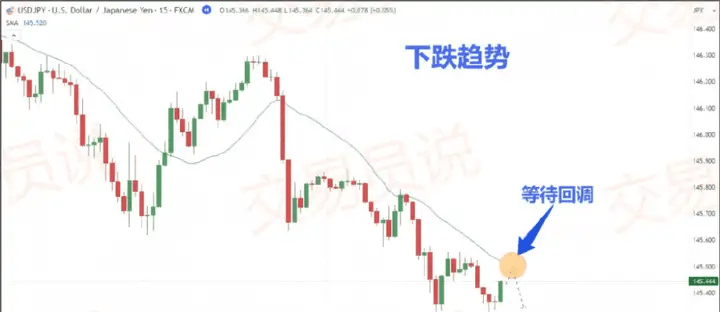
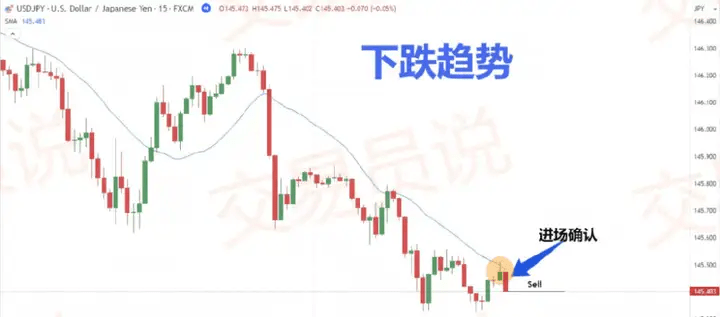
4. Entry confirmation.
There are two ways to confirm entry: using price action or technical indicators.
Price action confirmation: observe chart patterns or candlestick patterns. Common chart patterns include double tops/bottoms, head and shoulders tops/bottoms, triple tops/bottoms, etc. Common candlestick patterns include engulfing patterns, pin bars, inside bars, etc.
● Technical indicators confirmation: can use stochastic indicators, relative strength index (RSI), MACD, and other tools.
When using this trading strategy, be sure to focus on the following aspects:
1. Only enter when the market is trending.
Entering when the market is in a clear and established trend can significantly increase the likelihood of successful trades; the price is more likely to continue its original direction.
Having direction is beneficial for traders to operate in line with existing momentum. Conversely, trying to trade in a market without a trend or in a lateral market is difficult.
This may lead to price trends being difficult to predict and result in unfavorable trading outcomes.
2. Avoid counter-trend trading.
Counter-trend trading carries high risks; operating against the trend means that the trader is effectively betting that the market will reverse its current direction, which requires very precise judgment.
Grasp the right timing and use strong reversal signals as a basis.
3. Enter during active trading periods.
Active trading periods usually coincide with the overlap of major markets, such as when the European market and the New York market are open simultaneously. In these
Trading during active periods provides better opportunities because the volume and price volatility are relatively higher, leading to tighter bid-ask spreads and less slippage.
Slippage and better execution quality.
Conversely, trading during low activity periods (such as Asian sessions, weekends, or holidays) may face larger spreads and lower liquidity.
Making trading execution more difficult.
Is the 20 EMA suitable for intraday trading?
The answer is yes. The 20EMA is suitable for both scalping and day trading. However, in day trading, it usually requires
Wait for a specific pattern to appear before entering the market, and once you find this pattern, confirm it using support and resistance levels.
It is very easy to identify.
You should see a strong upward or downward move within the first two hours after the market opens, followed by a price pullback to the 20EMA. Remember,
To maintain the effectiveness of this strategy, you also need to confirm the trend direction on higher time frames. If the trend on the higher time frame is consistent with the earlier
If the price movement is consistent with the trend near the 20EMA, then the probability of reversal is very high.
Does the 20EMA strategy fail? Backtesting results tell you.
Like any other trading strategy, the 20EMA is not flawless; it may fail, and sometimes the price does reach support or resistance.
Resistance levels may still consolidate; the price may even ignore the 20EMA line and fluctuate back and forth. If you encounter such a situation, it is best to
Pause trading and patiently wait for the next opportunity, as this market environment is full of uncertainty.
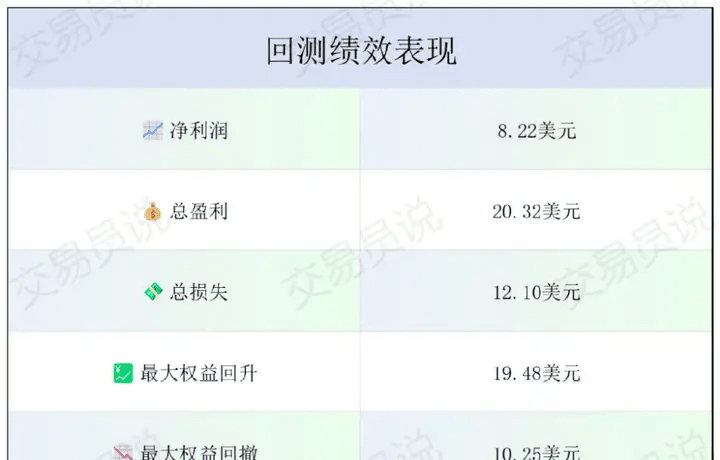
For the 20EMA strategy for day trading, a week of backtesting was conducted from March 5, 2025, to March 12, 2025. The results showed
Indicates that although the strategy may fail in some cases, it still achieves positive returns overall.
The specific details are as follows:
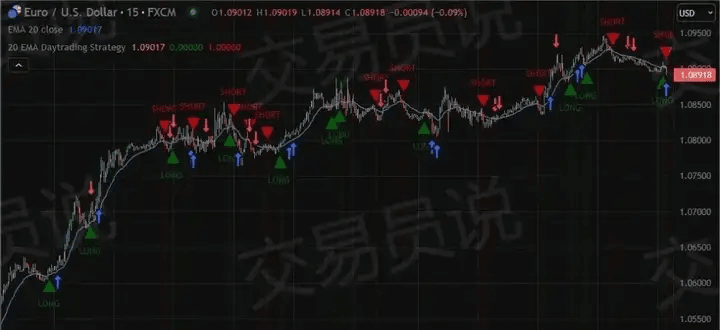
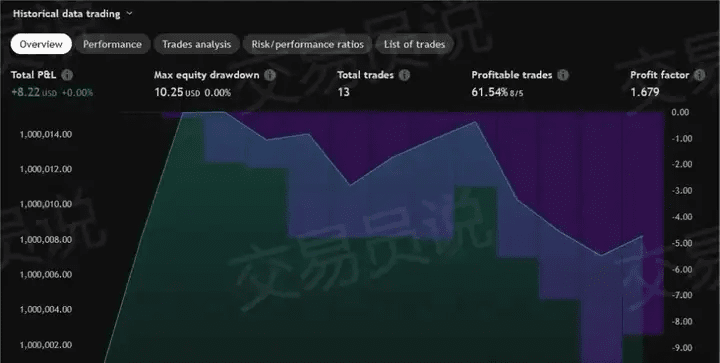
In 7 days, a total of 13 trades were conducted, validating the value of the 20EMA strategy as a day trading system. More importantly, the strategy achieved a win rate of 61.54% and generated a total profit of $8.22.
Conclusion.
The 20 EMA trading strategy is a simple yet powerful strategy. Compared to SMA (Simple Moving Average), EMA (Exponential Moving Average) is closer to price fluctuations, showing a more accurate 'rebound line' on the chart.
The strategy is simple enough that even novice traders can quickly grasp it, and it is quite effective for short-term trading on the 15-minute chart. However, remember to confirm the trend on the daily chart first and pay attention to support and resistance areas.
Even if the 20EMA strategy may fail at some times, you can still enhance your win rate by analyzing multiple time frames and adding more tools to your charts. Moreover, if you are trading in the direction of the major trend confirmed by the daily chart, the overall probability of profit remains very high.
Although it may take some time to fully master this method, it is indeed worth a try. More importantly, you should first test this strategy on a forex demo account before applying it to a real account.
Bull market token accumulation always earns: 6 major investment points revealed.
1. Fixed investment: Holding coins is king, fixed investment, unlimited addition. In a bull market, holding a certain investment amount does not require frequent adjustments, it is stable and advantageous.
2. Mindset first: Invest according to funds and thinking, buy and stick to it. Maintain a calm investment mindset, make rational decisions based on your own funds and thinking characteristics.
3. Increase allocation: do not over-invest, diversify according to preference, and avoid concentration in one asset. Diversified investment should be based on personal preferences and needs.
4. Increase liquidity: After making a profit, withdraw the principal first; it varies by person. Withdraw some profits in a timely manner to ensure the safety of your capital, and then consider reinvestment.
5. Holding coins is king: you can either hold on or mix freely. The coins you hold can be chosen for long-term holding or adjusted freely according to the market situation.
6. Popularity & empty positions: Do not go all in on popularity; take out 20% of the position, take profits when you see them. When the market is hot, it is not advisable to blindly follow the trend; timely adjustments to positions are necessary to maintain a rational mindset.
The above six major investment points can be referenced in a bull market, but specific operations should be comprehensively considered based on individual market conditions to avoid blindly following.
Playing in the crypto circle is ultimately a contest between retail investors and market makers. If you don't have cutting-edge news or first-hand information, you can only get cut! If you want to layout together and harvest the market makers together, you can come find me! Welcome to follow Huihui, where you can watch live trading, learn, and communicate, and clearly understand the direction and strategy of the market. No matter what the market style is, knowing in advance allows for better control!
The team still has positions available, get on board quickly, and let you become the dealer and also a winner.$BTC $ETH


