
📊 1. Consolidation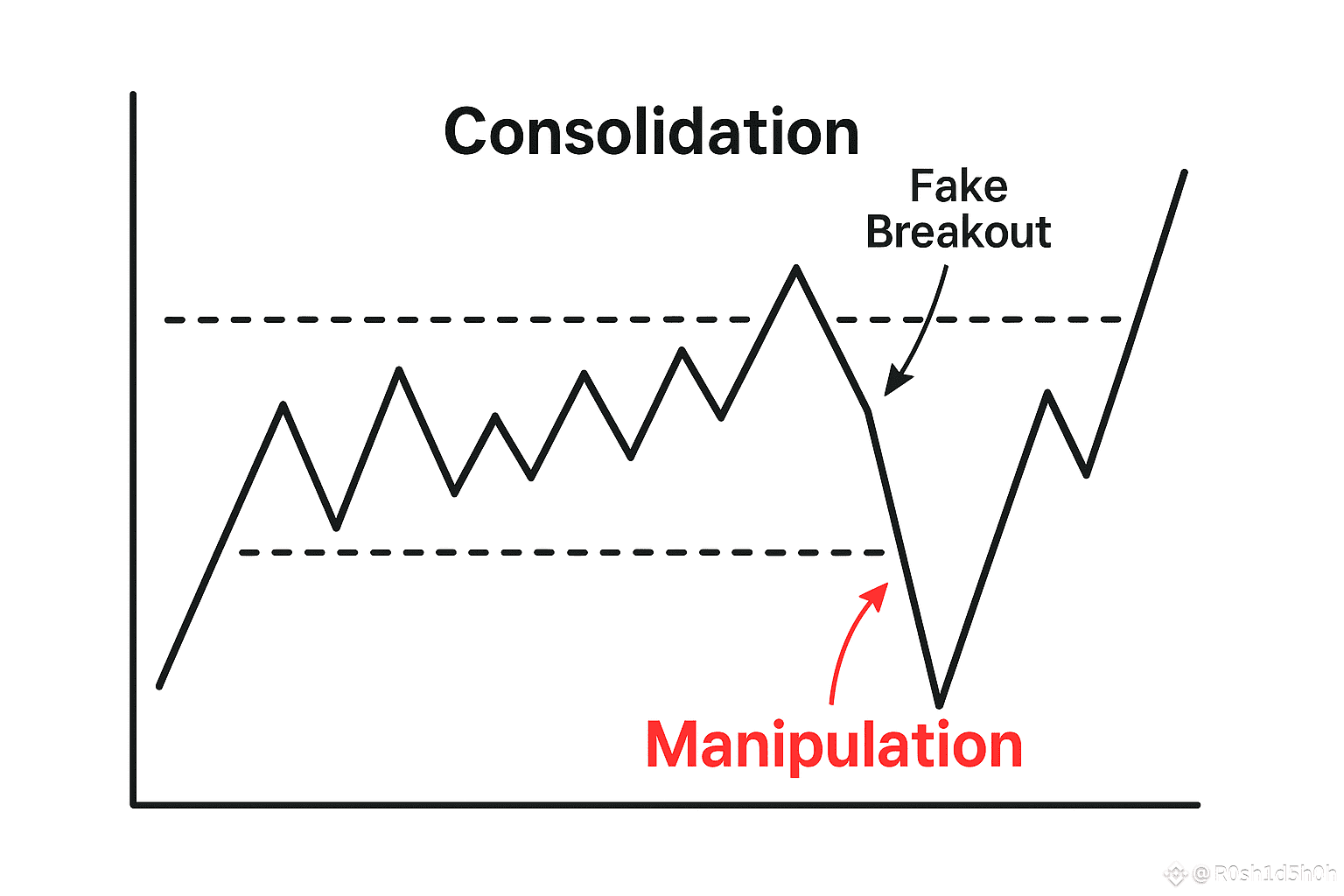
Definition:
Consolidation is a period when price moves sideways within a tight range — neither trending strongly upward nor downward.
It reflects a pause in market direction as buyers and sellers battle for control.
In other words:
The market is “resting” before making its next big move.
Characteristics of Consolidation:
Price stays within a defined zone (support and resistance).
Low volatility compared to trending phases.
Volume decreases as momentum slows down.
Market sentiment is neutral or uncertain
Types of Consolidation:
Accumulation (after a downtrend):
Smart money buys quietly while retail traders are fearful.
Often leads to a bullish breakout (uptrend).
Distribution (after an uptrend):
Smart money sells quietly to late buyers.
Often leads to a bearish breakdown (downtrend).
Why It Matters:
Consolidation often precedes major breakouts or breakdowns.
Traders use it to anticipate the next trend.
Range traders can buy at support and sell at resistance.
Example:
Imagine Bitcoin trading between $60,000 and $62,000 for two weeks.
Buyers and sellers are balanced.
Once price breaks above $62,000 with volume, that’s a bullish breakout (end of consolidation).
🧠 2. Manipulation
Definition:
Manipulation refers to intentional price movements created by large players (smart money) to deceive retail traders — often during consolidation or key market phases.
These moves are designed to:
“Trap” traders in the wrong direction before the real move happens.
Common Forms of Manipulation:
⚠️ 1. Stop Hunt
Price spikes above or below key levels to trigger stop-loss orders.
Purpose: to liquidate retail positions and fill institutional orders at better prices.
Example: Price dips below support briefly → triggers stop-losses → instantly reverses upward.
⚠️ 2. Fake Breakout (Bull Trap / Bear Trap)
Market pretends to break out of consolidation — then quickly reverses.
Example:
Price breaks above resistance → traders go long → price collapses back down.
This lets institutions sell into retail buying pressure.
⚠️ 3. Liquidity Grab
Institutions need liquidity (buyers or sellers) to enter big positions.
They push price into zones where many stop orders sit.
Once enough liquidity is collected, they move price in the opposite direction.
Manipulation Often Happens During:
Low-volume periods (e.g., before big news).
Consolidation zones (where liquidity builds up).
Major support/resistance levels.
How to Protect Yourself:
Don’t chase breakouts — wait for confirmation and retest.
Identify liquidity zones — where stops likely sit.
Pay attention to volume — manipulation usually has sharp spikes with no follow-through.
Think like smart money — ask, “Who is being trapped here?”
🔄 How Consolidation and Manipulation Work Together
StageWhat HappensWho ActsConsolidationPrice ranges quietlySmart money builds positionsManipulationFalse move or stop huntSmart money clears liquidityReal MoveStrong breakout or breakdownTrend begins
Example sequence:
Price consolidates.
False breakout traps traders.
Price reverses sharply — true direction begins.
🧩 Summary
ConceptDescriptionKey SignWhat to DoConsolidationSideways market — indecision phaseRange-bound price, low volumeWait for breakout or trade the rangeManipulationSmart money’s fake moves to trap tradersStop hunts, fake breakoutsAvoid emotional entries; confirm direction
Would you like me to show you a chart illustration of consolidation and manipulation (like a Wyckoff-style “liquidity grab” example)? It visually shows how smart money fakes out traders before the real move — super useful for recognizing it in live markets.
