
In the arena where AI Agents deeply integrate with blockchain, GOAT Network has firmly established itself in the core sector of the industry, thanks to its robust underlying infrastructure, global ecosystem layout, and practical product matrix. The overall growth potential and long-term investment value are strongly supported by solid logic.
GOAT Network has built a digital economy system anchored by three foundational protocols, leveraging the x402 payment protocol and the ERC-8004 identity mechanism, complemented by the self-developed AgentKit toolkit. This creates a complete loop for AI Agents from identity verification, on-chain transactions, to commercial monetization. AgentKit serves as the core access layer for developers, incorporating 95 on-chain operational capabilities, 13 types of plugins, 5 major framework adaptation modules, and 30 merchant-specific features. It natively integrates the ERC-8004 identity system and is compatible with the GOAT Network, Bitcoin, and the LayerZero cross-chain ecosystem. Developers can quickly enable existing AI Agents to perform signed transactions, receive x402 payments, and register on-chain identities without starting from scratch, significantly lowering the development barrier for commercializing AI Agents on-chain.
From a technical standpoint, GOAT Network builds a Bitcoin-secured Layer 2 network based on the BitVM2 architecture, coupled with its self-developed Ziren zkVM zero-knowledge virtual machine and decentralized sequencer, using a Type-1 zkEVM architecture. This ensures 99.9% stability and mathematical-level security inherited from Bitcoin while being compatible with EVM ecosystem development logic, allowing developers to automate high-value transactions using conventional smart contract code. The project establishes a three-tier value support system: the payment layer relies on x402 for cross-network, no-intermediary instant transfers; the settlement layer generates real BTC-based revenue from network activities; and the identity trust layer assigns verifiable on-chain identities to every AI Agent, user, and institution through ERC-8004, combined with the Goat Scan address verification and automatic bounty task settlement mechanism, reinforcing the foundation of ecosystem trust.
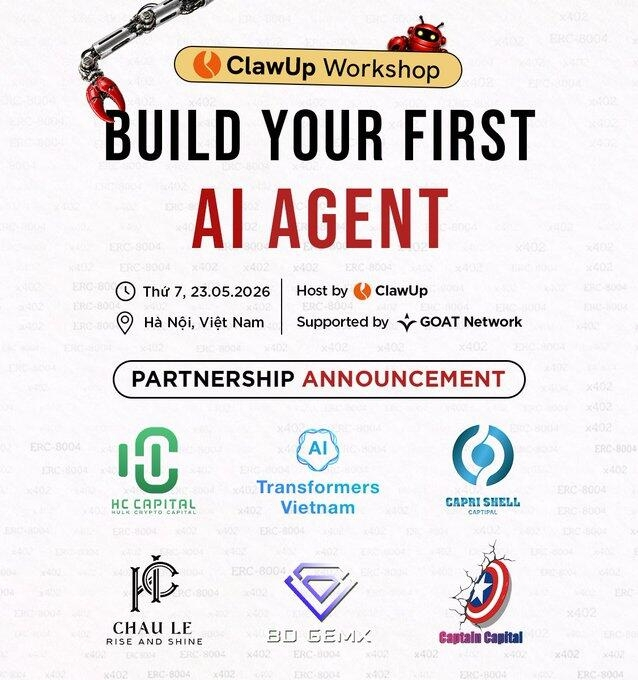
On the ecological implementation front, GOAT Network's global offline activity layout is steady and has yielded impressive results. The project has launched a global tour of workshops and hackathon events; previously in San Francisco, 157 AI Agent on-chain registrations were completed in a single day, and 49 x402 payment integration transactions were executed at the workshop live. The large OpenClaw hackathon attracted 928 developers, and the USDC hackathon received over 200 project submissions in a single season. Recently, offline activities have ramped up, with a ClawUp practical workshop scheduled for May 23, 2026, in Hanoi, Vietnam, aimed at developers, startup founders, marketers, and AI enthusiasts. Participants will be guided by industry experts through practical sessions, allowing them to build operational AI Agents in just three steps, and they can also partake in community raffles to win up to $100 in benefits. Following this, on May 26, the project will participate in Toronto Tech Week in Canada, hosting an OpenClaw campus hackathon where winners will receive Mac Mini devices, internship positions, and entrepreneurial incubation support, all while providing technical guidance and catering on-site, continuously attracting high-quality global developers to join ecosystem construction.
Ecosystem operations and product iterations continue to maintain a high-frequency advancement rhythm. The user journey's second season and second phase have successfully concluded, completing two core activities: the agency task dashboard and the agency results challenge, with the third phase immediately launching ecosystem task gameplay, guiding users to deeply experience core tools and merchant demonstration scenarios such as x402, AgentKit, ERC-8004, and ClawUp through their own AI Agents. Meanwhile, the project has formed a strategic partnership with ormilabs to improve the underlying infrastructure of x402, paving the way for the large-scale adoption of AI Agent payment ecosystems. ClawUpAI has also completed a significant version update for its operating environment, with new Agents deployable in the updated OpenClaw and Hermes operating environments, along with optimized operational documentation, end-to-end testing default rules, and dashboard interaction language, significantly enhancing product usability.
Additionally, the project continuously outputs in-depth industry research and developer support systems. The official publication of industry research data clearly showcases the current landscape of AI Agent applications, which are highly concentrated in software engineering, while other sectors like finance, healthcare, e-commerce, law, logistics, and more, remain in a state of development. This gap in the market provides GOAT ecosystem developers with vast entrepreneurial and implementation opportunities. The official release includes a comprehensive guide for transforming ordinary AI Agents into economically viable AI Agents, outlining six key construction dimensions: autonomous decision-making, security risk control, economic closed loops, and distribution implementation. Simultaneously, the GOAT AI developer funding program is now online, providing quality projects with financial support, technical empowerment, ecosystem traffic connection, and subsequent investment alignment, guiding developers to create AI Agent products with real commercial value and a circular economic closed loop. The official platform has also launched practical teaching demonstrations, guiding developers step by step on how to build AI Agents through ClawUp and connect with AgentKit to unlock various on-chain functionalities, lowering the entry barriers for newcomers.
From a long-term development logic perspective, GOAT Network accurately captures the core pain points of AI Agent commercialization, addressing common industry issues like identity absence, fragmented payments, complex on-chain interactions, and insufficient security. With a foundational security base backed by Bitcoin and the ecological barriers constructed by the x402 and ERC-8004 native protocols, along with the robust development toolchain provided by AgentKit and ClawUp, coupled with global offline activities, strategic partnerships, and developer support programs running in parallel, the ecosystem user base and the number of live applications will continue to grow steadily.
As the project nears completion of its AI ecosystem construction, significant breakthroughs are expected in the native identity system and x402 application scenarios, further unlocking the value release space of the AI Agent economic ecosystem. With a solid technical architecture, impressive implementation data, rapid global ecosystem expansion, and a comprehensive developer incentive mechanism, GOAT Network's growth potential in the AI + blockchain track is fully opened, providing ample space for long-term value appreciation, making it a core asset with substantial allocation value in the AI Agent on-chain ecosystem track.