


Since the event last month when the United States confiscated 127,000 Bitcoins from Chen Zhi, discussions about Bitcoin no longer being secure have become rampant. For a moment, it was hard to tell whether there were really that many fools or if it was just the incompetence of those who missed out.
This case has recently revealed new details, clarifying why Chen Zhi's Bitcoins were stolen.
In technical terms, it is because Bitcoin uses asymmetric encryption technology. The Bitcoin private key is a string of 256-bit binary random numbers, with a theoretical number of attempts to crack it being 2^256 times, which is nearly impossible.

However, if this 256-bit binary private key is not completely randomly generated, for example, if 224 bits follow a specific pattern that can be deduced, and only 32 bits are randomly generated, it would significantly reduce the strength of the private key, requiring only 2^32 (approximately 4.29 billion) attempts to crack it through brute force.
In layman's terms, Chen Zhi's lubian mining pool did not use the most secure 256-bit binary random algorithm, but instead used a 32-bit binary algorithm, which are completely not on the same level of security. Let alone American hackers, even if we let Ju Zuo in, it wouldn't take more than a few hours to run through all combinations—because there are only over 4 billion.
So the question is whether the problem lies with Bitcoin or with his own wallet?
For example, you put money in your wallet, but you didn't zip it up, and someone stole your money.
But once the words about hackers breaking the Bitcoin network and Bitcoin having security vulnerabilities come out, a bunch of people without coins and those chasing traffic immediately have a brain orgasm, starting to take things out of context and spreading them, fearing that the coin circle won’t be chaotic enough.
People like us naturally scoff at such naive questions, but newcomers inevitably get shocked, starting to panic and doubt, which can cause a shock to the industry, and we don't want more people to misunderstand.
So here, Ju Zuo will make a simple and easy-to-understand analogy:
If you believe that Bitcoin being stealable means Bitcoin is no longer secure,
So if the rubles in your pocket are lost, does that mean rubles are also insecure?
You said it's not true, I accidentally lost it; my wallet fell and someone picked it up.
That's not right! This coin was lost, and coins that can be stolen must be insecure, right?
These two things are fundamentally the same logically; if you do not agree that cash being stealable = cash is insecure, then you cannot question that Bitcoin being stealable = Bitcoin is insecure.
Understand? This is called common sense.
Speaking of which, Ju Zuo really can't help but talk about another display of ignorance.
Ju Zuo has seen a bald idiot on video multiple times blabbering about how Bitcoin is insecure and cannot withstand quantum attacks, and the key is that there are really people watching.
Don't you look at how this person looks? How can you listen to what he says?
Come on, today Ju Zuo will tell you again what common sense is.
What Ju Zuo wants to talk about is very simple, everyone knows: cost. This is a very basic economic concept.
After reading this, you will understand why those who say Bitcoin is insecure have absolutely no common sense.
First of all, are there quantum computers now? The answer is yes, whether in China or the United States, quantum computers already exist.
So, are quantum computers commercially available? Obviously not, why? Cost.
Some people will definitely argue that if the state owns quantum computers, it can launch state-level hacking actions, right? They can attack Bitcoin with quantum computers.
Okay, I think what you said makes sense, so let’s get back to the topic: cost.
Second, does building a quantum computer require cost? The answer is certainly yes, and it is a high cost.
Currently, the only countries that can build quantum computers are China, the United States, the United Kingdom, Canada, Finland, and Japan. This is a very high threshold.
So do you think the reason they built quantum computers is to crack Bitcoin?
Do you mean that a sovereign country invests such a large cost just to commit theft? Do you think this would pass within the government?
Do you not need personality, meaning the country doesn’t need national character?
Don’t assume others are as filthy-minded as you because of your own dirty thoughts.
You are a beggar, fantasizing that the emperor should hold a gold bowl while begging?
Is it possible that the emperor can eat without having to beg like you?

Third, even if the cost of quantum computers decreases in the future, allowing certain special groups to use them, I would like to ask, does launching an attack (cracking) require cost?
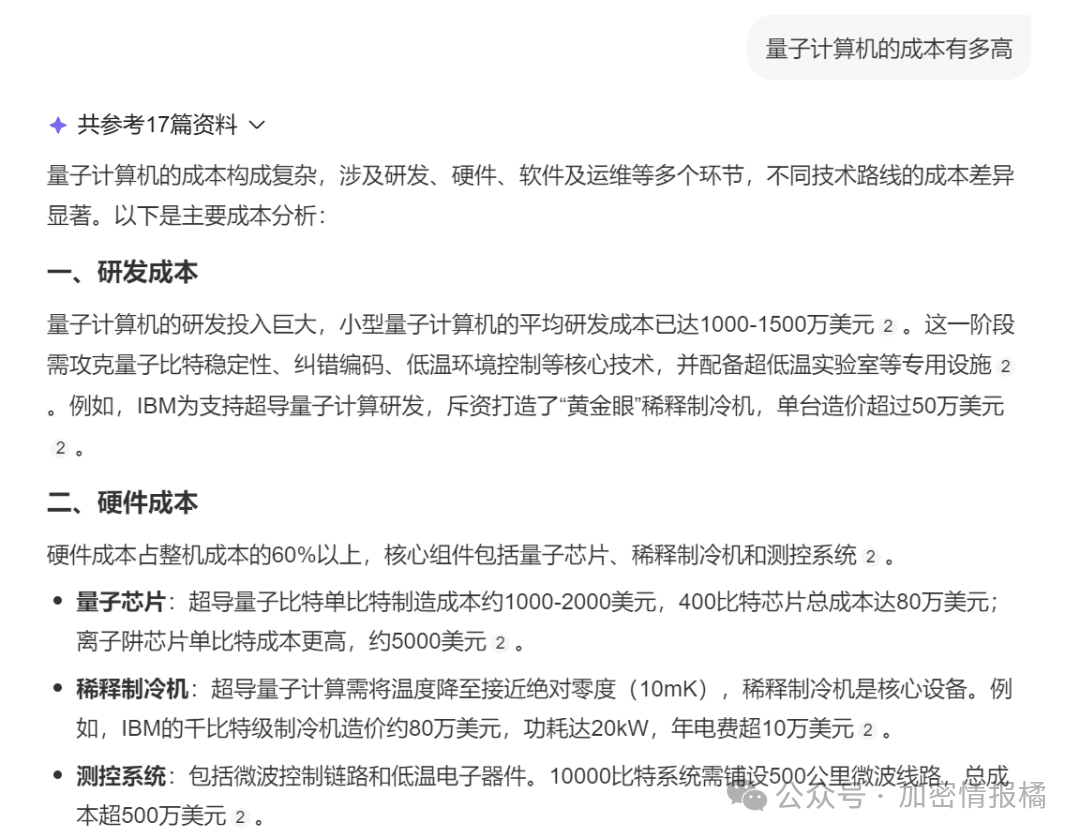
The costs here include time costs, equipment costs, environmental costs, operational costs, and attack costs, among others.
Let’s casually estimate a range value; let's assume each attack costs $300,000.
Do you know what this means?
This means that cracking addresses worth under $30,000 is meaningless—would you engage in a losing business?
And as long as you are an adult with a brain, it’s not hard to think that even if I am a big player, I can simply split my wallet into amounts below the attack cost!
What's wrong? Is your brain dead, and is the hodler's brain also dead?
Why do I say that people who randomly bark online every day have no common sense? Even Ju Zuo feels that answering this question lowers my status. I am afraid this statement would hurt your self-esteem:
How many coins do you have? Is it worth someone going through so much trouble to target you?
Every day without a couple of bucks in your pocket, and you still have to deal with persecution delusions?
Using a six-digit password to protect a five-digit balance every day, and you still care whether Bitcoin is secure?
Do you deserve it?

Alright, the concept of common sense and cost is fully explained today. Normally, Ju Zuo really doesn't want to answer these questions, but recently I have encountered too many idiots, and I can’t take it anymore, so I decided to write an article to respond uniformly.
If there are still people around you who say Bitcoin is insecure, remember to directly throw this article in their face and make them shut up—don’t you even have common sense, barking here?
Why must you expose your IQ?

In conclusion, the coin circle is very unfriendly to newcomers, and there are many pitfalls in the coin circle.
(2025.11.21 article)

