
Financial freedom at 38! Entered the crypto world at 25 and earned eight figures in 10 years! A blood-and-tears warning: 99% of people fail because of their "mindset," not their skills!
"At 25, I rushed into the crypto world with all my savings of 50,000 yuan; at 38, I made enough money to last a lifetime through crypto trading, with assets exceeding 10 million yuan. No team, no insider information, and I've never even worked a day in my life—now I sleep until I naturally wake up every day, walk my dog, drink tea, and look at candlestick charts. Worries? They don't exist."
But if you thought this was a "motivational, feel-good" article, you can scroll past it now.
The truth I'm about to tell might send chills down the spines of 80% of people in the cryptocurrency world.
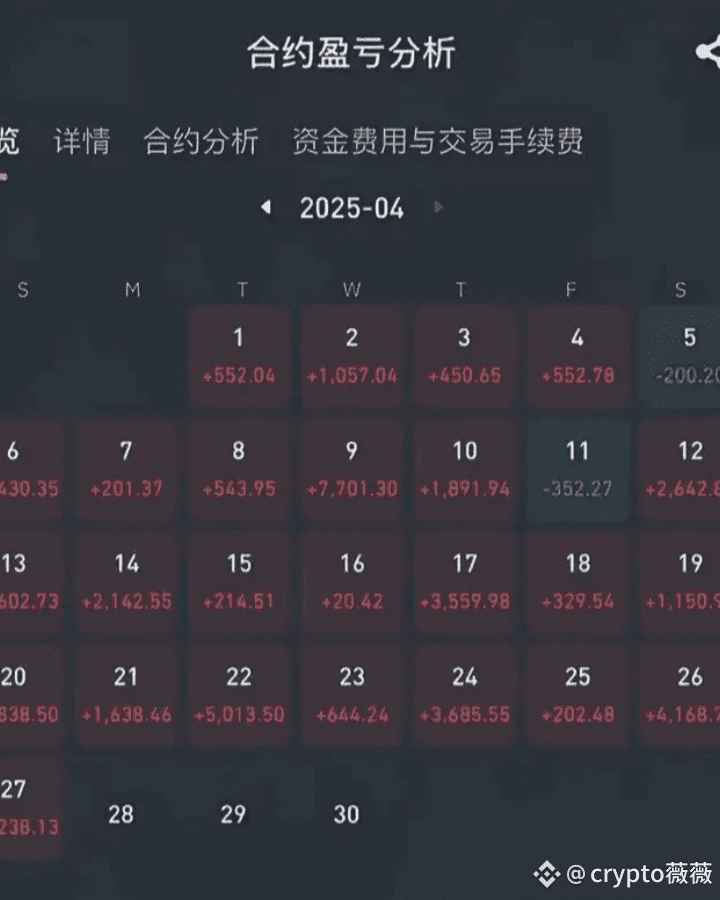
Nine ironclad rules for cryptocurrency trading summarized by a senior trader; remember them well and you'll benefit for life. Shared only once.
1. Regarding returns
Let's say you have 1 million. If you achieve a 100% return, your assets will reach 2 million. If you then lose 50%, then...
This means your assets will return to 1 million. Obviously, losing 50% is much easier than gaining 100%.
II. Regarding price fluctuations
If you have 1 million, and your assets increase by 10% on the first day, reaching 1.1 million, and then decrease by 10% on the second day, your assets will remain at 990,000. Conversely, if your assets decrease by 10% on the first day and increase by 10% on the second day, your assets will still be 990,000.
Third, regarding volatility
If you have 1 million, you will earn 40% in the first year, lose 20% in the second year, earn 40% in the third year, lose 20% in the fourth year, and earn 40% in the fifth year.
The loss was 20% in the sixth year, leaving assets of 1.405 million yuan. The annualized return over six years was only 5.83%, even lower than the coupon rate of 5-year certificate-type treasury bonds.
Fourth, regarding 1% per day
If you have 1 million, and you can earn 1% every day before leaving the market, then after 250 days your assets will reach 12.032 million, and after 500 days your assets will reach 145 million.
Fifth, regarding 200% annually.
If you have 1 million, and you achieve a 200% return for 5 consecutive years, your assets will reach 243 million after 5 years. However, such high returns are difficult to sustain.
Sixth, regarding a 10-fold increase in ten years.
If you have 1 million and hope to reach 10 million in ten years, 100 million in twenty years, and 1 billion in thirty years, then you need to achieve an annualized rate of return of 25.89%.
7. Regarding averaging down
Suppose you bought 10,000 yuan worth of a certain cryptocurrency when it was 10 yuan, and now it has dropped to 5 yuan. If you buy another 10,000 yuan worth of it, then your cost basis will be reduced to 6.67 yuan, not the 7.5 yuan you might expect.
8. Regarding holding costs
If you have 1 million yuan and invest in a certain cryptocurrency with a 10% profit, when you decide to sell, you can keep 100,000 yuan worth of tokens. This will reduce your cost basis to zero, allowing you to hold the cryptocurrency long-term without any pressure. If you are extremely bullish on this cryptocurrency and keep 200,000 yuan worth of tokens, you'll find your profit increases from 10% to 100%. However, don't get too excited, because if the cryptocurrency later drops by 50%, you might still incur a loss.
9. Regarding asset portfolios
There is a risk-free asset A (annual return of 5%) and a risky asset B (return of -20% to 40%). If you have 1 million, you can invest 800,000 in risk-free asset A and 200,000 in risky asset B. Then your worst return for the year is zero, and your best return may be 12%. This is the prototype of CPPI technology+ applied to capital-protected funds.
The methodology I'm going to talk about today is applicable to making money in both the cryptocurrency world and the real world.
Many people who teach how to make money will tell you how to do it. For example, business people will tell you to be an honest person and to be altruistic.
A high-ranking official told you to work diligently and serve the people, saying that's how you achieve your current position.
He'll use himself as an example, saying that he succeeded through this method. If you simply believe it, you definitely won't make money.
They may not even realize that they have all made a mistake of reversing cause and effect.
They are using their own results to make their point. All these things that can be presented and accepted by the majority are just results, not causes.
For example, in a market, everyone operates with integrity, sells good products, and is a good person.
So if you want to get rich, you have to sell counterfeit goods like crazy.
If everyone sells counterfeit goods, then if you want to make big money, you have to give up the huge profits from counterfeit goods and only sell genuine goods.
You can't get rich by doing the same things as most people.
In business, this is called differentiation. If you're pursuing a girl and everyone tells you to be sincere, and your competitors are doing it, then you still won't succeed, no matter how amazing the courses you take or who's mentoring you. At this point, you can rely on boasting and fabricating value, which will greatly increase your chances of winning.
If your competitors are all boastful and extravagant, then you need to be incredibly sincere and different from them; this will greatly increase your chances of winning.
The implicit meaning of "know yourself and know your enemy" is that in order to be different from them.
When others in the crypto world are unwilling to engage in arbitrage, you should aggressively pursue it. That's how you can make a fortune.
When others don't care about inscriptions, you keep grinding for them. That's how you make a fortune.
If everyone rushes to trade bullish stocks and contracts, and you do the same, you're bound to lose everything.
The reason you can get rich by hoarding Bitcoin is that most people don't know how to hoard, but you hoard relentlessly. While most people only hoard for 4 years, you hoard for 10 years or more. That's how you get rich.
If you're a tech enthusiast and are dedicated to studying technical operations in the cryptocurrency world, consider following our WeChat official account (圆圆聚财) to get the latest cryptocurrency news and trading tips!
If you want to make cryptocurrency trading a second job to support your family, then you must study this article carefully, which will save you at least 10 years of detours!
You might be wondering: What exactly is price action trading? Price action trading is a method that uses historical prices (including opening, high, low, and closing prices) to aid trading decisions. Unlike indicators, fundamental analysis, or algorithms, price action trading provides observations of actual market behavior, rather than market expectations based on personal predictions. If you invest time in learning price action trading, you will be able to trade using clearer charts and more accurately determine your entry and exit points.
In this guide, you will learn the following:
(1) The truth about support and resistance is often overlooked by market participants.
(2) The secrets behind market behavior: revealing the true trend of the market.
(3) The secret to interpreting candlestick patterns: How to time your trade entry with extremely high accuracy.
(4) Candlestick pattern cheat table: Understand candlestick patterns without having to memorize any candlestick patterns.
(5) M.A.E Trading Formula (a simple price action trading system that anyone can learn).
2. The Truth About Support and Resistance
(1) Define support and resistance levels
Support level: A horizontal area on the chart where buyers expect to push prices higher; Resistance level: A horizontal area on the chart where sellers expect to push prices lower, as shown in the example below.
EUR/USD daily support and resistance levels
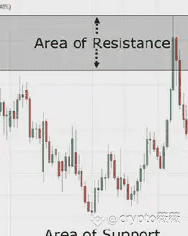
Supports (USD/CAD)
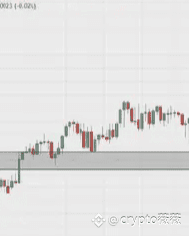
Resistance level (GBP/JPY)
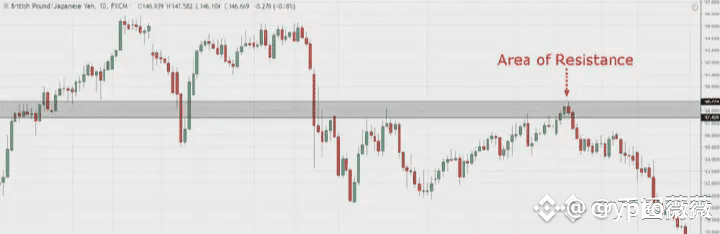
Furthermore, support and resistance levels have a conversion property, which means that when a support level is broken, it may turn into a new resistance level, and similarly, when a resistance level is broken, it may turn into a new support level, as shown in the figure below.
Previous support levels have now become resistance levels (GBP/AUD)
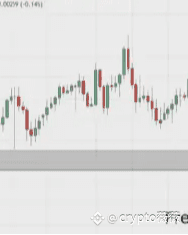
Previous resistance levels have become support levels (New Zealand Dollar/US Dollar)
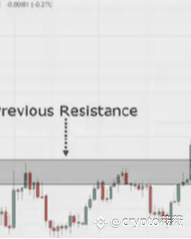
But why does this shift occur? The reason is that when the price breaks through the support level, traders who were initially long will suffer losses and be in a losing position. Therefore, when the price rebounds back to the support level, these traders can now close their positions at the break-even point to reduce their losses, leading to selling pressure. This is only part of the reason; because those traders who missed the breakout opportunity will want to short the market, this further increases selling pressure. This is why when a support level is broken, it often turns into a new resistance level.
At this point, you might ask: How do I plot support and resistance levels on a chart? Here are the guidelines I use:
1) Shrink your chart (I need at least 200 bars).
2) Draw the most obvious level (it may not be an important level if you need to guess again).
3) Adjust the level to obtain the most "contact points" (the actual body part or shadow part of the candlestick chart).
(2) Dynamic support and resistance levels
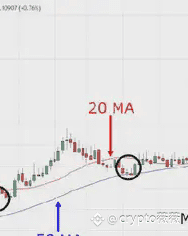
According to classic technical analysis theory, support and resistance levels are depicted as horizontal areas on a chart. This method is generally quite effective when the market is range-bound or in a weak trend. However, this method may be less applicable in strong trending markets, which is why you need to rely on dynamic support and resistance levels in strong trending markets.
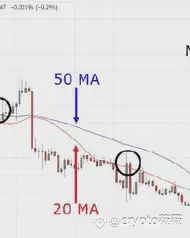
So, what exactly are dynamic support and resistance levels? Dynamic means that these levels change as prices "move," rather than remaining fixed. For example, in a strong trending market, a 20-period moving average can act as dynamic support, as shown in the diagram below.
Alternatively, in a healthy trending market, the 50-period moving average can act as dynamic resistance, as shown in the diagram below.
Expert advice: Dynamic support and resistance levels can also appear in the form of trend lines or trend channels.
3. The secrets behind market behavior: revealing the true trends of the market.
The essence of trading is that the market is constantly changing; it may be in different states such as an upward trend, a downward trend, range-bound trading, low volatility, or high volatility. However, if you can step back and examine the market from a more macro perspective, you will find that the market is often in one of four stages: accumulation, advancement, distribution, or decline.
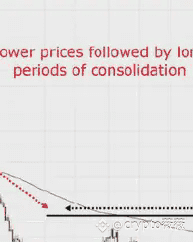
(1) Accumulation stage
The accumulation phase typically occurs after a period of price decline, appearing as a range-bound market within a downtrend. During this phase, the following points should be noted:
1) Prices have been declining for the past five months or longer (within the daily timeframe).
2) The market exhibits a range-bound pattern with distinct support and resistance zones, despite the overall downward trend.
3) The 200-day moving average is flattening out.
4) Prices fluctuate around the 200-day moving average.
The following figure shows a specific example.
(2) Promotion phase
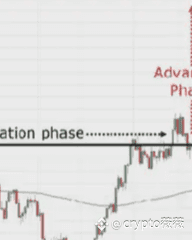
The advancement phase is an upward trend, accompanied by a series of higher highs and lower lows. During this phase, the following points should be noted:
1) This occurs after the price breaks through the resistance level during the accumulation phase.
2) A series of higher highs and lows were observed.
3) The price is above the 200-day moving average.
4) The 200-day moving average has started to rise.
The following figure shows a specific example.
In the field of economics, no market can continue to rise indefinitely. After a period of growth, the market will inevitably show signs of fatigue, which marks the entry of the market into the third stage of its development cycle.
(3) Allocation stage
The distribution phase typically occurs after a period of price increases, and its characteristics resemble a sideways market within an uptrend. During this phase, the following points should be noted:
1) This phase occurs when prices have been rising for at least the past five months or longer (based on daily price changes).
2) The market is showing a sideways consolidation pattern with clear support and resistance levels, while it is still in an overall upward trend.
3) The trend of the 200-day moving average has stabilized, indicating that market momentum has weakened.
4) Prices are fluctuating around the 200-day moving average, indicating increased market uncertainty in the short term.
The following figure shows a specific example.
Under the current market conditions, the market remains in equilibrium, with buyers and sellers having relatively equal power and being on equal footing. However, once the price falls below the established support level, the market trend will reverse, and we will enter the final stage of the market cycle.
(4) Descent phase
The downtrend is characterized by a series of decreasing highs and lows. During this phase, the following points should be noted:
1) The decline phase occurs immediately after the price breaks through the support level during the distribution phase.
2) The market will exhibit a series of gradually decreasing highs and lows, marking a downward trend.
3) Prices will be below the 200-day moving average, indicating that the long-term market trend has weakened.
4) The 200-day moving average will show a downward trend, confirming the overall downward trend of the market.
The following figure shows a specific example.
What is the importance of understanding the four stages of the market? In fact, understanding the current stage of the market allows you to adopt appropriate forex price action strategies or trading strategies. The specific steps are as follows:
1) If the market is in an advancing phase, it is appropriate to take a buyer's position (rather than a seller's position). In this case, you should look for buying opportunities when prices break out or pull back.
2) If the market is in a distribution phase, you should be aware that once the price breaks below the support level, the market may face significant downside risk. In this case, you can consider shorting when the support level is broken, or waiting for the price to pull back after the breakout before selling.
Once you have a deep understanding of the four phases of the market, you will be able to choose the appropriate price action trading strategy for different market conditions, thus avoiding getting lost in trading.
4. The Secret to Deciphering Candlestick Patterns: How to Time Your Trading Entry with Extreme Precision
At this point, you have grasped the overall concept of price action trading. You know where to place trades (near support and resistance levels) and the appropriate strategies to adopt under different market conditions (i.e., the four stages of market development). However, a crucial piece of the puzzle remains incomplete in the trading decision-making process: determining the specific trading opportunity. In this context, candlestick chart patterns become particularly important, providing a technical analysis tool for selecting trading opportunities.
What is the candlestick chart pattern, and how does it work?
A candlestick chart pattern contains four basic data points, which represent the following information:
(1) Opening price: refers to the first trading price at the start of a specific time period.
(2) Highest price: refers to the highest transaction price reached within a fixed time period.
(3) Lowest price: refers to the lowest transaction price reached within a fixed time period.
(4) Closing price: refers to the last trading price at the end of a specific time period.
In candlestick chart analysis, for bullish candles, the opening price is always lower than the closing price, while for bearish candles, the opening price is always higher than the closing price. Next, you will delve into a series of powerful candlestick chart patterns that will help you plan your entry points more accurately: (1) Hammer; (2) Bullish Engulfing Pattern; (3) Shooting Star; (4) Bearish Engulfing Pattern.
(1) Hammerhead shape

The hammer candlestick pattern is a bullish reversal pattern formed on a single candle after a downtrend. Here are its identifying characteristics:
1) This pattern almost does not contain an upper shadow.
2) The closing price is in the top quarter of the price range for that trading day.
3) The length of the lower shadow is approximately two to three times the length of the body (the candle's body).
The market significance of the hammer candlestick pattern is as follows:
1) When the market opens, sellers dominate, thus driving prices down.
2) When selling pressure reaches its peak, strong buying intervention pushes prices up.
3) The buying power was strong enough that the closing price was higher than the opening price.
In short, the hammer candlestick pattern is a bullish reversal candlestick pattern that indicates market rejection of lower price levels. However, simply observing a hammer candlestick does not mean that the market trend will immediately reverse. To increase the probability of successful trading, additional "confirmation signals" are needed, which will be explained in detail later.
(2) Bullish engulfing pattern

A bullish engulfing pattern is a bullish reversal candlestick pattern consisting of two candles that forms after a downtrend. The following are its identification criteria:
1) The closing price of the first candle shows a bearish trend.
2) The body of the second candle completely "devours" the body of the first candle (excluding the shadows).
3) The second candle closed bullish.
The market implications of a bullish engulfing pattern are as follows:
1) During the first candle, sellers dominate, causing the price to close below the opening price.
2) During the second candle, strong buying pressure intervened and caused the closing price to be above the high of the previous candle—indicating that the buyers had won the price battle.
3) Fundamentally, the bullish engulfing pattern conveys the message that the buyers have overtaken the sellers and gained control of the market.
Furthermore, due to the different ways candlestick patterns form in different timeframes, the hammer candlestick can usually be regarded as a bullish engulfing pattern formed in a shorter timeframe, as shown in the figure below.
(3) Meteor morphology

The Shooting Star pattern is a bearish reversal pattern formed by a single candlestick after a price increase (it's worth noting that the Shooting Star pattern is the opposite of the Hammer pattern on the chart). The following are the identifying characteristics of the Shooting Star pattern:
1) This pattern almost never contains a lower shadow.
2) The closing price is in the bottom quarter of the price range for that trading day.
3) The length of the upper shadow is approximately two to three times the length of the body (the body of the candle).
The market significance of the meteor pattern is as follows:
1) When the market opens, buyers dominate, which drives prices up.
2) When buying pressure reaches its peak, strong selling pressure will drive down the price.
3) The selling pressure was strong enough that the closing price was lower than the opening price.
In short, the shooting star pattern is a bearish reversal candlestick pattern that indicates the market is rejecting higher price levels.
(4) Bearish engulfing pattern

A bearish engulfing pattern is a two-candle bearish reversal candlestick pattern that forms after a price increase. Here are the identification criteria:
1) The closing price of the first candle shows an upward trend.
2) The body of the second candle completely "devours" the body of the first candle (excluding the shadows).
3) The second candle closed in a bearish manner.
The market interpretation of the bearish engulfing pattern is as follows:
1) During the first candle, the buyer gained control of the market, causing the price to close higher than the opening price.
2) During the second candle, strong selling pressure intervened, causing the closing price to be below the low of the previous candle, indicating that the sellers had won the price battle.
Essentially, a bearish engulfing pattern conveys the message that sellers have overtaken buyers and gained market dominance.
5. Candlestick Pattern Cheating Table: How to understand any candlestick pattern without memorizing any candlestick charts.
(1) Trend
You might be wondering: What is a trend? A trend represents the "longer" or main phase of a market trend. If the candlestick is long (in an uptrend), it indicates strong market momentum because buyers have control of the market. Conversely, if the candlestick is short, it suggests that buying power is insufficient because buyers may have exhausted their momentum. The following chart shows an example of a trend movement.
(2) Pullback trend
Pullbacks constitute a "shorter" or secondary phase in a market trend. A longer candlestick indicates increasing counter-trend pressure; conversely, a shorter candlestick suggests a healthy pullback, and the original trend may resume on its own. The following diagram illustrates an example of a pullback.
3) Swing point
Swing points refer to the highs and lows in price fluctuations, that is, the "points" on the chart where prices clearly reverse, as shown in the figure below as a specific example.
This is crucial because it helps determine whether the market is in an uptrend, downtrend, or consolidation phase. As a fundamental guiding principle:
1) If the swing highs or lows show an upward trend, the market is in an upward trend.
2) If the swing highs or lows show a downward trend, then the market is in a downtrend.
3) If the swing highs or lows do not show an upward or downward trend, the market is in a sideways consolidation phase.
Next, to understand any candlestick pattern, you need to grasp two key elements: (1) How does the price position relative to the closing price of the trading range? (2) How does the size of this candlestick pattern compare to other candlestick patterns?
(1) How does the price position relative to the closing price of the trading range?
This element can reveal the forces that are temporarily in control of the market, as shown in the candlestick chart pattern below.
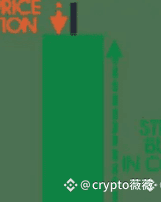
So, who currently controls the market? Observing that the price closed near the high of this trading range indicates that buyers currently hold the initiative in the market. Now, please observe this candlestick chart pattern, as shown in the image below.
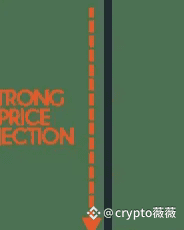
Who is dominating the market? Despite the appearance of bullish candlesticks, sellers may actually be in control because the price closed near the low of the trading range, indicating market resistance to higher price levels. Therefore, if you want to understand the dominant forces in the market, ask yourself: Where is the price closing relative to the trading range?
(2) How does the size of this candlestick pattern compare to other candlestick shapes?
This question aims to reveal whether there is significant momentum (or conviction) behind the current market movement. All you need to do is compare the size of the current candlestick with the size of the previous candlestick. If the current candlestick is significantly larger (e.g., twice or more than the previous one), this indicates that there is strong force behind the market movement, as shown in the image below as a specific example.
If there is a lack of significant underlying forces in the current market trend, the size of the current candle will be roughly the same as the size of the previous candle, as shown in the figure below.
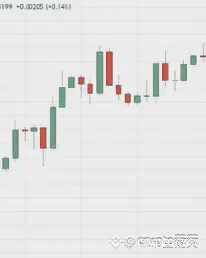
Today, you have the ability to interpret any candlestick pattern directly without having to memorize specific candlestick patterns.
6. MAE trading formula or price action for forex trading
Now you have mastered the core elements of price action trading (including support and resistance levels, market structure, and candlestick patterns). Next, we will use this knowledge to identify high-probability trading opportunities, those trading setups that are both consistent and profitable. Here, I will introduce you to the MAE trading formula, a proprietary trading technique I developed to help traders quickly achieve trading results. The formula works as follows: (1) Market structure analysis; (2) Value zone identification; (3) Determination of entry trigger conditions.
(1) Market structure analysis
When faced with a blank chart, beginners often feel lost because they are unsure of what to do next: should they buy, sell, or remain on the sidelines? This is precisely why the first step is to establish the market structure, as it guides your trading decisions.
Therefore, you should ask yourself the following questions: Is the market currently in an uptrend, a downtrend, or a sideways consolidation phase? (In other words, identify the current stage of the market's development.) Once the market structure is clear, you will know to follow the path of least resistance. For example, if the market is in an uptrend, you should focus on finding buying opportunities; if the market is in a downtrend, your focus should shift to selling opportunities; if the market is fluctuating within a range, you can choose to buy or sell depending on the situation.
(2) Value area identification
Simply identifying the market structure is insufficient for making a complete trading decision, as you also need to pinpoint the specific entry point. You might wonder: the market offers multiple potential entry points, how should I choose? The answer is that you should choose to trade from a valuable market area to achieve your goal of buying low and selling high. For example, the following areas can serve as reference points for trading: support and resistance levels, widely accepted moving averages, and trend lines.
(3) Determination of market entry trigger conditions
At this point, you have grasped two key elements of trading decisions: first, determining the market structure, and second, identifying suitable entry points (value zones). The final part of the trading equation is determining the specific entry timing. I personally prefer to trade when the market displays reversal signals, which validate my market predictions. These reversal signals may appear in the form of price reversal patterns, such as hammer patterns, shooting star patterns, bullish engulfing patterns, and bearish engulfing patterns. Next, I will share some examples of how the M.A.E. formula is applied in actual trading.
1) Example 1
GBP/USD Daily: Determining Market Structure
GBP/USD Daily Chart: Awaiting Price Reaching Value Zone
GBP/USD Daily: Enter on a valid entry trigger
2) Example 2
T-Bond 4 Hours: Identifying Market Structure
T-Bond 4 Hours: Waiting for the price to approach the value zone
T-Bond 4 Hours: Enter on a valid entry trigger.
Seven golden rules for cryptocurrency trading!
1. If a strong coin falls from its high level for nine consecutive days, be sure to follow up promptly.
2. If any cryptocurrency rises for two consecutive days, be sure to reduce your holdings promptly.
3. If any cryptocurrency rises by more than 7%, there is still a chance for it to rise further the next day. It is advisable to continue to observe.
4. For strong, high-performing cryptocurrencies, be sure to wait until the pullback is over before entering the market.
5. If any cryptocurrency shows little fluctuation for three consecutive days, observe for another three days. If there is no change, consider switching to another cryptocurrency.
6. If you fail to recoup your previous day's cost price by the next day, you should exit the market immediately.
7. If there are three on the gainers list, there will be five; if there are five, there will be seven. For cryptocurrencies that have risen for two consecutive days, buy on dips; the fifth day is usually a good selling point.
In the crypto world, it all boils down to a battle between retail investors and market makers. If you lack cutting-edge information and firsthand data, you're guaranteed to get fleeced! If you're interested in strategic planning and profiting from market manipulation together, feel free to contact me. I welcome like-minded crypto enthusiasts to discuss this together!
There's a saying I wholeheartedly agree with: the boundaries of knowledge determine the boundaries of wealth; a person can only earn wealth within the boundaries of their knowledge.
A good mindset is crucial for cryptocurrency trading. Don't let your blood pressure spike during market crashes, and don't get carried away during surges. Prioritize securing profits. For those without abundant resources, a steady and pragmatic approach is the unwavering way to survive.
The market is never short of opportunities; the question is whether you can seize them. By associating with experienced and suitable people, we can earn more! There are still spots available in the team, join quickly!
SUI TURMP BONK PEPE OM SOL PNUT NEIRO
#币安HODLer空投AT #加密市场反弹 #美SEC推动加密创新监管