
Introduction
The financial world is undergoing one of the biggest transformations in decades — and it’s happening on the blockchain.
Decentralized Finance, commonly known as DeFi, is reshaping how people borrow, lend, trade, earn interest, and move money across the world.
Unlike traditional banks that control financial systems, DeFi uses blockchain and smart contracts to provide open, fast, transparent, and permissionless financial services.
Whether you’re a crypto investor, a developer, or simply curious about the future of money — understanding DeFi is essential.
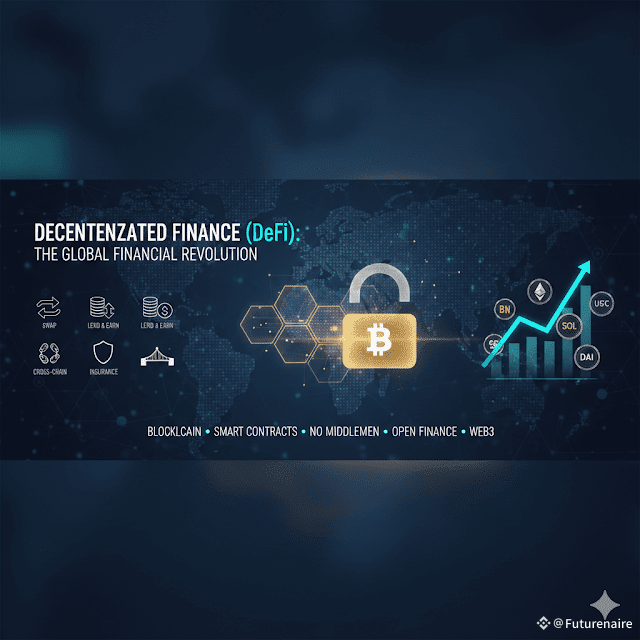
Disclaimer: AI- generated images used for visual purposes
What Is DeFi?
DeFi (Decentralized Finance) refers to financial services that run on blockchains, without banks, brokers, or centralized institutions.
Instead of relying on human intermediaries, DeFi uses smart contracts to execute transactions automatically.
In simple words:
🔹 DeFi = Finance without middlemen
🔹 You control your assets, not a bank
🔹 Transactions are open, transparent, and global
How DeFi Works
DeFi is powered by three main components:
1. Blockchain Networks
Ethereum was the first major DeFi chain, but now others like BNB Chain, Solana, Avalanche, and Polygon are widely used.
2. Smart Contracts
These are self-executing digital agreements that run automatically once conditions are met.
No approval, no paperwork, no delays.
3. Crypto Assets & Tokens
Users interact with DeFi apps using tokens like ETH, BNB, SOL, or stablecoins like USDT and USDC.
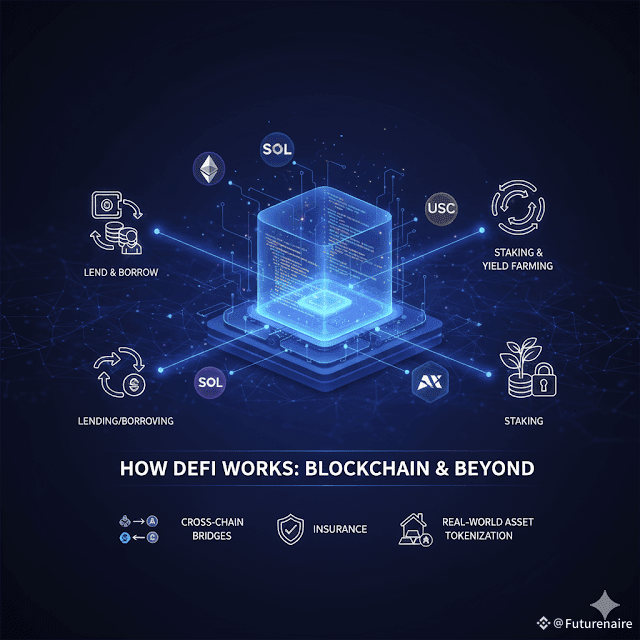
Disclaimer: AI- generated images used for visual purposes
Key Features of DeFi
Here’s what makes DeFi different from traditional banking:
✔ Decentralization
No central authority controls your money.
✔ Transparency
All transactions are visible on the blockchain.
✔ Permissionless Access
Anyone with a crypto wallet can use DeFi.
✔ Self-Custody
You own your private keys — and your assets.
✔ 24/7 Global Access
DeFi never closes. No weekends. No holidays.
✔ Borderless
Send money across countries in seconds.
Benefits of DeFi
DeFi is growing rapidly because it solves real problems:
1. Financial Inclusion
Anyone with internet can participate — even without a bank account.
2. Higher Earnings
DeFi yields often outperform traditional savings accounts.
3. No Middlemen
Lower fees, faster settlements, and more control.
4. Fast Innovation
Open-source development creates new financial tools at lightning speed.
Top Use Cases of DeFi
1. Decentralized Exchanges (DEXs)
Platforms like Uniswap, SushiSwap, and PancakeSwap allow users to:
Swap tokens instantly
Provide liquidity and earn fees
Trade without registration or KYC
Everything happens through smart contracts — no centralized authority.
2. Lending & Borrowing Platforms
Examples: Aave, Compound, Venus
You can:
Lend your crypto and earn interest
Borrow instantly by providing collateral
Avoid bank approvals and credit checks
The process is automated and transparent.
3. Staking & Yield Farming
Users can lock their tokens to:
Secure the network (staking)
Provide liquidity and earn rewards (yield farming)
These rewards can be passive and substantial, depending on market conditions.
4. Stablecoins in DeFi
Stablecoins like USDT, USDC, DAI, and FDUSD play a major role by offering:
Price stability
Easy trading
Reliable collateral for loans
Without stablecoins, DeFi would be far more volatile.
5. Decentralized Derivatives & Synthetic Assets
Platforms like Synthetix and dYdX let users trade:
Tokenized stocks
Synthetic commodities
Perpetual futures
This opens global access to markets traditionally controlled by institutions.
6. DeFi Insurance
Since DeFi can be risky, insurance platforms like Nexus Mutual help protect users from:
Smart contract hacks
Exchange failures
Protocol vulnerabilities
7. Cross-Chain Bridges
Bridges allow users to move assets across different blockchains.
Examples:
Wormhole
LayerZero
Multichain
Without bridges, DeFi would remain isolated on separate blockchains.
Risks and Challenges of DeFi
DeFi is powerful — but not perfect. Key risks include:
⚠ Smart Contract Bugs
A coding error can lead to millions lost.
⚠ Rug Pulls & Scams
Fraudulent teams can drain liquidity pools and disappear.
⚠ Impermanent Loss
Liquidity providers may lose value due to price changes.
⚠ Liquidation Risks
Borrowers can lose collateral if market prices drop suddenly.
⚠ Regulatory Uncertainty
Governments worldwide are still developing DeFi regulations.
The Future of DeFi
The future looks promising as more innovations emerge:
⭐ Tokenization of Real-World Assets
(Real estate, stocks, debt, invoices, gold — all coming on-chain)
⭐ Institutional Adoption
Banks and large companies are entering DeFi.
⭐ AI + DeFi Integrations
Autonomous trading bots, smart risk management, AI-powered yield strategies.
⭐ Faster & Cheaper Blockchains
Layer-2 networks like Arbitrum, Base, and Optimism are making DeFi scalable.
DeFi is not a trend — it's a global financial revolution.
Conclusion
DeFi is redefining the very foundation of finance.
From lending and borrowing to trading and earning — everything is faster, open, and powered by blockchain.
Whether you're a beginner or advanced crypto user, DeFi offers:
✔ more control
✔ more transparency
✔ more opportunities
The financial future is decentralized — and DeFi is leading the way.


