
In 2025, a significant event is happening that deserves the attention of all cryptocurrency participants:
ICOs are making a strong comeback from silence and have the opportunity to replace airdrops as the source of the next wave of massive wealth opportunities.
This is not nostalgia, nor is it a historical replay.
This is a systemic turning point driven by multiple factors, including changes in funding structure, participant structure, on-chain behavior, and an imbalance in market incentive culture.
This time, the ways ordinary people participate, the potential returns, and the opportunity windows will be completely different from those in 2017.
⸻
01 The retreat of airdrops and the return of ICOs: changes in funding structure are reshaping the market
Over the past three years, the market has formed an extremely distorted model:
• VCs buy in at extremely low FDV
• Project parties list with extremely low circulation
• Retail investors take over at high FDV
Data shows that the average FDV of projects listed from 2022 to 2024 is 6-15 times higher than VC round FDV, while the circulation available to retail investors on listing day is on average less than 3%.
This means that the vast majority of profit margins are locked by early insiders.
At the same time, airdrops are rapidly evolving into a
"Free chips → Immediate sell-off → High FDV → No sustainable users" death cycle.
According to Token Terminal's statistics at the end of 2024:
• Over 82% of light users will sell airdrops within 7 days
• The average drop in airdrop projects over 60 days exceeds 43%
• The actual retention rate of projects is less than 15%
Airdrops essentially become 'decentralized equity dilution', but not 'user binding'.
This directly gives rise to the core contradiction of 2024-2025:
VC wants long-term returns
Retail investors need fair entry
Project parties need real users
The incentives for the three parties have been completely torn apart.
The return of ICO is the inevitable result of fixing this gap.
⸻
02 Why has ICO become the market consensus again?
Unlike 2017, this time the return of ICO is structurally driven, not emotionally driven.
(1) Improved participant quality: growth in both numbers and professionalism
The scale of crypto users grew from about 85 million in 2018 to over 360 million in 2025 (CAGR ≈ 18.1%).
More importantly:
• Increased DEX usage
• Explosion in on-chain operations
• More mature average user holding structures
Users have transformed from 'gamblers' to 'behavioral investors'.
⸻
(2) Surge in stablecoin supply providing available liquidity for ICOs
In 2021, the stablecoin supply was about $160 billion
and by 2025 it exceeds $320 billion (doubled)
This means:
• Users have more funds 'available for investment at any time'
• ICO can gain natural buying power
• Primary market liquidity is much stronger than in the past
⸻
(3) Migration after retail investors' fatigue with memecoins
In 2024, the market value of memecoins surged more than 540%,
but starting Q1 2025:
• Funds shift from MEME to primary issuances
• Liquidity mining declines
• Airdrop returns drop sharply (average APY decreases from 120% to 18%)
Funds are looking for new 'bridge assets'.
ICO just happens to fill that role.
⸻
(4) Clearer regulatory environment
The US, Hong Kong, Singapore, and the UAE have made it clear for 2024-2025:
• Public token sales require transparent KYC
• Token economic models must be disclosed
• Prohibit VCs from underestimating valuations in 'dark trading'
ICO is moving from 'chaos' to 'compliance'.
This gives real projects a chance to stand out through ICO.
⸻
03 How is ICO more 'interest-binding' than airdrops?
The defects of airdrops have been fully exposed:
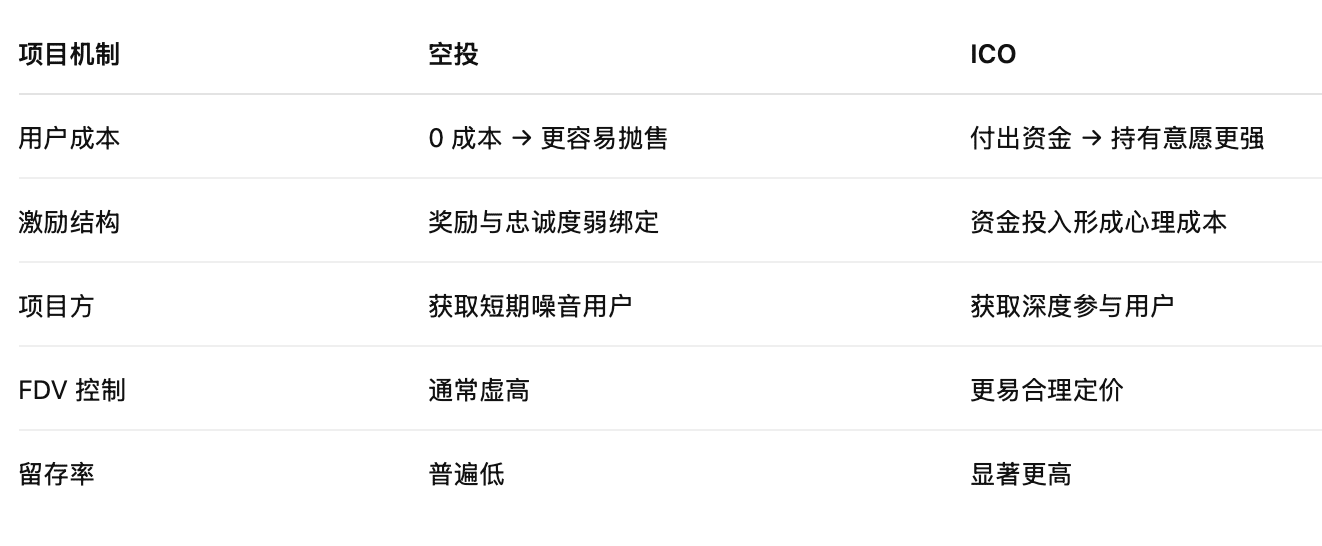
On-chain data shows:
• The user retention rate after paying to participate in ICOs for 30 days is 3.4 times that of airdrop users
• The average holding time of ICO users for 60 days is 4.1 times that of airdrop users
ICO is not just a financing method; it is a community screening mechanism.
⸻
04 Three forces driving the ICO craze of 2025
1) Exchange-driven: Coinbase's $375 million acquisition of Echo
Coinbase's goals have become very clear:
Making ICOs compliant
Allowing everyone to initiate fundraising
Let retail investors participate at the same valuation as VCs for the first time
The data from the public offering round of its first project Monad has proven:
• The number of participating users is 2.7 times that of ordinary airdrop users
• The funding scale is 4 times the value of airdrop rewards during the same period
⸻
2) Mature on-chain fundraising tools
• Echo (Coinbase series)
• MetaDAO (Kaito)
• Sonar (instant launch platform)
These platforms allow project parties to complete issuance faster, more transparently, and at lower costs.
⸻
3) The rebound after the crash of high FDV models
In 2024, a large number of high FDV projects listed and plummeted:
• Average drop in 60 days: –46%
• More than 70% of projects with FDV >10B broke
The market is already tired of venture capital enjoying the dividends.
ICO is precisely the market tool to restore 'fairness'.
⸻
05 How can retail investors position themselves in the new ICO cycle? (Key point)
If ICO becomes the mainstream financing method, participants need three core abilities:
⸻
1) Build on-chain reputation
Future ICO discounts, whitelists, and quotas
are likely to be determined by on-chain behavior rather than a task system.
The logic of making money becomes:
"The more genuine and long-term your on-chain behavior, the lower the price you can obtain."
Constructible behaviors include:
• Long-term use of a particular chain
• Providing liquidity
• Paying for use in non-airdrop protocols
• Donations to public goods (like Gitcoin)
• Long-term unified use of the main address
Such behaviors have already been recorded by many platforms.
In the future, this may directly determine:
• ICO discounts
• Allocation quotas
• Priority purchase rights
⸻
2) Deploy assets across multiple chains and participate in early ecosystems
For example:
• Monad
• Berachain
• Solana SVM ecosystem
• Bitcoin L2
• Fuel
• Celestia Rollup ecosystem
These are all key areas for compliant ICOs in the future.
⸻
3) Use capital management tools to expand layout efficiency
Such as:
• INFINIT
• Giza
• Catapult
• Omni cross-chain fund management tools
Used to maintain on-chain presence across multiple ecosystems simultaneously.
⸻
06 Three major challenges that ICO still needs to solve
ICO is not perfect; it still faces:
1) Improper design of token economic models → Risk of market crash remains
If FDV is unreasonable, ICO will also fail.
2) There are still gray areas in legal regulation
Especially in high-capital areas like the US, South Korea, and Japan.
3) The market may face the risk of 'over-ICO' saturation
If everyone can issue coins every day, enthusiasm will be diluted.
⸻
07 Conclusion: ICO will not replace airdrops, but will rebuild the incentive order of crypto
The ICO craze of 2025 is not a replica of 2017.
It is a reset of the incentive culture driven by changes in market structure.
The past airdrop culture has come to an end:
"Free chips → Immediate sell-off → No value users"
The return of ICOs has brought the market back:
• Fairer participation
• Clearer incentives
• More reasonable valuations
• Longer holding periods
This will be the infrastructure for the next round of crypto wealth.
The real opportunity does not lie in 'whether there is an ICO',
but in whether you have built on-chain reputation in advance and can obtain the cheapest chips.


