Many just watch the candlestick chart.
But serious capital looks at the structure, liquidity, and verifiability.
The tokenization of real-world assets (RWA) is gaining traction because it connects two worlds: the efficiency of blockchain and the value of traditional assets like bonds, credit, or real estate.
The question isn't whether the narrative sounds good. The question is: how robust is the infrastructure that supports it?
"True disruption doesn't happen when money enters the ecosystem, but when real assets gain the liquidity and transparency that only decentralized technology can provide."
— Elise_Crypto
The technical foundation
RWA projects like ONDO, CFG, or $OM stem from a powerful idea: to represent real-world assets on the blockchain, from Treasury bonds to credit instruments.
But here’s the difference between a serious project and just a narrative:
the value isn’t in the ticker, but in the architecture.
What really matters:
Proof of reserves or asset verifiability
Custody model
Regulatory compliance
Secondary liquidity
Redemption mechanism
Issuer transparency
If you can't verify what backs the asset, how it’s custodied, and under what legal framework it operates, then you're not looking at infrastructure: you're looking at marketing.
Metrics that don’t lie
When analyzing this sector, the market usually focuses on price and market cap.
But in RWA, the most useful metrics are different:
Actual TVL
Volume linked to underlying assets
Sustainable growth of users or institutions
Quality of liquidity
Redemption and settlement capacity
In other words:
not all TVL is created equal, and not all liquidity is equally reliable.
The reality of risk
The RWA narrative is powerful, but it’s not without friction.
1. Custody risk
Even if the blockchain works perfectly, the underlying asset still depends on custodians, issuers, legal structures, and third parties.
2. Regulatory risk
Here, decentralization isn’t enough.
Projects aiming to scale in RWA need to coexist with KYC, AML, licensing, and jurisdictional frameworks.
3. Liquidity risk
Even a 'stable' tokenized asset can suffer if the market goes into stress and secondary liquidity dries up.
4. Execution risk
Tokenizing an asset doesn’t guarantee adoption.
Without real demand, institutional integration, and clear issuance/redemption processes, the token may exist... but without economic depth.
4. Cases the market is watching
$ONDO
It has positioned itself as one of the most visible names in the RWA narrative, especially due to its exposure to products linked to U.S. Treasury bonds.
Its proposal stands out for focusing on relatively low-risk assets and a structure aimed at attracting more conservative capital.
$OM (MANTRA)
It has built its narrative around regulatory compliance and infrastructure prepared for tokenized assets.
The thesis here is clear: the future of RWA will likely not belong solely to fast chains, but to networks capable of integrating with legal and institutional demands.
$CFG (Centrifuge)
It’s one of the historical references in the sector, focusing on bringing private credit and real financial assets to on-chain environments.
Its relevance doesn’t come from media noise, but from having worked for years on one of the ecosystem’s toughest problems: connecting real financing with DeFi.
5. Conclusion
RWA could be one of the most important narratives of the next cycle.
But it could also become a mirage if the market confuses tokenization with structural soundness.
The opportunity isn’t in buying any token labeled 'RWA.'
The opportunity lies in identifying which projects have:
Verifiable assets,
Clear legal framework,
Functional liquidity,
and real demand.
Because in this sector, the difference between reality and mirage isn’t defined by price: it’s defined by infrastructure.
#RWAS #Blockchain #EliseCrypto #InversionInteligente #Web3 #FinanzasDescentralizadas 🌐📈🛡️

Article
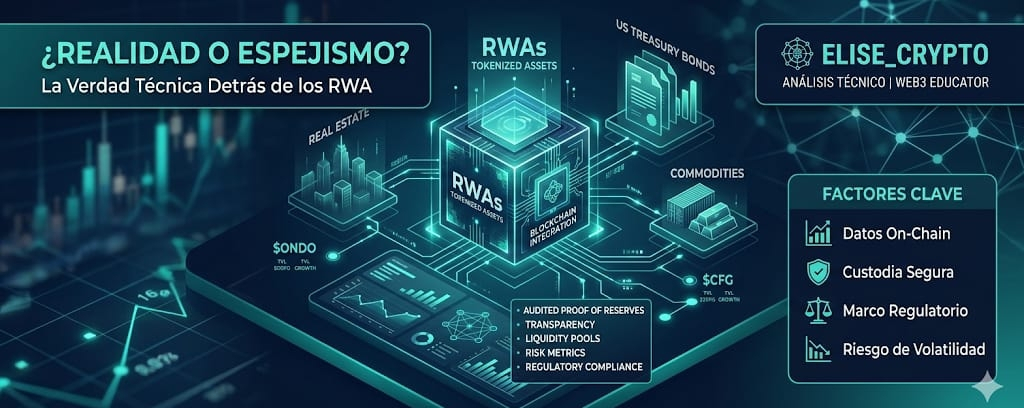
Reality or Mirage? The technical truth behind RWA assets
Disclaimer: Includes third-party opinions. No advice. Binance AI may be used without guarantee. See T&Cs.