
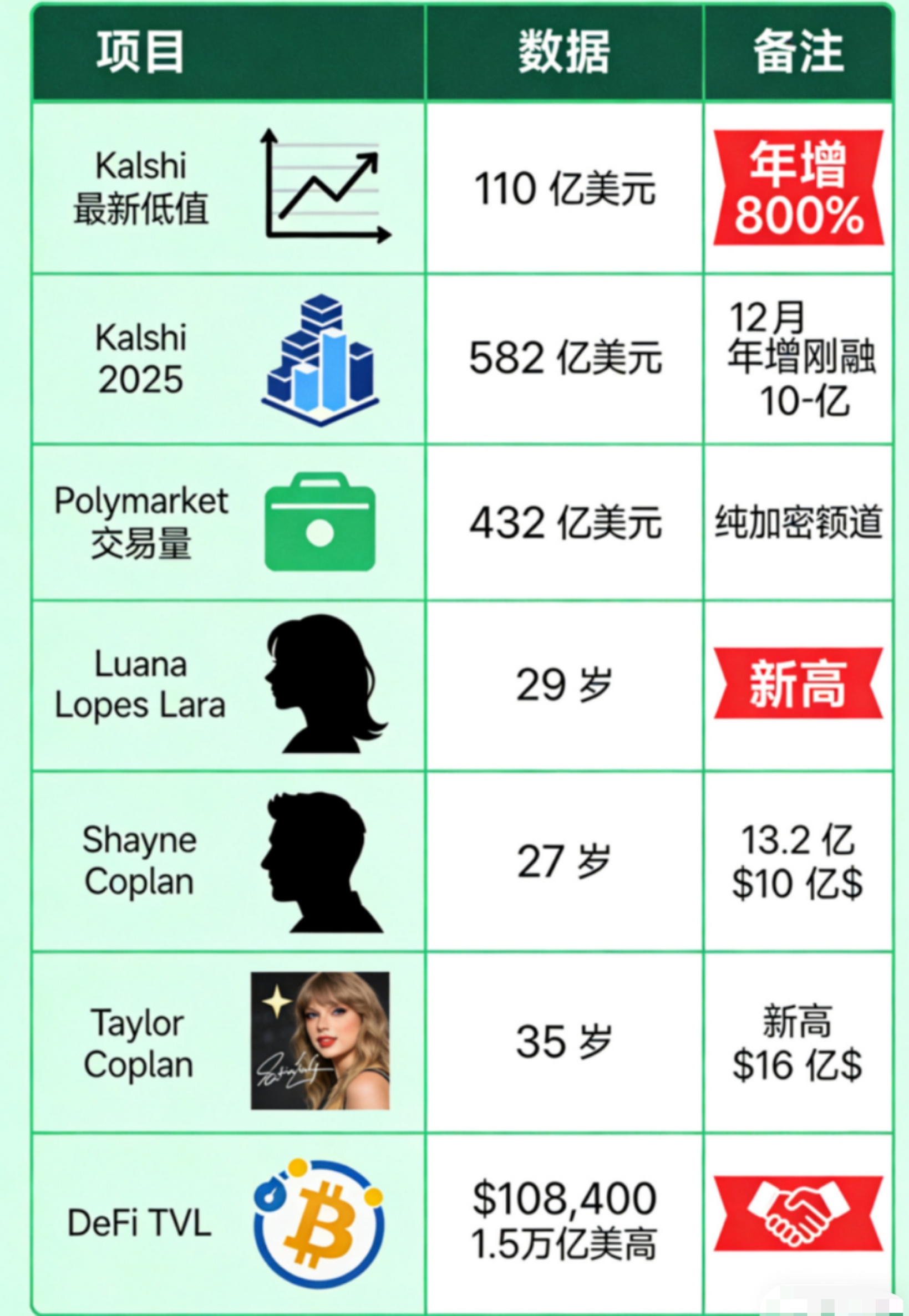
In the technological wave of 2025, prediction markets are rising at an astonishing speed, becoming the fastest field for valuation surges and wealth creation after artificial intelligence (AI). These platforms allow users to trade contracts by 'betting' on future events (such as election results, sports events, or economic indicators), reshaping fundraising tools and becoming 'real-time oracles' for media and investors. According to Dune Analytics, the weekly trading volume of the world's top five prediction platforms has exceeded billions of dollars, with star companies like Kalshi seeing their valuations soar from $200 million at the beginning of the year to $11 billion—an increase of more than five times.
1. Kalshi's marriage with CNN: Endorsement from mainstream media ignites market enthusiasm.
Traditional media giant CNN has officially integrated Kalshi's predictive data, marking the transition of prediction markets from the crypto circle to mainstream visibility. Through API real-time integration, CNN embeds Kalshi's probability data into television, digital, and social platforms, including:
1. Real-time data ticker: Displays instant odds for event contracts, such as 'Probability of Democrats controlling Congress: 72%'.
2. Content coverage: Politics (election win rates), news (economic recession probabilities), culture (Oscar award predictions), and weather (hurricane paths).
3. Chief analyst Harry Enten leads: He will enhance data-driven reporting using Kalshi data, for example, combining polls with market odds to predict the trends of the 2026 midterm elections.
This collaboration is free of charge (CNN obtains data for free), but Kalshi has exclusive exposure rights, preventing competitors like Polymarket from intervening. It enhances Kalshi's user stickiness (nominal trading volume reached $5.8 billion in November, an 8-fold year-on-year increase) and verifies the accuracy of prediction markets—research shows that its predictions often outperform traditional polls. Coincidentally, Kalshi's strategic advisor includes Trump Jr., which adds to the topicality during politically sensitive times.
2. Female founder Lopes Lara: From ballet dancer to billionaire at 29, breaking Taylor Swift's record.
Kalshi's co-founder Luana Lopes Lara (29 years old, COO) recently surpassed singer Taylor Swift (35 years old, $1.6 billion) and AI figure Lucy Guo (31 years old, $1.25 billion) with a net worth of $1.3 billion, becoming the world's youngest self-made female billionaire. Her story is like an inspiring script: a descendant of Brazilian immigrants, she was once a professional ballet dancer in Austria (enduring rigorous training), later switched to studying computer science at MIT, and interned with co-founder Tarek Mansour (CEO, of Lebanese descent, MIT alumnus) to establish Kalshi in 2018, each holding about 12% shares. They spent 18 months obtaining the CFTC federal license, avoiding 'gray' platforms like Polymarket, becoming the first regulated prediction market in the U.S.
3. The 2025 financing roadshow is booming:
June: Series C, $185 million, valuation $2 billion.
October: Series D, $300 million, valuation $5 billion.
December: Latest round, $1 billion, valuation $11 billion (lead investor: Paradigm, participants: Sequoia, a16z, ARK Invest).
Lopes Lara's wealth calculation: 12% share × $11 billion ≈ $1.32 billion (paper value). She jokingly said: We're not gambling, but creating a brand new asset class. This breaks the previous record: In April 2025, Lucy Guo (Scale AI co-founder) replaced Swift with Scale AI's $25 billion valuation (Meta acquired 49% equity) and 5% shares ($1.2 billion). Once a Thiel Fellow, at 30 years old she still drives a Honda Civic and shops at Shein, emphasizing keeping a low profile for long-lasting wealth.
4. Crypto market resurgence: The 'new nobles' refreshing SBF records.
In the 2025 crypto bull market, prediction markets and the crypto space are deeply integrated, giving rise to several figures surpassing Sam Bankman-Fried (SBF) in peak wealth ($26.5 billion, now $0, sentenced to 25 years for the FTX collapse). SBF was once the king of crypto, but in 2022, FTX misappropriated $8 billion of client funds, leading to bankruptcy. The new round of market signals is strong.
Shayne Coplan (Polymarket founder) $2.7 billion Polymarket receives $2 billion investment from NYSE's parent company, valuation $9 billion, only 27 years old, platform trading volume $4.3 billion (Dune data), focusing on crypto predictions.
Alexandr Wang (Scale AI CEO) $3.6 billion Scale AI valuation $25 billion (Meta investment) + predictive data integration, not purely crypto, but AI crypto applications exceed SBF peak.
Brian Armstrong (Coinbase CEO) $11.2 billion Coinbase market capitalization rebounds, Q3 trading volume surges, stablecoin + prediction market integration, far exceeding SBF.
Changpeng Zhao (CZ, Binance founder) $33 billion Binance global market share rebounds, predictive contracts expand despite 2023 fines, with a return to peak in 2025 bull market.
These 'new nobles' largely stem from the intersection of prediction and crypto: Polymarket's trading volume tripled, Kalshi expanded to 140 countries. Market signal +1: Bitcoin breaks $100,000, DeFi TVL exceeds $1 trillion, prediction markets may become the next trillion-dollar sector.
5. Why are prediction markets the next 'gold mine'???
Accuracy higher than polls: Kalshi data shows a prediction error of only 2% for the 2024 election, far surpassing traditional methods.
Growth engine: Sports contracts account for 80% of Kalshi's trading, Parlay betting innovation drives it.
Risk warning: Regulatory easing (CFTC victory), but gambling-related controversies still exist (such as recent class action lawsuits).
From Lopes Lara's transition from ballet to technology, to CNN's real-time odds, this market trend is not just numbers, but a revolution about 'foreseeing the future'. The next billion-dollar story may be in your bets.
