
I have been trading cryptocurrencies for 10 years, starting with an investment of 700,000 and making a profit of 58 million, using only 5 layers of positions. Just relying on this one trick, the monthly return can reach 70%. I shared the essence of this with my apprentice, who has mastered the technique and uses this method for short-term trading. In 3 months, his returns doubled. Today, I have specially organized this valuable information to share with those destined to receive it, so please keep it well.
Everyone's original intention for coming to the cryptocurrency world is the same, and this is beyond doubt. If you are just here to pass the time with a casual attitude, then this is not the right place for you. We come to the cryptocurrency world to gain more profits and to make our families live a little better. If we say that technology in the cryptocurrency world is the prerequisite for profit, then the strict principle that needs to be adhered to is the key to long-term profitability.
If you want to treat trading coins as a second source of income and want to share a piece of the pie in the coin circle, and are willing to spend time growing and learning, then don’t miss this article. Read it carefully, each point is the essence of the coin circle. It can be said that whether in a bull market or bear market, these iron rules can help you! I will also share my ten years of experience in trading coins!
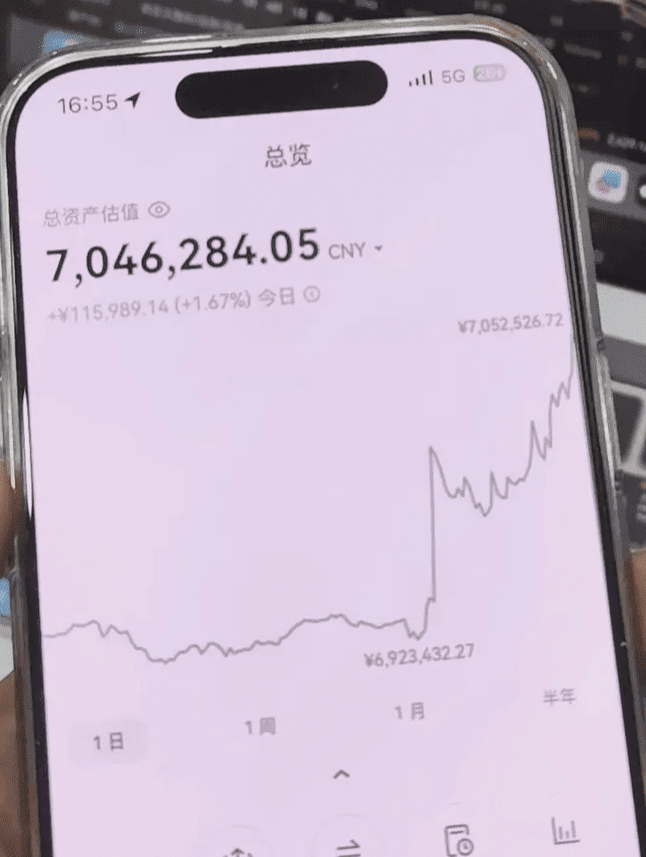
The reasons for missing out can be summarized into four common issues.
First of all, we are always lazy and afraid of trouble.
Even when seeing Bitcoin's price continuously hitting new highs, we are reluctant to actively understand it. We wait with the mindset that it might crash at any moment, waiting to see a joke. The root of this mentality lies in our desire for money is not that strong, causing us to miss various opportunities.
Secondly, we have an innate resistance to new things.
We always tend to like familiar things and instinctively resist unfamiliar things. However, if we can combine the unfamiliar with the known and transform it into something we are familiar with, we can more easily accept new things.
However, most people blindly criticize and mock Bitcoin without understanding it and consider it a bubble. This practice undoubtedly causes us to miss the opportunity to get rich. Only when we fully understand and recognize the value and potential opportunities of new things can we make informed decisions.
In addition, there is a spirit of adventure, or a gambler's mentality.
Even if we fully recognize the investment value of Bitcoin, we still fear failure and are reluctant to invest too much capital. This mentality limits our investment scale and potential returns.
We always tend to listen to others' opinions and are unwilling to deeply research new things ourselves. This behavior not only causes us to miss out on opportunities to get rich but also limits our personal growth and development.
If we cannot overcome these issues, even with another opportunity to get rich, we are very likely to miss it.
As a veteran trader in the coin circle for ten years, unafraid of the winds and waves, surviving through bull and bear markets relies on these 15 iron rules, which are the accumulation of my years of experience!
Patiently watch, check for gaps, and I believe you will gain something! My trading experience and insights are now fully disclosed.
Let’s be real, if you want to stand firm in the coin circle, you need enough experience. Especially in the next two years, seizing opportunities means getting off to a good start. Now everyone is eagerly looking at the fourth quarter. If you can make it through these two years and become an all-round warrior, that’s worth more than just making money!
The following trading insights are all earned through my hard work. Be sure to like and save after reading:
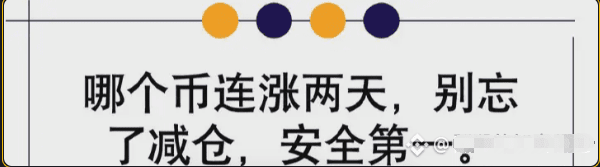
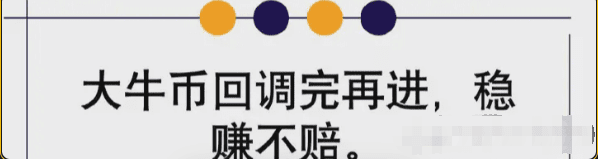


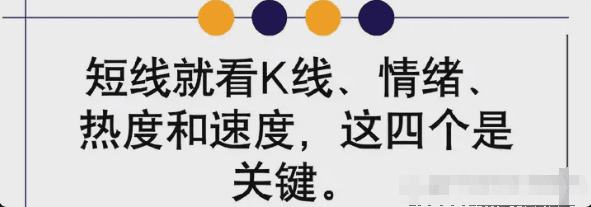
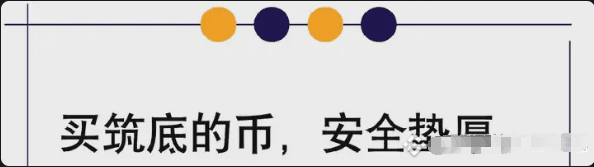
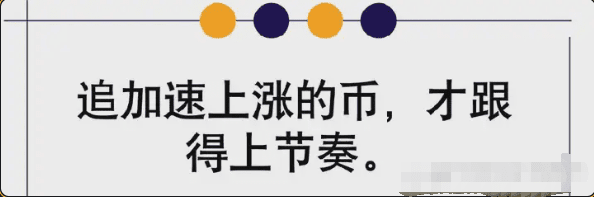
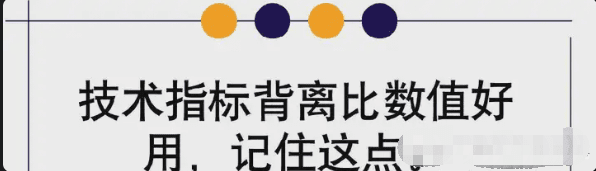
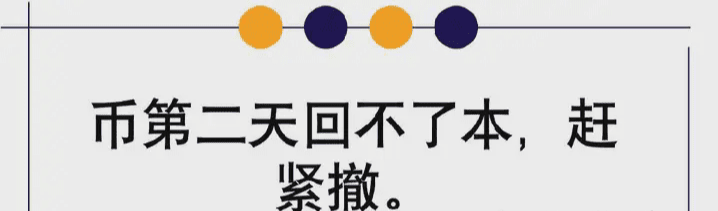
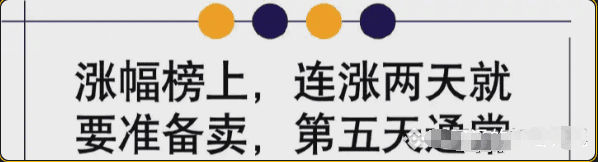
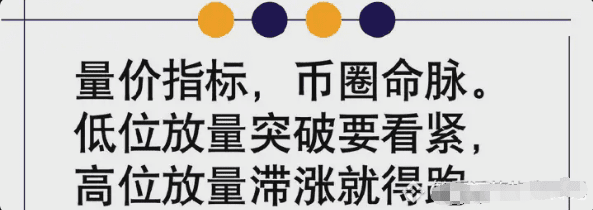
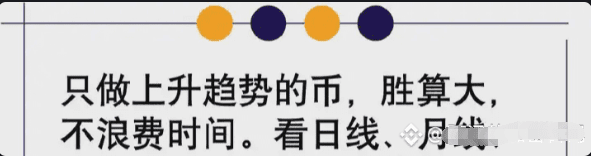
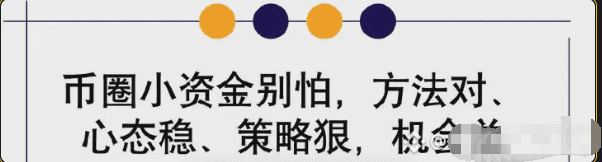
I am sharing my 15 golden rules for trading coins, and I will present them in a visual way for everyone to understand better. If you find it useful, please like, save, and share it with friends who need it. If you have questions, feel free to discuss in the comments.
Introduction to the coin circle: Master these 24 K-line patterns!
From the classification perspective, there are a total of 48 types of K line patterns, of which bullish lines account for 24 types, and bearish lines account for 24 types. The two are similar in shape, only one is bullish and the other is bearish.
Bullish lines are mainly divided into small bullish, medium bullish, large bullish, and bullish cross stars.
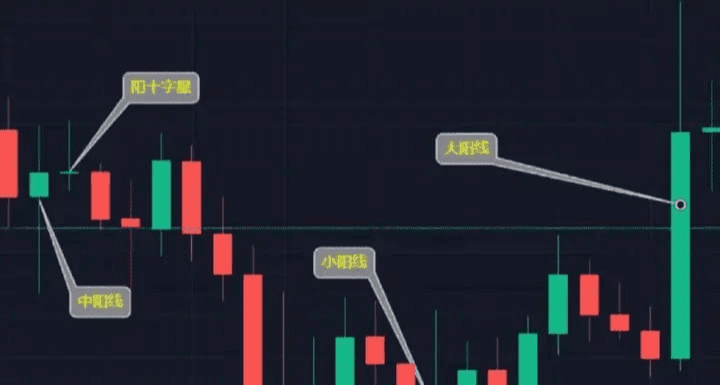
The fluctuation range of small bullish lines is generally between 0.6% and 1.5%;
The fluctuation range of medium bullish lines is generally between 1.6% and 3.5%;
The fluctuation range of large bullish lines is above 3.6%.
1. Bullish cross star
The market turning point of balance between bulls and bears.
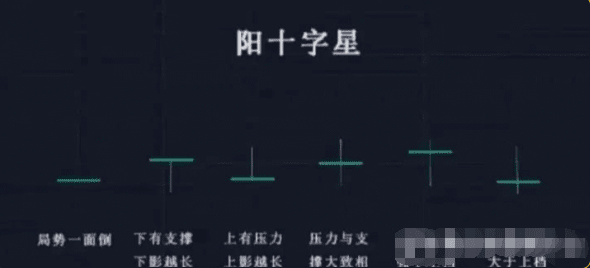
The fluctuation is very small, the opening price and closing price are extremely close, and the closing price is slightly higher than the opening price. The appearance of the bullish cross star indicates that the market is in a chaotic and unclear stage, and the future rise and fall cannot be predicted. At this time, it is necessary to make a comprehensive judgment based on the shape of the previous K line combination and the price area at that time.
2. Small bullish line
The bullish active trend is relatively soft.
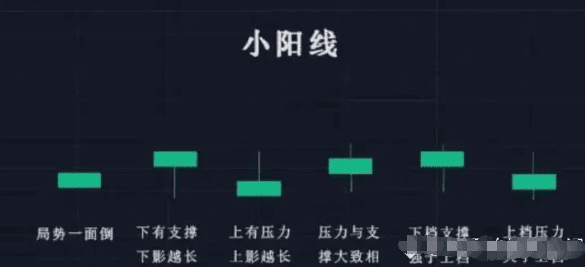
Its fluctuation range is larger than that of the bullish cross star. The bulls have a slight advantage, but the upward momentum is weak, indicating that the market's development is uncertain.
3. Medium bullish line
The bullish forces are strong.
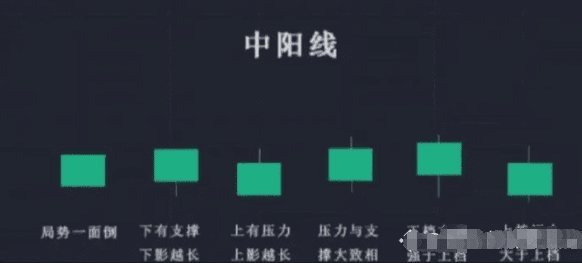
The buying force is greater than the selling force, and the buyers hold the advantage, causing prices to ultimately rise and close.
4. Large bullish line
The bulls hold an absolute advantage.
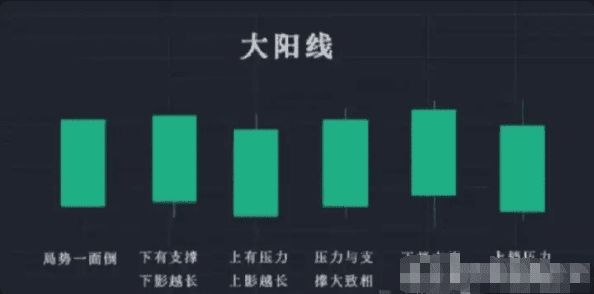
From the moment the market opens, buyers aggressively attack. There may also be a struggle between buyers and sellers in between, but buyers exert maximum strength all the way to the close. Buyers always dominate, causing prices to rise all the way until the close.
The larger the bullish line entity, the stronger the buying pressure, and generally, the market will rise. The longer the lower shadow, the stronger the buying pressure, and the market will generally rise. The longer the upper shadow, the stronger the selling pressure, and the market will generally fall.
Bearish lines are mainly divided into large bearish, medium bearish, small bearish, and bearish cross stars.
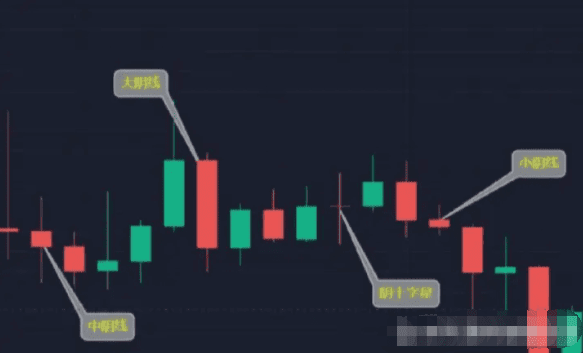
1. Bearish cross star
The market turning point of balance between bulls and bears.
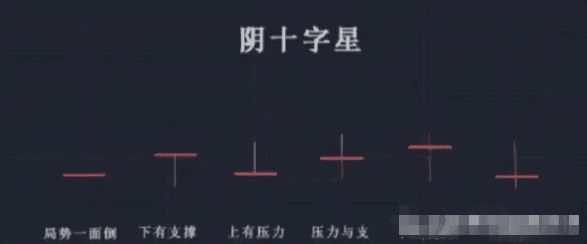
The intraday chart of the bearish cross star is similar to that of the bullish cross star, except that the closing price is slightly lower than the opening price, indicating a weak market and an unclear direction of development.
2. Small bearish line
Bearish trends are relatively soft.
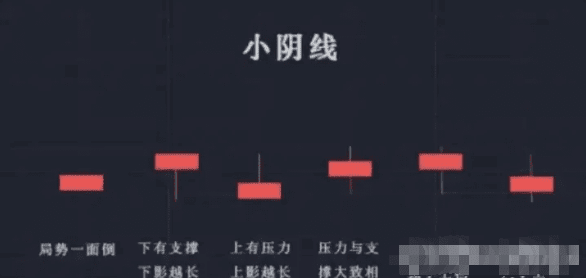
The bearish side is exerting pressure, but the intensity is not strong.
3. Medium bearish line
Bearish forces are strong.
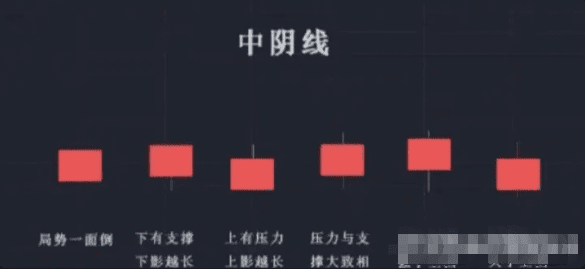
The selling force is greater than the buying force, and the sellers hold the advantage, causing prices to ultimately fall and close.
4. Large bearish line
The bearish side occupies absolute advantage.

In the trading process, as the selling force increases, buyers are reluctant to chase high prices, and sellers gradually take the initiative, causing the price to reverse and trade below the opening price, resulting in a price decline.
The larger the bearish line entity, the stronger the selling pressure, and generally, the market will fall. The longer the lower shadow, the stronger the buying pressure, and the market will generally rise. The longer the upper shadow, the stronger the selling pressure, and the market will generally fall.
Six deadly mistakes to be wary of in trading:
1. Heavy positions lead to death, 2. No stop-loss leads to death, 3. Greed leads to death, 4. Blindly entering leads to death, 5. Frequent operations lead to death, and 6. Left-side operations lead to death. These experiences can only be understood after going through many painful lessons.
Unfortunately, retail investors have short memories, often losing big because of these mistakes. Are you also paying for the same errors? Every loss is a profound lesson, yet most traders still struggle to avoid repeating the same mistakes.
First, heavy positions lead to death, the price of greed. Heavy position trading is one of the most common mistakes traders make. When you invest a large amount of capital into a trade, you are essentially replacing rational decision-making with a gambler's mentality. The volatility of the market means that any trade carries risk, and heavy positions only amplify that risk, leading to unbearable potential losses. Heavy position trading often results in a broken capital chain, or even complete exit. The unpredictability of the market means you can never guarantee profits from every heavy position. It is recommended to diversify investments and strictly control the risk exposure of each trade, keeping each trade's risk between 1% and 2%, ensuring that even in the event of losses, the overall capital does not suffer a devastating blow.
Secondly, no stop-loss leads to death, the tomb of lucky mentality. Trading without stop-loss is the second major pitfall for traders. Without a stop-loss plan, you cannot effectively control risks and can only passively suffer during market fluctuations. Trading without stop-loss will prevent you from exiting in a timely manner during losses, leading to expanding loss amounts and even total loss of capital. It is recommended to clearly set stop-loss points before each trade and strictly execute them. A stop-loss is not a sign of defeat but a basic respect for market risks.
Thirdly, greed leads to death, the trap of desire. Greed is one of the weaknesses of human nature; traders often try to earn unrealistic profits, thereby ignoring the potential risks of the market. Overly pursuing profits can make you hesitant when in profit, ultimately missing the best exit opportunity and even leading to profit reversal. It is advisable to set reasonable profit targets and exit in a timely manner once the target is reached. Remember, trading is not charity; your goal is to profit steadily, not to get rich overnight.
Fourth, blindly entering can lead to death, the risk of ignorance. Blindly entering is a manifestation of lacking a trading plan. Without clear entry logic, it is simply gambling instead of trading. Blindly entering can cause you to lose direction in the market and ultimately fall into the abyss of losses. It is recommended to formulate a detailed trading plan before entering, including entry points, stop-loss points, take-profit points, and risk-reward ratios. Only when the plan is clear can you enter safely.
Fifth, frequent operations lead to death, a lack of patience. Frequent operations are a reflection of traders' eagerness to succeed. Overtrading not only increases the fifth, but also raises the probability of making mistakes. Frequent operations can leave you exhausted in the market, ultimately causing you to make costly mistakes due to fatigue and emotional fluctuations.
Sixth, left-side operations lead to death, the error of timing. Left-side operations refer to forcefully entering during unclear market trends. This behavior often leads to falling into the quagmire of losses. Left-side operations can expose you to enormous risks during market fluctuations, ultimately causing losses due to misjudgment. It is recommended to wait for the market trend to clarify before entering. Right-side operations may miss some profits, but can effectively reduce risks.
At the end of last year, my principal was only 500U, and I wanted to make some money in the coin circle, but no one paid attention. I dared not touch leverage and didn't dare to play with contracts. But with just this little money, I used a simple strategy to roll it into over 10,000.
This is my real experience, absolutely not empty talk. Throughout, I only did one thing: understand the rhythm, control my hands, and don’t act rashly.
How to roll? Let me give you three direct tips:
15-minute short-term rhythm entry.
Choosing coins is simple; just look for those with daily capital movements. For example, popular coins like ETH and BNB, enter short-term when MACD crosses golden or breaks small platforms. The target is simple: make a 3%-5% profit and run.
Intra-day rolling + take profit reinvestment.
Each profit should be taken when reached, don’t stubbornly hold on, stop after making 10U. Use the profits to roll into the next trade, and if you lose, don’t touch the principal.
Control your hands, control your heart.
Don't trade in choppy markets, don't chase prices late at night, don't gamble on news, and most importantly: don't follow others. Make your own decisions and take responsibility.
For example:
First operation: Enter AR coin, break through the short-term platform, made 27U.
Second time: ETH, 5-minute volume breakout, made 44U.
Third time: BNB broke through 655, made 60U.
Just like this, 500U → 820U → 1300U → 2400U, rolling step by step.
Don't underestimate the method's simplicity; there are many details involved.
For example: Which K line patterns are effective? How to judge the authenticity of trading volume? How can you avoid cutting losses? These aren't things that can be explained in a few sentences; I've left a review for each step.
If you only have a few hundred U and want to turn things around, remember: low capital does not mean low opportunity; the key is how to play this hand. Don't explore and take the wrong path; steady and firm is the way to turn things around.
Relying on no news, no luck, just having a good plan and execution, you can also succeed.
Decoding the hidden signals in the coin circle K lines: 3 patterns that market makers don’t want you to know.
To be honest, behind the K lines in the coin circle hide too many unknown traps. You think you understand the K line chart, but in reality, that is just superficial work. What true experts see are these 'capital traps'.
For example, I once accurately escaped the peak 12 hours before a sharp decline in BTC; today I will teach you a few tricks to help you identify the market makers' operations and avoid being cut off.
1. True and false breakouts: Beware of 'fishing lines'.
You see, there are always K lines in the market that break previous highs, a bunch of retail investors chase the price, and then the market makers suddenly reverse and smash the price, causing everyone to be liquidated.
How to crack it?
Look at the trading volume when breaking through. If the trading volume is not sufficient during the breakout, it is basically a false breakout. A real breakout should have a trading volume that is more than twice the average volume of the previous three days.
For example: In January 2024, when ETH broke through $2100, the trading volume did not keep up, and then it plummeted 15% within 24 hours.
2. Accumulation signal: Market makers are 'quietly' collecting.
Sometimes, the market makers will use long lower shadows and low volume to accumulate shares. This pattern seems like the price is being suppressed, but a quick rebound means that funds are quietly entering at low levels.
How to identify?
During sideways fluctuations, a sudden increase in bullish volume is almost a precursor to the market makers' action. You can check if there are large whale addresses massively increasing their holdings in the low price range.
3. Death reversal pattern: Top signals must be understood in advance.
This is the top signal that can help you avoid chasing highs. The most common patterns, 'hanging man' and 'evening star,' are signals for market makers to raise prices and prepare to reverse and smash the price.
How to look at the top?
If the top pattern appears and the exchange's contract holdings surge, the probability of a sharp decline is honestly over 80%.
Case: Last November, BTC appeared to have a 'double top' at $38,000 and then quickly fell to $35,000.
These are techniques I have explored through long-term practice. The best part actually lies in how to combine on-chain data and large orders from exchanges to make judgments in advance. I hope you can learn these, seize the movements of market makers, and not be cut off again.
The 'dumbest' method of trading coins in the coin circle, turned 20 times! You can learn it too!
I admit, my methods are frankly embarrassing, especially in the eyes of those 'big shots' who love to play with K lines and trend analysis. I’m just a low-level player in the coin circle. But guess what? With this 'dumb' method, I rolled 8000U to 140,000! Not only me, but even my fans have steadily flipped their positions and made it back. You might think I'm bragging, but this is truly the real result.
So, how did I do it?
Follow the main force, don't be an analysis dog.
Many people like to analyze, talking about moving averages, trends, and data, making it all sound grand. However, I don't look at K lines, nor do I do trend trading; I even don’t bother to watch the market. I directly track the capital flow of market makers: who is accumulating, who is dumping, who is the main force—I simply follow the main force without guessing the rise and fall, easily executing trades.
After a sharp decline, bravely pick up the pieces.
When others panic, I am excited! During three consecutive large bearish lines, while the community is full of complaints, I love to pick bottoms. Many people cut losses, while I choose to take profits. I picked up the bottom of BNB with seven friends, making 22% in 24 hours. A sharp decline is the best time to pick up bargains; when everyone is scared, I'm willing to step in!
Don’t get emotionally attached to the market; the account is what matters.
Do not be greedy, do not gamble, do not fantasize. Every trade, I only execute high-win-rate strategies, and I never get attached to any coin. You see, I never chase prices, nor do I cling to a certain ideal in the coin circle. My belief is my account! Follow the logic you can replicate, don't get emotionally attached to the market, and in the end, the account is what you can truly rely on.
To be honest, many people lose money not because their methods are wrong, but because they are 'too smart', and instead take the wrong path. As for me? I’m dumb, lazy, and rigid, and as a result, I’ve made a fortune.
You don't need to know a lot; just find someone who truly understands and copy their methods. Are you still randomly guessing price movements and frequently getting cut by market makers? Don't fantasize that luck will favor you—it really is too difficult.
The art of rolling positions is not something that can be mastered on a whim. It requires timing, location, and people to increase the odds of winning. Here are four golden opportunities for rolling positions:
(1) Breakthrough after a long-term sideways market: When the market has been in a sideways state for a long time, and volatility drops to a new low, once the market chooses a breakout direction, it may be time to consider rolling positions.
(2) Buying the dip during a strong bull market: In the wave of a bull market, the market experiences a strong rally followed by a sudden drop. At this point, it may be worth considering using a rolling position strategy to capture the bottom buying opportunity.
(3) Weekly level breakthrough: When the market breaks through key resistance or support levels on the weekly chart, it is like breaking through a solid defense line. At this time, rolling positions can seize this breakthrough opportunity.
(4) Market sentiment and news events: When market sentiment is as changeable as the weather, or when significant news events and policy changes may shake the market, rolling positions can become your weapon.
Key thinking: Cut losses, let profits run, rather than 'profit a little and run, suffer losses stubbornly.'
The above are the summaries of my 10 years of practical experience and techniques in trading coins. They may not be applicable to everyone, and each person needs to combine their own practice for use. As a trader, the most frightening thing is not that you have technical problems, but that your understanding is insufficient, falling into these trading traps without realizing it! There is no invincible trading system, only invincible people who use trading systems! This is the truth; the trading system ultimately returns to the person!
Wen Jing focuses on Ethereum contract spot ambush, and the team still has positions available to get in #加密市场观察 $ETH