

If you break down Gavin's life, you'll find an extremely clear, almost stubborn main thread: he was never "using the system," but rather "inventing the rules."
At five or six, he explored the world on his own in a secondhand Lego school without instruction manuals; at nine, he wrote his own "first line of destiny" in front of his first computer in his bedroom; in his teens, he was not satisfied with just playing games, but made his own Dark Times and Bomber Man, turning his classmates and magazine judges into players; later, he taught himself AMOS, C++, and OpenGL, wrote games, made websites, tinkered with electronic samplers, and designed handmade board games—repeatedly turning the world in his mind into a system that others could actually "enter".
These experiences may seem like a list of interests for a geeky teenager, but looking back today, you'll find something even more important: Gavin never believed in the "world given by authority" from a very young age. What he cared more about was whether he could design a fairer and more fun world himself.
Whether it's the rules of the open world, or the crypto-economic and governance designs behind Ethereum, Polkadot, and JAM, they are all essentially the same thing:
It's not about giving people a path, but about building an entire world where they can "walk and explore on their own."
It's not about blindly following authority, but about letting the rules themselves counteract authority.
Therefore, when we talk about Gavin today, we're not just referring to him as "the founder of a public blockchain" or "a tech guru," but rather as someone who started practicing with Lego and eventually extended his imagination to games, hardware, board games, social systems, and Web3, and how he spent his life answering the same question:
If rules are not used to control people, but to unleash their creativity, how could the world be redesigned?
This is where the real fun of the following dialogue begins.
From Lego to Code: How Gavin Wrote the World's First Line of Destiny at Age 9
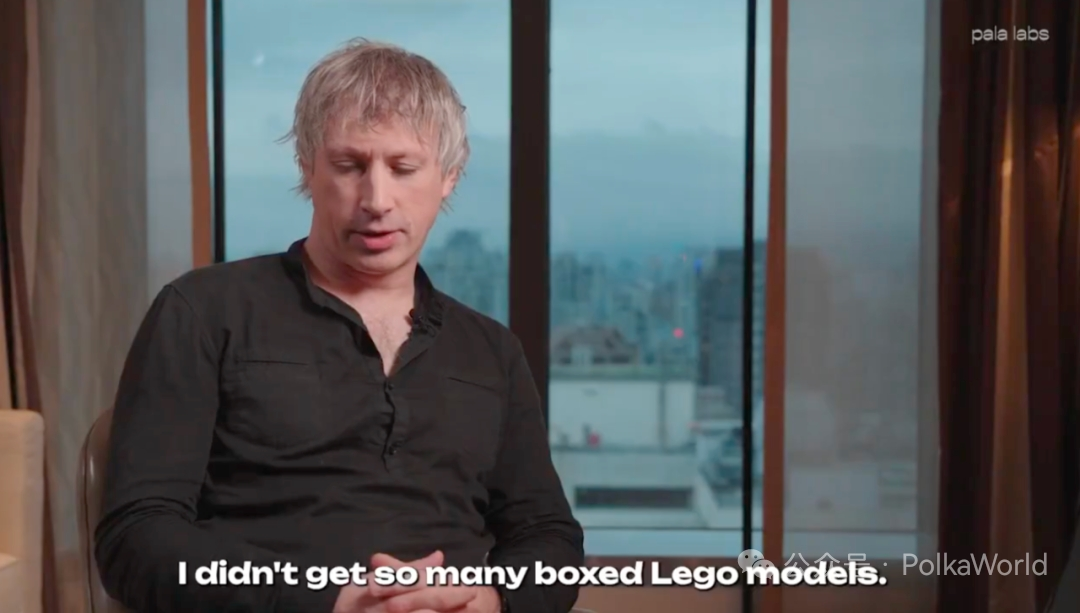
Gavin: I started playing with LEGO bricks when I was very young, probably five or six years old. Now I find that my kids also really love LEGO, but my childhood was a bit different from theirs—my family had limited financial resources and couldn't afford many boxed LEGO sets, so most were secondhand, and they didn't even come with building instructions. I had no choice but to figure out how to build them myself. But that was actually quite good; it really stimulated my imagination.
I first encountered computers when I was about seven or eight years old. Two families around me had computers: one was my neighbor across the street, and the other was a family friend. It was through them that I developed a strong interest in computer programming. Although I knew playing games was fun, programming was much more appealing to me. You can create things through programming, making the computer run according to your ideas and plans. This is actually quite similar to playing with Lego, but programming has a higher "creative ceiling," allowing you to solve various problems in different ways, while Lego can only build physical models.
About a year later, I got my first computer. Initially, my neighbor across the street taught me programming, demonstrating a few simple programs. After that, I was mostly self-taught, receiving little further guidance. A year or two later, I got a better computer. To test the new equipment, I borrowed an old programming manual from a friend. Although I only borrowed it for a few days, it was enough for me to learn the entire programming language. I thoroughly enjoyed it then; programming was what I wanted to do most. I would occasionally go out to play, but most of the time I stayed in my bedroom writing code. I was probably nine or ten years old that year.
Throughout my childhood, I owned several computers, but programming was always something I persisted in doing. I also played games during my teenage years, but later I started developing my own. It wasn't because I couldn't afford the games I liked, but because I found making games much more interesting—it was a much better form of creative expression than simply playing games.
Pala Labs: What kind of games do you make?
Gavin: I've worked on several games, and the first one I was quite satisfied with was called *Dark Times*, a medieval-themed game. It's a bit like an early version of *World of Warcraft*, but back then there was no 3D technology. The game used a top-down perspective, allowing players to freely move around the game world. Moreover, the game world was procedurally generated, making each playthrough unique—the scene layout and character positions were all different. You could fight and trade with NPCs, search for resources in houses, or hunt wild animals in the forest; the gameplay was quite diverse.
For me, this was a form of creative expression. I didn't think much of it at the time, but later I shared the game with a few friends at school. They all said it was quite interesting and suggested I take it to a computer store to show the manager. Computer stores back then were different from now; they were more like gathering places for enthusiasts, not just places to sell games and make money. The stores usually had demo units, and if you had a friendly manager—which was the one I met that day—you could not only play on the demo unit but also demonstrate your own software.
My next game was also 2D (that's what games were all like back then), somewhat like the popular game Bomberman. The initial motivation for making this game was simple: I'd played Bomberman at a friend's house, but I didn't have the money to buy it, so I made a copy myself. However, because I wanted to unleash my creativity, my version ended up being even better than the original—I added many new features, various weapons and items, and enemies with different AI. The creation process was incredibly fun; I was about 14 years old that year. I even submitted the game to a national magazine's game competition for my computer. Although I didn't win first place, I got second. The judges commented that in any other edition of the competition, this game would definitely have won first place. However, in that year, another contestant submitted a work that achieved a special technological breakthrough—it was the first time that technology had been used in a game, so the first prize had to be awarded to that contestant. But the judges also specifically mentioned that my game was far more fun to play than the other entries. I was incredibly happy to receive such recognition. Unfortunately, I no longer have a copy of it. It was originally stored on the table in my grandfather's garage, but the garage was very damp, and the disc got moldy and eventually spoiled.
I also developed a few games during my teenage years, but if I had to pick my favorites and the ones I did best, these two would be the most outstanding.
Beyond Programming: How Gavin Extends His Childhood Creativity to Games, Hardware, Board Games, and Social Systems
Pala Labs: Have you always used the same programming language?
Gavin: From around age 12 to 17, I only used one language when developing video games—AMOS, short for AMOS BASIC. Generally speaking, BASIC is a slow language and not well-suited for developing complex programs. To be honest, the games I made weren't particularly complex, but even so, the original language's speed couldn't keep up with the demands. However, later an extension tool was released for this language, essentially a compiler, which could directly increase the game's running speed by 10 times. With this tool, developing fun games using AMOS became truly feasible.
Around the age of 17, I replaced my old computer—a Commodore Amiga—with a new, self-assembled IBM-compatible machine. Back then, everyone did it; self-assembled computers offered better value for money, allowing you to get a better-spec computer for less. My computer had a very basic configuration, costing only £100 in total. While not high-end, its performance was sufficient for exploring many new things. I also received a lot of help from a classmate's father, who owned a systems engineering company and always had a lot of spare old computer hardware. He gave me the case, motherboard, and even the monitor, so I only ended up buying the CPU and a sound card, which was quite good for £100.
After getting a new computer, I started learning C++ programming, a true "professional-grade language," on a completely different level from BASIC. I continued developing video games, the one that left the deepest impression on me being the computer port of the board game (Catan). To make these kinds of games, I had to learn graphics programming—which is completely different from ordinary text programming, and it's not easy to implement in C++. There are various ways to implement graphics programming, and many are incompatible with specific hardware. Later, I learned a bit of OpenGL, which finally allowed me to develop games with graphical interfaces.
Later, I briefly switched to web development and made some websites, such as a website specifically for storing my music collection. I uploaded all my music to it and added comments and other content, which was quite interesting.
Later, I wanted to make another game, but I never got around to it. When I was a kid, I especially loved a space-themed game called *Frontier: Elite 2*, which was kind of like a single-player version of *EVE Online*. When it was released on the Commodore Amiga, it was one of the earliest high-quality 3D games, groundbreaking in many ways. I used to play it a lot, so I wanted to recreate a similar game on my personal computer, using the mainstream graphics technology of the time while retaining the open-world experience of the original. Actually, I already had the design ideas and framework for this game when I was 18 and still in school. It wasn't until I was around 23 or 24 that graphics card performance improved significantly, enabling real-time rendering of near-photorealistic game scenes, which finally gave me the opportunity to start developing it. I did create some decent graphics demos, but unfortunately, I didn't have enough time to focus on completing it. This was probably the last time I seriously developed a video game in my spare time.
Interestingly, I later went to work for the company that developed the game (Frontier). Unfortunately, I wasn't actually involved in the game's development there; instead, I was responsible for developing the audio technology behind it. However, I've always hoped to rekindle my passion for game development in my later years.
Pala Labs: So before you got into blockchain, were most of your creations computer-related? Have you ever created any physical works other than computer-based ones?
Gavin: Yes, I have. I tried electronics in a technical project, and I wanted to make a sound sampler. People might be unfamiliar with this now, but in the early 1990s, with 16-bit computers, you needed such a device to record audio into a computer. Modern computers have built-in microphone jacks or Bluetooth, making audio recording very convenient, but back then, home computers typically only output audio, such as playing music or sound effects. Audio input was difficult – ordinary home computers simply didn't have this function.
At the time, there were dedicated audio input hardware options available, priced around £50, but for someone from a poor family like mine, it was still beyond my budget. However, I discovered that the microchips used to make such devices were quite cheap, costing only about £1.50. But to connect the microchip to the computer properly, a whole host of other electronic components were needed. I found the blueprints for this sound sampler and tried to assemble it myself, attempting three times, but ultimately failing. Fortunately, I did get a decent grade on this technical project because I made a wooden, metal-inlaid casing with knobs. Although the device itself didn't work properly, the well-made casing, the functional knobs, and the clear labeling earned me a good grade like a B or A.
Pala Labs: It sounds like you've always been passionate about creation since you were a child, not just playing with ready-made toys given to you by others, but creating your own "clay toys" and enjoying it.
Gavin: Yes, like I said before, my family wasn't well-off. Of course, we never went hungry, but most of the gifts I received for Christmas or my birthday were secondhand, especially computer-related gifts—they were all secondhand. Under those circumstances, I couldn't just play those old games over and over again; that would be too boring. So, I always had a burning desire to imagine, to create, to make things myself. This passion for creation permeated my entire childhood, and it took many forms.
For example, when I was a child, I designed a board game myself. It started when I played a game called "Amulet" at a friend's house, and that game was really fun. For several months, we played it once or twice a week. I thought it would be really interesting to make a board game with a similar style but with new elements and adjusted gameplay, so I started making it. We played it a couple more times afterward, but we couldn't improve the game. But ever since childhood, game theory itself, and designing entirely new interactive modes, have always been areas of great interest for me.
This is actually related to political science, sociology (or certain branches of sociology), and even behavioral psychology. In short, I've always enjoyed exploring people's behavioral patterns in different scenarios. It was because of this interest that I later designed a board game. I was probably around 27 years old, maybe 28 or 29, I can't quite remember. I have a few very close friends, and we all love playing board games. At that time, I had an idea to create a board game unlike any other on the market—a geometry-themed building game. The gameplay involves building cities, and the scoring rules are linked to geometric principles. The core is the ratio of a building's floor area to its perimeter, especially the number of adjacent walls. This mechanism was very novel; I had never seen it in other board games before, so I wanted to try and recreate it. The development of this board game went through countless revisions, taking about two or three years in total. Of course, I didn't dedicate myself to it full-time, as I had other things to do. During those two years, I continuously tested and optimized the rules, simplified the gameplay, until I was finally satisfied with the game experience.
By the time the final draft was completed, I was about 31 years old, and I even compiled a well-organized instruction manual for the game. I asked one of my good friends to help make the physical game; he was exceptionally handy. I was mainly responsible for the game design and graphic design, while he handled some of the illustrations and even made the wooden game accessories by hand. It took us almost a year to complete 42 sets of the board game. At that time, we didn't have much money. Although ordering thousands of sets from a board game company would only cost 10 to 15 pounds per set, that amount was still out of reach for us. Moreover, the process of making it ourselves was inherently fun, so we ultimately chose to make it entirely by hand. I still have one set, and he probably has one or two left. I played it again recently and found the game still very enjoyable; I'm still very proud of it.
What's even more noteworthy is that a well-known German board game magazine gave it a very positive review. The magazine said they would publish it, but I haven't checked since and I'm not sure if it was ever published. However, once we finished the sample, finalized the rules, and were satisfied with the final product, we stopped pursuing it further.
I think this is actually a watershed between two completely different abilities:
One is to conceive and realize from scratch, turning ideas in one's mind into something tangible;
Another approach is to promote and operate from one to one hundred, making more people aware of it and buy it. This involves a series of things such as marketing and business development.
These two kinds of things often require very different personalities to accomplish, and I am clearly the kind of person who is good at starting from scratch.
The rules aren't the point; the emergence effect is.
Pala Labs: So, designing board games and designing blockchain networks based on cryptoeconomics have a lot in common?
Gavin: Exactly, that's true. Today's blockchain networks are vastly different from those of ten years ago. Besides the divergence between short-term and long-term thinking within the industry, there's also a disconnect between pure cryptography and cryptoeconomics. Some now advocate building large systems solely through complex cryptography, rather than relying on cryptoeconomics, but this is still just a topic of discussion within the industry. Personally, based on current data and the latest reports, I believe we haven't reached the point where we can abandon cryptoeconomics and rely entirely on pure cryptography.
However, cryptography is extremely difficult, far beyond my capabilities—it requires exceptional mathematical thinking, which I lack. I know some people with this ability and work closely with them, but I'm simply not cut out for it. I'm more inclined to be a game theorist and engineer than a cryptographer.
You're absolutely right. Designing a fun board game and designing a secure and practical crypto-economic system are essentially very similar. What they have in common is that the goal of designing rules is to achieve the "emergent effects" that the rules themselves generate, rather than the rules themselves.
This is crucial, and it's what distinguishes us from politicians. When politicians and legislators formulate rules, they often don't consider the emergent effects of those rules; they simply "patch" what they perceive as social problems. They often fail to realize that the simple rules they think will solve problems may ultimately have completely different effects than expected. Sometimes, they not only fail to solve the problem but actually make it worse; sometimes, even if they solve the original problem, they trigger a chain reaction more serious than the problem itself. Therefore, formulating rules (or laws) in this situation is not a wise move.
As game theorists, our task is to understand the relationship between rules and emergent effects. This relationship is usually non-linear, even random, and difficult to predict precisely. Especially when numerous rules interact and jointly influence the outcome, its complexity rivals the three-body problem, exhibiting a chaotic state that cannot be predicted based solely on basic principles. You must first put it into practice, allowing participants to actually engage, and then observe the specific effects. This is somewhat similar to protein folding or the development of new materials; you can roughly deduce a recipe, or even create a new one. You can guess from experience which ingredients are suitable and which cooking techniques are effective, but the final result must be verified through hands-on practice (practice makes perfect). Even top chefs can ruin a dish due to improper ingredient combinations.

The key is that this is a process of "rational guessing + accidental discovery + repeated attempts". You have to accept that the first attempt is almost impossible to succeed perfectly. But sometimes you will find that a certain direction has great potential, so you continue to adjust and optimize along that direction.
When I designed that board game, I started with a core gameplay concept that I felt had great potential. Then, I spent three years repeatedly modifying and testing it, observing its emergent effects—was the game fun? Did everyone like it? Was there a clear winning strategy? Or was it all down to luck? Through a lot of feedback and iteration, I finally found the optimal solution, and once it was finalized, I was done.
Essentially, it's more like an art form.
Unfortunately, I feel that many existing rules in society are often not based on considerations of emergence effects, but rather stem from the short-sighted views of legislators.
Gavin: I never worship authority, nor do I want to become one.
Pala Labs: It seems there's a consistent philosophy behind all these developments, from Ethereum to Polkadot (the "world computer" in your eyes), and now JAM. Behind these projects you've been involved, there appears to be a consistent set of principles. Do you think this philosophy gradually formed during your adolescence and into your twenties, or was it rooted in you from the beginning?
Gavin: I think some core elements of this philosophy are indeed deeply ingrained. I'm often asked who my idol is, and until recently, I couldn't give a good answer. I've never had a specific idol, nor do I have that kind of blind worship of authority. In my view, there are all sorts of systems in the world; some work well, like the scientific and academic systems; others are less than ideal. But as for specific individuals, I don't have any particular object of worship—of course, I do have respect for them.
However, after reading some philosophy books and broadening my horizons, this idea changed slightly. Now I do have some people I admire and who are worthy of my emulation, one of whom is Richard Feynman—a Nobel laureate in physics. After reading his autobiography, I was deeply moved and felt he was an excellent role model, a true spiritual idol. But overall, I've never really been comfortable with the concept of "authority"—whether it's being forced to obey authority or becoming an authority myself.
I believe a world that rejects authority and doesn't require blind trust might be a better place. In such a world, people would be willing to spend time examining and analyzing their surroundings, making rational decisions based on facts, rather than following the instructions or indoctrination of authority figures. I remember when I was eight or nine years old, my stepfather said he would send me to join the army when I turned 15. This idea terrified me at the time; I really didn't want to enter such a hierarchical, authority-worshipping system. I don't know why I had this aversion; perhaps it was due to bad experiences dealing with authority figures when I was young. But the idea that "we should build a society where everyone is equal, where everyone is an equal individual, not a follower or an authority figure" is indeed an attitude I've always held deep in my heart.
This attitude is naturally reflected in my work, even in the games I want to develop—whether it's the space trading game or the early medieval-themed game (Dark Times), they are all centered around open worlds. In these games, there is no authority, no hierarchy, and no "ultimate villain" that requires you to prove yourself brave enough. There may be benevolent forces in the world, as well as malevolent ones, but you live entirely for yourself, and the core gameplay is exploration. I've always felt that these kinds of games are more fun to play, and this applies to life as well—life is more interesting when you explore the world as a free individual and make your own decisions. Although this is often not easy, I believe it is a more ideal way of life.
Pala Labs: Is this your unwavering pursuit of a free world? This belief that you have always cherished continues to inspire you to move forward, even after 11 years of trials and tribulations.
Gavin: I think this is a deeply ingrained principle that I'll probably never change in my lifetime. Although people often say that people become more conservative as they get older, I'm not sure if that will change in the future, but at least for now, this belief is as firm as ever. Especially in the past two years, as I've focused on advancing projects like JAM, this pursuit has become even clearer.
Polkadot's initial design perfectly aligned with the core principles of Web3, such as decentralization. However, its implementation involved some compromises—primarily due to our initial funding model and the architecture built to ensure legal compliance, which to some extent constrained our actions.
The development of Polkadot was more like a "sprint," with the core objective of completing and delivering the product as quickly as possible, but the development process itself did not entirely adhere to these principles. Polkadot was exclusively developed by Parity, and even now, its mainstream client remains the Parity version—although other available clients are under development, its core dominance remains unchanged. The entire project, from design to development, was essentially completed by a single team, representing a product and software delivery-oriented model.
JAM, however, is different. We deliberately return to a more thorough decentralized model, which perfectly aligns with my long-held pursuit of "equal collaboration." As I mentioned before, I neither adapt to obeying authority nor like becoming an authority figure myself. The reason I continue creating here, besides my love for hands-on work, is primarily to reduce people's dependence on authority. If I were to become an authority figure myself, wouldn't that be putting the cart before the horse? I will do my best in my job and am willing to share my views; I'm grateful if people are willing to listen, but I absolutely do not want to be idolized or fawned over. This situation would make me very uncomfortable, and I would even want to avoid it. I prefer solitude and pursue a certain degree of academic purity. When exploring innovation in the field of cryptoeconomics, giving individuals sufficient autonomy is crucial.
Of course, soliciting opinions from others and engaging in collaboration are necessary, but groundbreaking initial ideas should absolutely not be decided by a committee alone. If everything requires collective discussion, it's easy to reach a stalemate—everyone has different ideas, no one is willing to firmly push forward with a particular solution, they'll just keep coming up with new ideas and shirking responsibility, ultimately causing the project to stall. Therefore, the initial idea is best led by one or two people, who must have sufficient motivation to refine it into a cohesive whole. This process can certainly involve iterative optimization and incorporating others' opinions, but there must be a clear core driving force.
However, once the project enters the construction phase, or once the solution is prototyped, its feasibility verified, and its practical value proven, decentralization must be promoted – after the core promoters have validated and implemented the idea, it should be handed over to more people to participate in the subsequent deployment. As I mentioned before, this requires two different types of people to accomplish, and I am clearly better at the initial pioneering work.
The problem lies in the difficulty of accurately grasping the transition period when the core promoters should relinquish control and allow the community to take over the decentralization process. The individuals involved may know the answer, but others may not be able to reach a consensus. In reality, many people actually prefer to trust authority—it makes things "easier" for them.
If people can trust a leader, they don't need to think for themselves; they can simply follow orders. I can understand this choice, as it's a matter of personal freedom. However, if most people in a community do this, problems are likely to arise—blindly following the leader could ultimately lead to a desperate situation for everyone.
Due to the length of the interview video, we will be releasing it in two parts! This is the first part; the second part will be released tomorrow. Stay tuned!
Original video: https://x.com/Polkadot/status/1993593944824070610
PolkaWorld Telegram group: https://t.me/+z7BUktDraU1mNWE1
PolkaWorld YouTube Channel:
https://www.youtube.com/c/PolkaWorld
PolkaWorld Twitter:
@polkaworld_org


