

When the 30 trillion dollar figure is officially confirmed in December 2025, the total amount of circulating national debt will have climbed to 30.2 trillion dollars in seven years, with the 'total national debt' reaching as high as 38.4 trillion dollars, rapidly approaching the statutory limit of 41.1 trillion dollars.
However, a more profound change is occurring than the expansion of scale: the cornerstone of low interest rates that has supported this vast debt system for decades has collapsed. Today, the annual interest expense of 1.2 trillion dollars is like a self-growing fiscal iceberg, its massive underwater part is quietly changing the course of the U.S. and even the global economy.
This marks a fundamental turning point—the core contradiction of U.S. fiscal policy has completely shifted from the "stock" problem of debt to the survival challenge of interest "flow."
 I. The structural uncontrollability of debt scale
U.S. national debt reaching $30 trillion is an expected yet astonishing result. Its structural characteristics determine the uncontrollability of this trend.
● The steep curve of doubling in seven years: Unlike the slow accumulation of previous decades, this round of debt expansion has shown astonishing acceleration. Since 2018, the scale of debt has more than doubled, meaning that the debt accumulated in the past seven years is equivalent to the total accumulated over the previous decades. The growth curve has steepened sharply, indicating that its driving forces have surpassed conventional economic cycles.
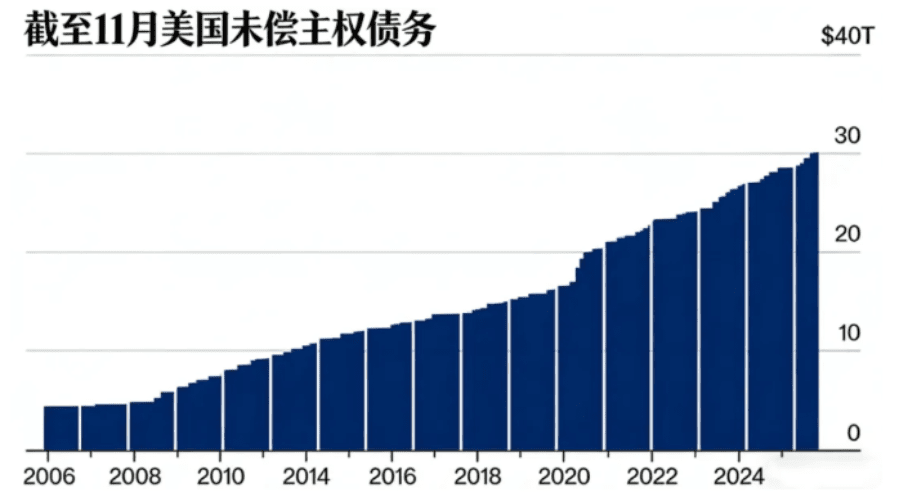
● The total debt crisis under "double leverage": The public often focuses on the $30.2 trillion circulating national debt, while a more comprehensive measure of "total national debt" (including government internal borrowing) has reached $38.4 trillion. This reveals two dimensions of the debt problem: externally, there is a need to continuously borrow new to repay old in the global market; internally, trust funds like social security have essentially become the government's "forced creditors," locking down fiscal maneuvering space in a dual manner.
● The reality pressure nearing the statutory ceiling: Current debt levels are just a step away from the statutory limit of $41.1 trillion. This means that it is almost foreseeable that Washington will once again stage intense "debt ceiling" political impasses in the near future. The debt issue is accelerating its spillover from the economic realm, becoming a trigger for a normalized political crisis.
 II. The dual core driving forces of debt runaway
The steep growth of debt is the result of two crises passing the baton: one is the sudden external pandemic shock, and the other is the internal policy storm triggered by actively responding to inflation.
● The legacy of "wartime finance" from the pandemic: In 2020, in response to the sudden halt of the economy, the U.S. launched "wartime-style" financing, issuing $4.3 trillion in national debt in a single year, with a fiscal deficit exceeding $3 trillion. This strong medicine stabilized the economy, but also permanently raised the debt baseline platform, akin to the difficulty of shedding "virtual fat" after injecting large amounts of hormones into the body.
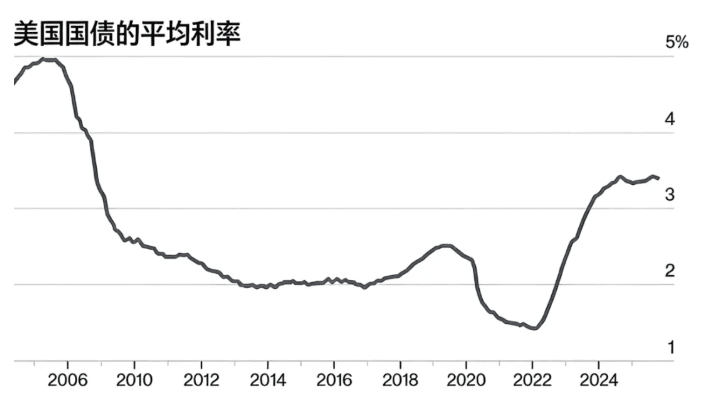
● The "chronic strangulation" of a high-interest rate environment: To extinguish the fire of inflation, the Federal Reserve has rapidly raised interest rates, completely replacing the engine of debt growth. All new and rolling debt issued by the Treasury must endure interest rates far higher than in the past. BNP Paribas points out that high interest rates make interest costs themselves a core factor exacerbating the debt problem. This means that debt growth has shifted from relying on external "blood transfusions" (new deficits) to relying on internal "blood production" (interest capitalization) in a self-recycling model.
● The formation of the "snowball effect" of interest: Two factors combine to create a lethal closed loop: high debt base × high interest rate environment = exponentially growing interest burden. The core of this "snowball" is no longer loose snow, but high-cost interest that is solidifying into hard ice.
III. How trillion-dollar interest reshapes finance
Annual interest expenditures of $1.2 trillion have transformed from mere accounting figures into a "fiscal black hole" with autonomous life, beginning to suffocate all other functions.
● The transformation from "maximum bearable cost" to "maximum single expenditure": This interest exceeds the total budget of most federal departments. It is no longer a financial cost in the background but has become the toughest demander at the budget table, competing at the top level with traditional expenditure giants like defense and healthcare, continuously squeezing their space.
● The "quicksand dilemma" and the futility of income efforts: Citigroup's "quicksand" metaphor accurately depicts the fiscal predicament: any new income seems like a drop in the bucket compared to trillion-dollar interest. Even optimistically estimating that new tariffs could bring in $300-400 billion, it is still far below the $1.2 trillion in interest. The financially healthy body is sinking, and increasing revenue merely slows the "sinking" but cannot change direction.
● The "pre-emptive seizure" of future policy space: This rigid expenditure is like a pair of iron pliers, pre-emptively locking down the government's ability to respond to future crises. No matter when the next recession arrives, the government will first face the enormous bill from "interest creditors" before it can restart large-scale fiscal stimulus, severely depriving fiscal policy of flexibility and initiative.
IV. Shockwaves spreading from the auction room to the globe
The impact of the debt dilemma is centered around the U.S. Treasury, releasing continuous shockwaves to the global market.
● Testing the limits of issuance pressure and market appetite: To cover deficits and maturing debt, the Treasury has hinted at "increasing auction size." The global market will be forced to digest an unprecedented supply of U.S. Treasuries, which may push up long-term yields, trigger asset price reassessments, and even become amplifiers of market volatility during certain liquidity crunches.
● The paradox and structural demand of "safe assets": Despite sustainability concerns, the global core status of the U.S. dollar and U.S. Treasuries is hard to replace in the short term. Paradoxically, new financial regulations (such as requiring stablecoins to be backed by U.S. Treasuries) may instead create new rigid demand in localized areas. This "must-hold" paradox profoundly reflects the structural dependence of the global financial system.
● The chaos of the "pricing anchor" for global capital costs: U.S. Treasury yields are the cornerstone of global asset pricing. Fluctuations and uncertainties in yields caused by its own fiscal problems will directly raise global corporate financing costs, affecting multinational investment decisions and imposing additional "U.S. fiscal tax" on an already fragile global economy.
Five, Dilemmas and Solutions
Faced with this interest-driven debt dilemma, policy choices are extraordinarily difficult, every path is fraught with thorns.
● The first path: "Waiting for a miracle"—that is, hoping to dilute the debt burden through continuous high-speed economic growth (significantly above interest rates). However, in the context of an aging population and slow productivity growth, this is more of a wish.
● The second path: "Praying for interest rate cuts"—that is, expecting the Federal Reserve to initiate a large-scale, sustained interest rate cut cycle to reduce interest costs. However, this is constrained by whether inflation is truly tamed, and may sow the seeds for the next round of asset bubbles and inflation, not a free option.
● The third path: "Fiscal reconstruction"—that is, implementing fundamental tax and spending reforms. This includes expanding the tax base, adjusting welfare structures, etc., but in a politically polarized society, this is tantamount to a high-intensity civil war, with little substantial breakthrough in the short term.

The fiscal fatigue of an era
$30 trillion in national debt and the trillion-dollar interest it generates declare an era of "fiscal fatigue." The U.S. may have to learn to operate in a new normal of "high debt-high interest," where national strategic resources are increasingly used to maintain credit as a basic survival task, rather than for future-oriented investments.
For the world, this demands that countries re-examine the safe boundaries of foreign exchange reserves and actively explore diversified international monetary cooperation schemes. The global economic vessel is sailing into a sea filled with unknown turbulence reflected by U.S. Treasury interest, and all passengers need to fasten their seatbelts and start thinking of a new navigation map.
Join our community, discuss together, and become stronger together!
Official Telegram community: https://t.me/aicoincn
AiCoin Chinese Twitter: https://x.com/AiCoinzh
OKX welfare group: https://aicoin.com/link/chat?cid=l61eM4owQ
Binance welfare group: https://aicoin.com/link/chat?cid=ynr7d1P6Z