
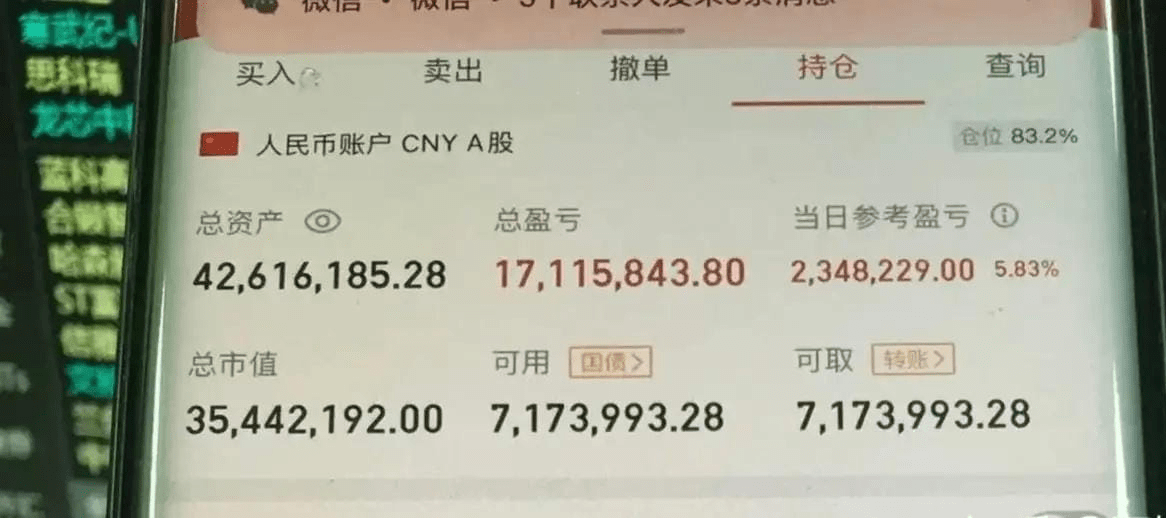
I was born in 1989, and I turned 300,000 in capital into 42 million; I can share about it.
Now my daily routine is.
6:30 Get up and run, rain or shine.
I open my computer at 9 o'clock, review yesterday's operations along with updates from this morning, and make adjustments based on my positions and specific situations for swing trading or short-term operations with small capital to enhance market feel.
The closing review takes 3-4 hours, which is the most important task of the day, aimed at finding undervalued stocks.
 After saying goodbye to the three-point-one-line life of my previous job, I regained the time that originally belonged to me.
Leaving the working life actually means that one has left the group. However, humans have been social creatures since ancient times, and this attribute has long been deeply imprinted in our genes. I once saw information that a psychologist conducted a survey about how many words humans say on average each day. The survey found that ordinary men speak an average of 2,000 to 4,000 words a day, while ordinary women speak 8,000 to 10,000 words a day. After leaving the working life, I found that the number of words I could say had decreased because there was no one to converse with. But instinct is instinct; the more it is suppressed, the more it will protest in other forms! I have felt countless originally weak emotions that are magnified infinitely! Loneliness, repression, despair, ecstasy, extreme confidence, extreme helplessness....
I don't want to live as a solitary island isolated from the world because of trading. I always believe that trading is just a means, not an end. The purpose of life must be about experiencing life! Everyone's life and death are the same in the end, so the one who has a better sense of experience is the winner. Professional trading can give me the opportunity for financial freedom, and financial freedom is just for that sense of experience!
Many people have ventured down the path of trading, but many have failed! I once asked myself, what is my greatest advantage in this market? This low-threshold trading market, where a thousand troops cross a single log bridge, is not an exaggeration, and why should I have a chance?
I answer myself: Time!
 It took me almost four years to successfully break through the 7.5 million mark from around 300,000 in my account, which can be considered the first step on the path of advancement!
I understand that this bit of profit is negligible to stock market experts; it is just my own experience, my own gains. For an ordinary person like me, hoping to change my fate through stocks, this is real, effective, and continuous. It gives me the courage, ability, and opportunity to choose a life I love, allowing my life's trajectory to potentially write a wonderful chapter. I applaud myself and cheer for myself! And also encourage the countless friends struggling on the speculative path. Even someone as impulsive and timid as me can slowly achieve advancement, so everyone can.
If you do not plan to leave the stock market in the next three years and are determined to treat stock trading as a second profession, you must read these ten stock trading iron rules. They are all practical tips for stock trading and should be saved!
1: A common problem among retail investors worldwide is that they hold onto losses and immediately sell as soon as they turn a slight profit, without looking at trends or transaction volumes, only focusing on account profits and losses. The final result is infinite losses and limited gains. It requires a reverse operation: holding onto profits and cutting losses at the slightest decrease. My profit-taking and stop-loss principle is to take profits at 15%, and stop-loss if profits drop to 10%. If it continues to rise, hold on. If it drops after purchase, cut losses if it exceeds 5% of the principal. If you can ensure a profit-taking of 10% each time and a stop-loss of 5%, then operating 100 times, even with a win rate of only 50%, your returns will reach 800%. Is that difficult? The difficulty lies in human greed and fear, which require harmony between knowledge and action.
2: Follow the hot spots. If you want to do well with small funds, you must follow the market's hot spots and stay ahead of the market. This is the most basic point. Without this, much effort is wasted. Whether you are buying on the board, buying low, or chasing rises, the goal is to follow hot spots and lead stocks, rather than simply making quick profits from boards. Many board traders randomly buy a board and leave when it opens high the next day, thinking this is stable compound interest. However, this is not the case. Buying boards is more about buying the strongest stocks in the market at the last determined moment to hold for the maximum profit.
3: First look at the macro policy trend, identify three currently popular sectors and themes, then select 1 to 2 leading stocks from each sector, keeping 3 to 6 stocks in your watchlist. Track them repeatedly, waiting for suitable opportunities to arise. When it’s time to act, be decisive; when waiting, be patient.
4: Below the 5-day moving average, either stay out or hold a light position. Recently, in the counter-trend market, everyone must have deeply understood a truth of the stock market: it's best to stay out below the 5-day moving average. Stockholders can check the index, and whenever the stock price is below the 5-day moving average, it's often hard to make profits. As long as the stock price is above the 5-day moving average, it's often hard to have losses. Of course, while the theory is simple, the actual number of people who can do it is few.
5: Do not look at stocks below the 20-day moving average. Many friends like to buy low, especially some stocks that have been in long-term adjustments at the bottom. Little do they know that such stocks are often very weak and lack capital support. The price movement of the stocks also confirms this point, so do not fantasize about how much profit you can make in the pit. The big profits must be in strong stocks. Conversely, think about it: will the probability of profit be high when dealing with weak stocks for a long time?
6: No matter how good a stock looks, do not fully invest. A position of 20% to 40% is good. If you are optimistic about it, hold 20%, very optimistic 30%, and especially optimistic 40%. Set stop losses at 5, 6, or 7 points, and take profits at 15, 20, or 25 points. After buying, only reduce your position, do not increase. High selling and low buying are only suitable for medium to long-term; short-term is for quick entry and exit. Reduce by 30% at 15 points, 50% at 20 points, 80% at 25 points, and finally leave 20% of your position. This helps you effectively control drawdowns, and if there is a real surge, having a little bottom position can prevent regret and maintain a good mindset.
7: Buy on divergence, sell on consensus. Often, stockholder friends ask me for advice on chasing rises and buying boards. Based on years of practical experience, I can clearly tell everyone that only during divergences, such as when the market sentiment is low, stocks are oscillating at high positions, or new themes emerge, is it suitable to act. Calm and peaceful market conditions often lead to actions taken by novices.
8: Grasp the emotional freezing point. The market has its own emotions every day. Most of the time, some emotional "freezing points" may occur during trading, perhaps at the opening or during a divergence after the opening, or in the afternoon or at the closing. In short, there are almost emotional freezing points in the market every day. Old Li often chooses to act at these freezing points because they can test the strength and weakness of individual stocks. Acting at this moment often allows one to acquire panic chips brought down by emotions while effectively avoiding chasing highs.
9: In fact, stock trading is about trading emotions. There are various ways to judge rises and falls, and the market is ever-changing, but the only constant is the mindset. If you cannot maintain your composure, you will lose money regardless of the method used. A good mindset can allow you to drink soup even if you cannot eat meat. How can you remain unshaken by rises and falls? You must continuously learn and improve your understanding; what we earn is the realization of that understanding.
10: If you have been doing this for a long time and have learned a lot of techniques and theories but still feel confused, at this point, I hope you can take a step back and reflect on yourself. Many people spend their entire lives studying the market but never take the time to understand themselves. In fact, the greatest enemy of the market is your inner self. Remember that slow is fast, gains and losses come from the same source, and reflecting on yourself will always surpass any theory!
This year marks my twelfth year of trading stocks. I started with tens of thousands and now support my family through stock trading! I can say that I have used 80% of the methods and techniques in the market. If you want to treat stocks as a second profession to support your family, sometimes listening and observing more will help you discover things outside your knowledge, at least saving you five years of detours!
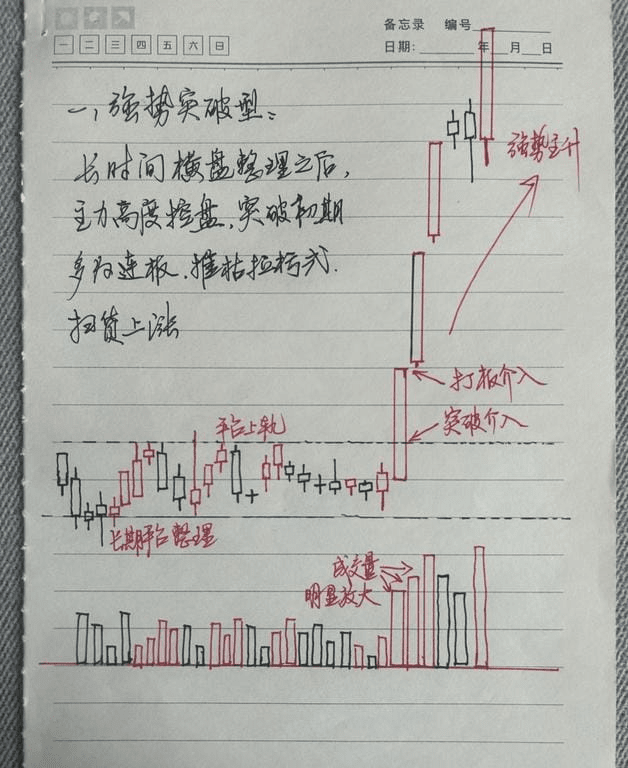
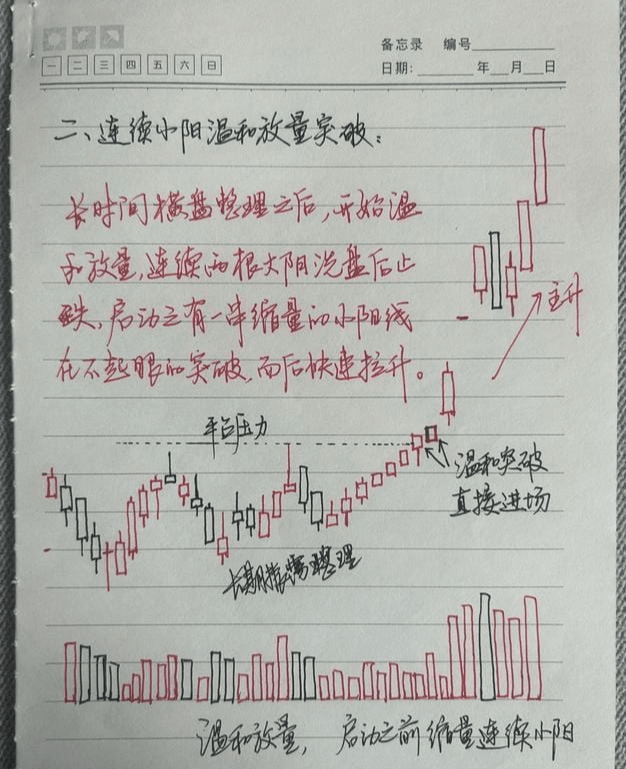
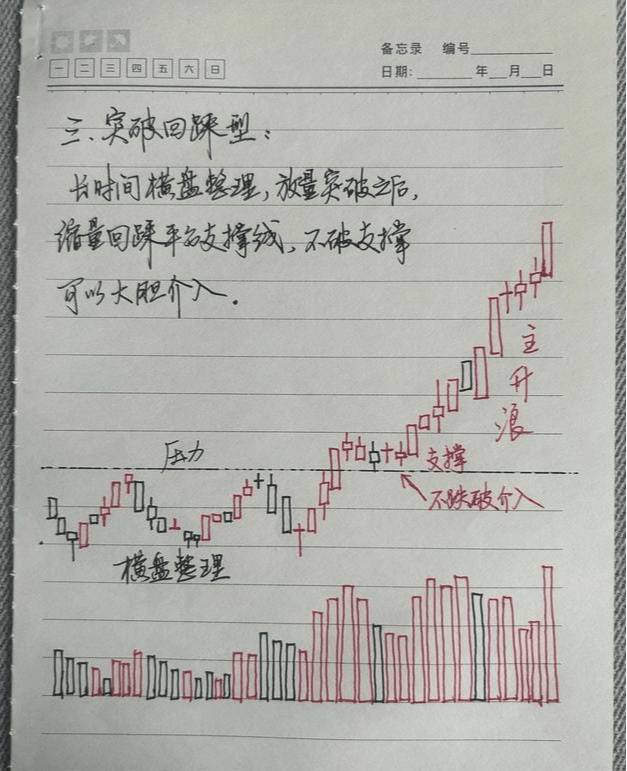
How to judge whether a stock has formed a breakout? You can start from four aspects: volume, price, time, and space.
1. Volume: Before the troops move, the supplies must arrive first. In the early stages of trend formation, significant volume is a necessary step, especially after a long period of horizontal consolidation. We need to pay close attention to the first volume spike, but this is not the best entry point. Generally, after a test pullback and the main force finishes washing out, the second volume spike rise is our real opportunity.
2. Price: Generally, look at the closing price. Regardless of the ups and downs during the process, if the closing can be stable, it indicates that the main force is serious! This is the key to distinguishing between real and false breakouts. In summary, if the closing can remain above the resistance level, the probability of a genuine breakout greatly increases.
3. Time: Before a breakout occurs, the stock price should preferably have experienced a long period of low-volume consolidation, lasting more than three months, with a concentration of shares less than 10%. Only under these conditions can the main force accumulate sufficiently, making the subsequent rise stronger.
4. Empty: Identify the key resistance levels. These resistance levels may be the previous volume adjustment's starting point, or the necklines of W-bottoms and head-and-shoulders bottoms, or even integer points of stock prices. As long as the resistance level is clear, once the stock price breaks through, the potential for price increase can be easily measured.
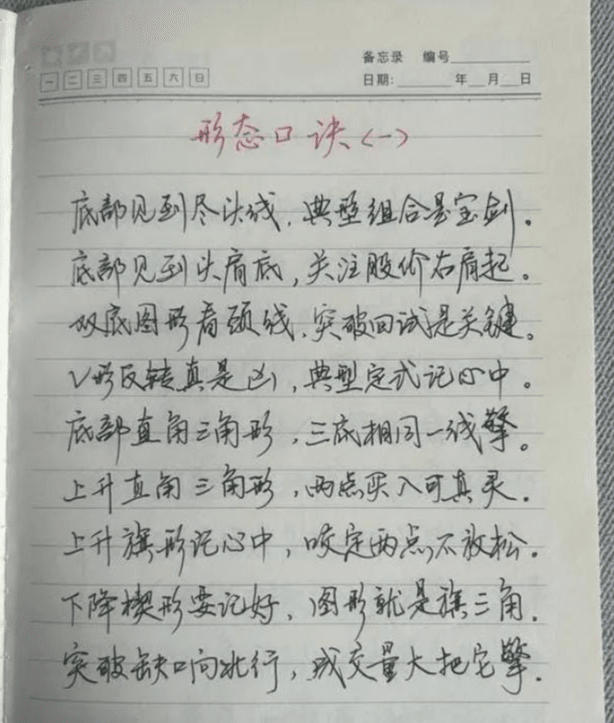
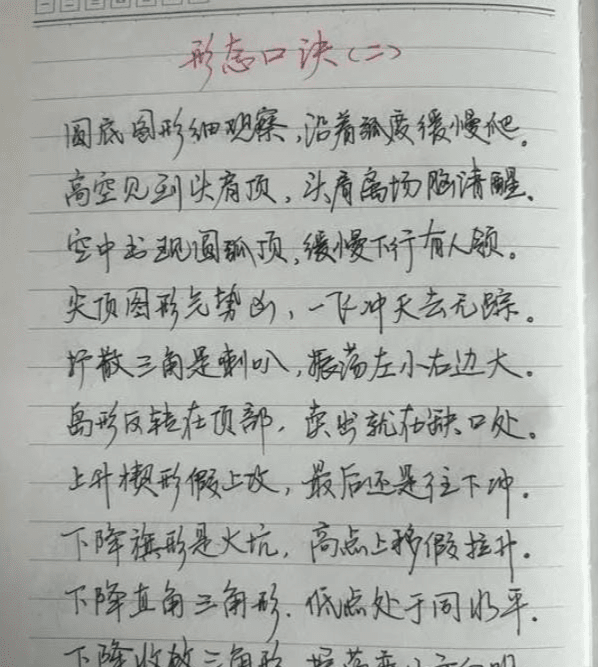
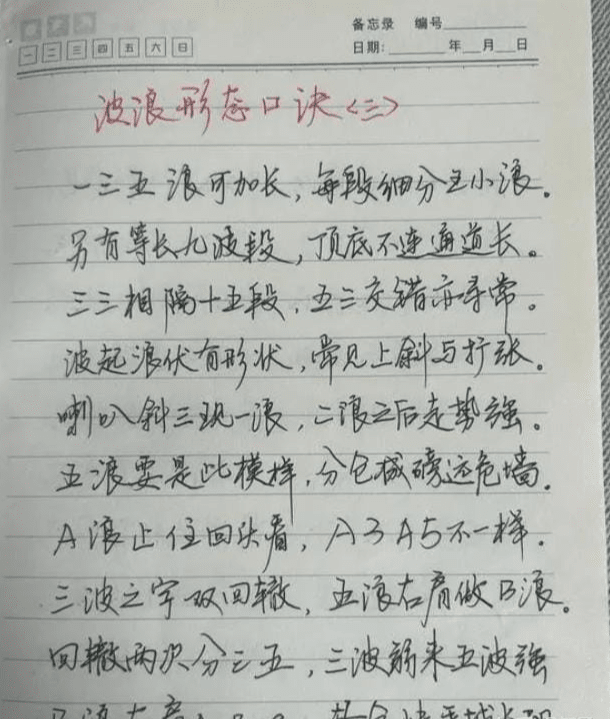
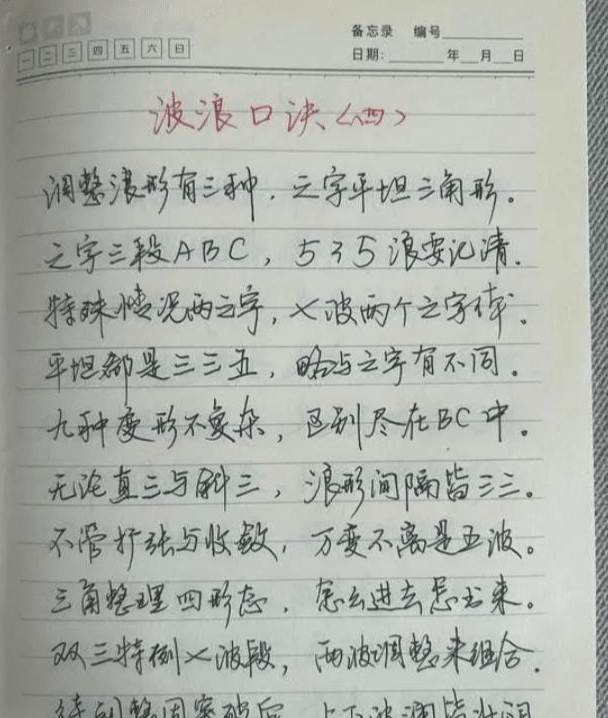
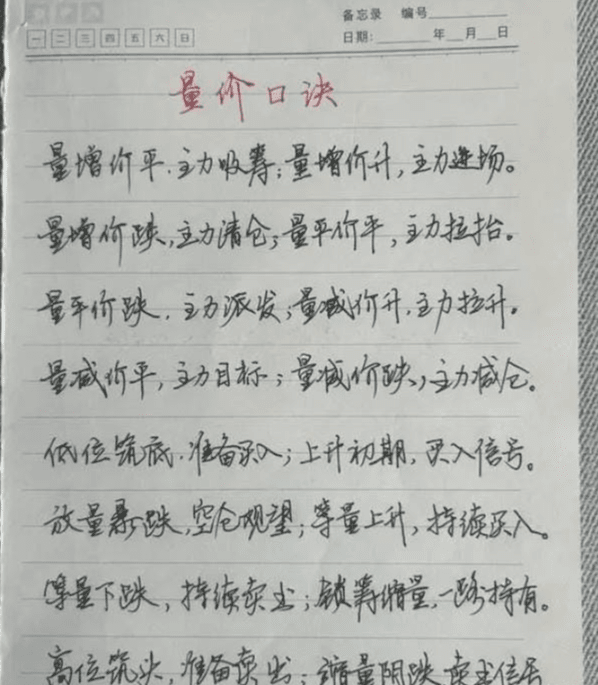
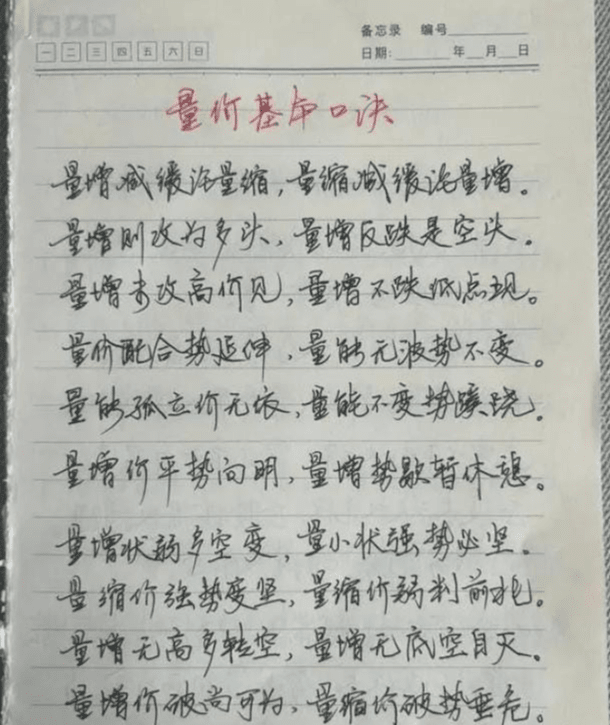
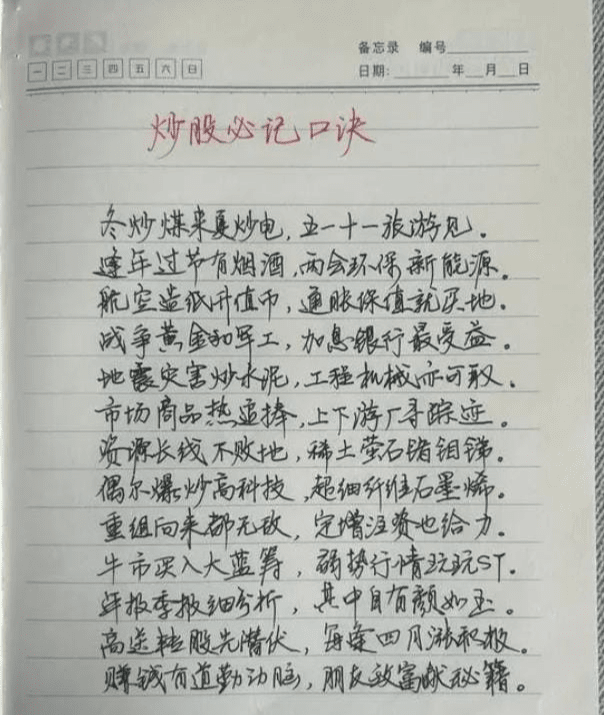
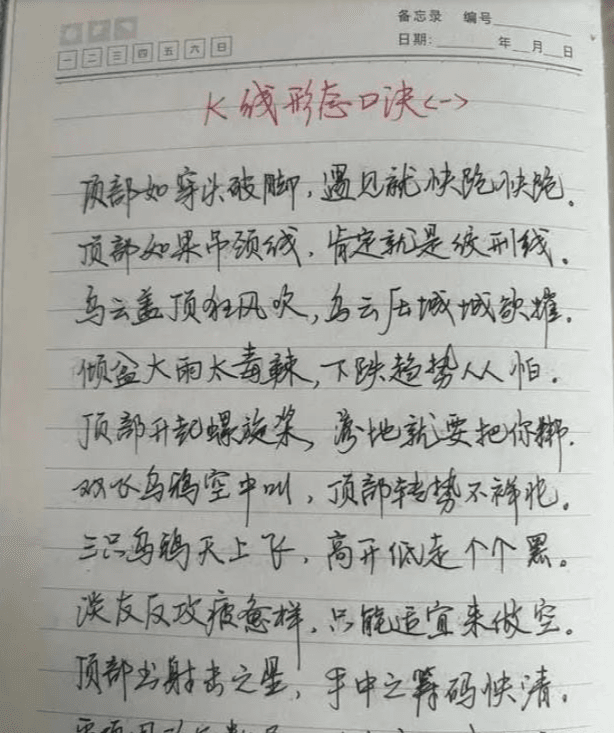
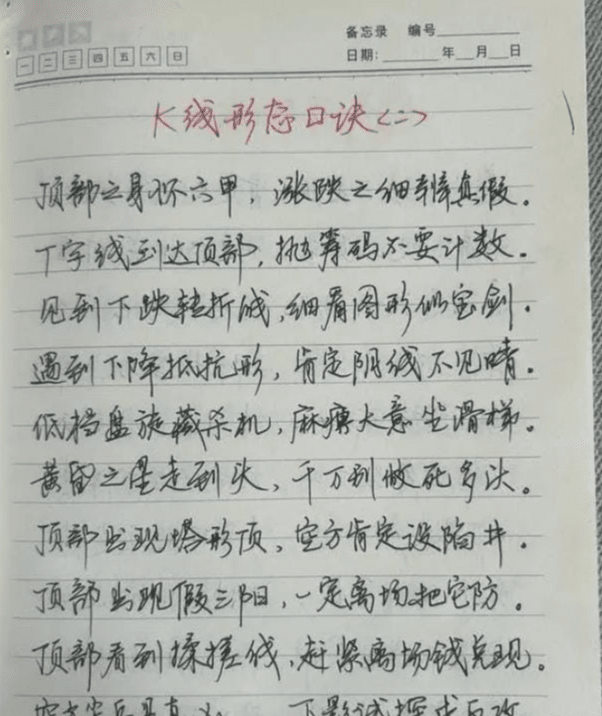
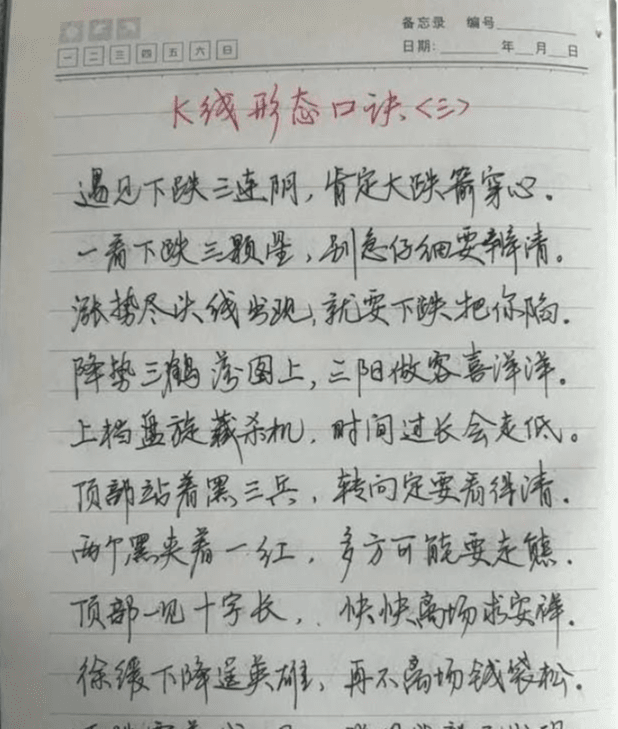
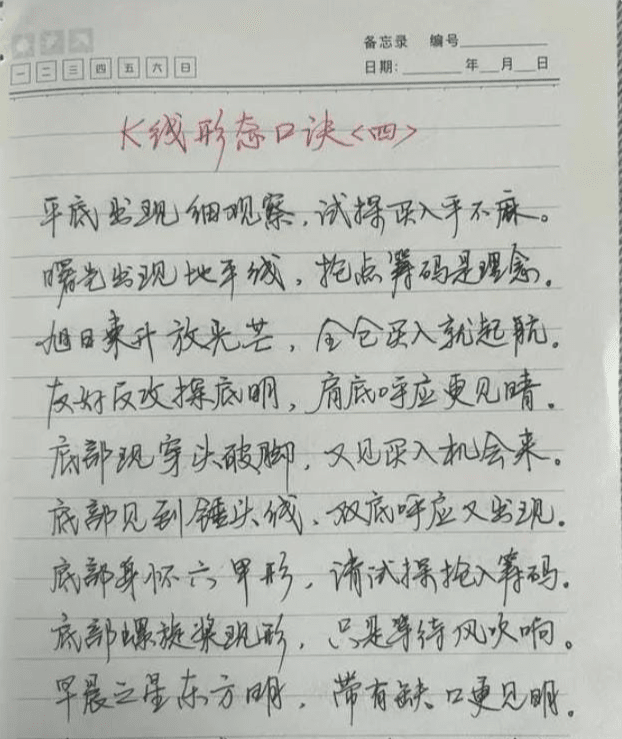
The above four dimensions are the basis for judging horizontal breakouts. To deepen everyone's understanding, I have decided to share my handwritten notes on stock trading that I have treasured for years, which condense my countless nights of reviewing. Each summary encapsulates the essence formed from my efforts.
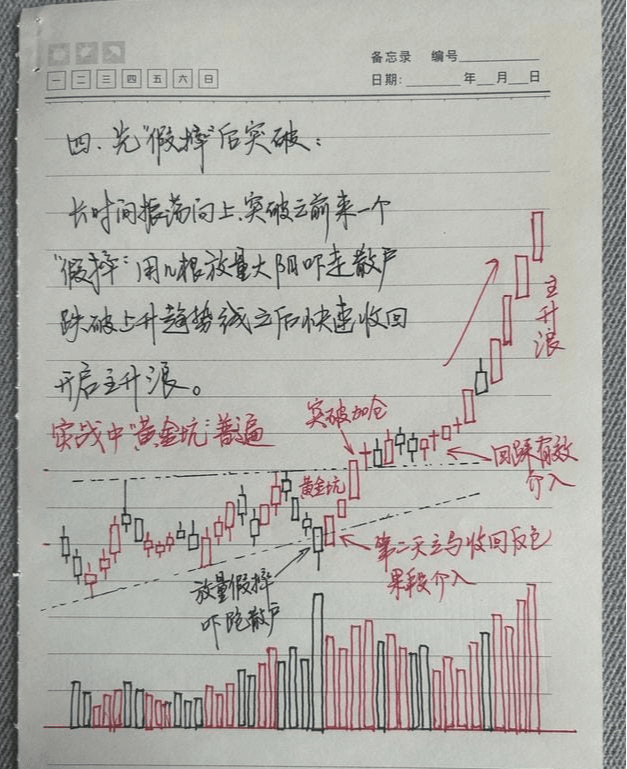
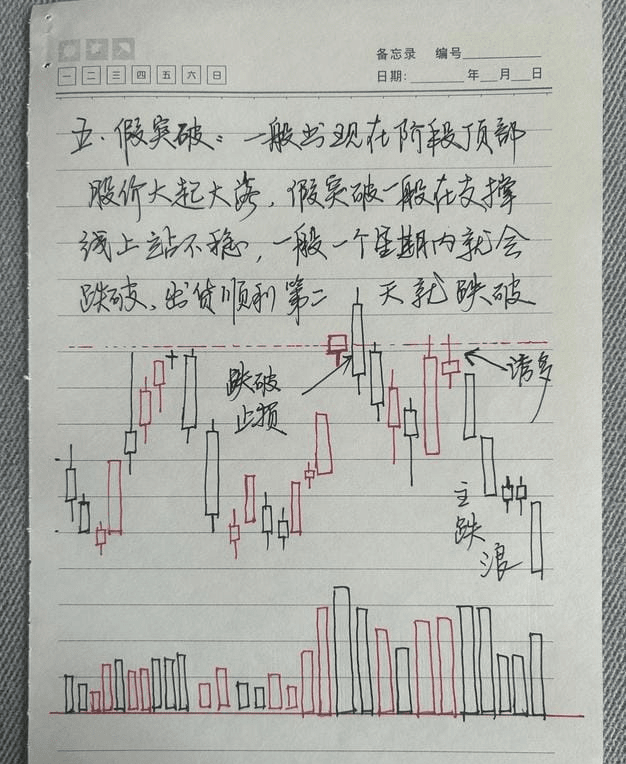
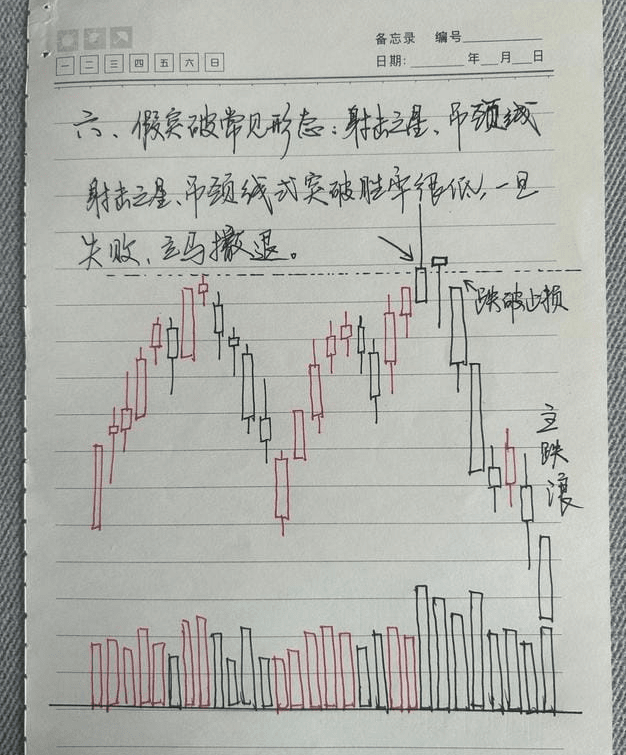
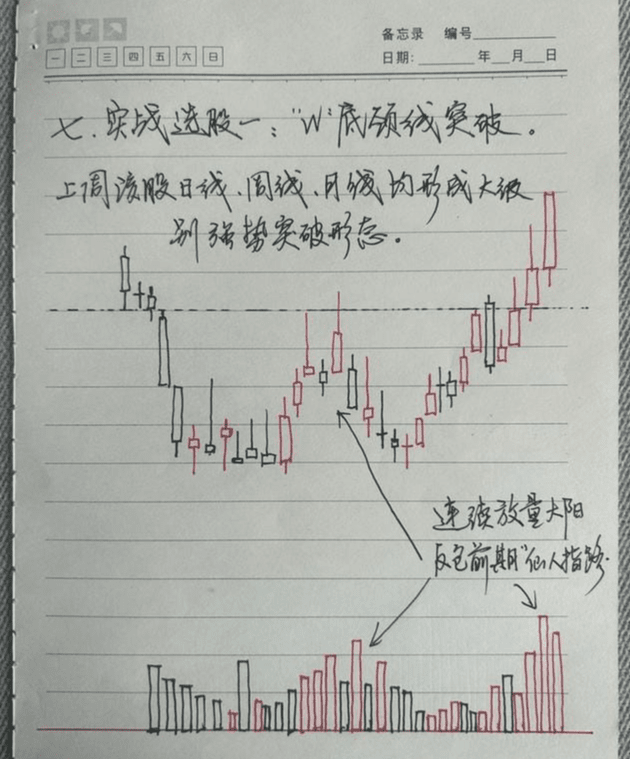
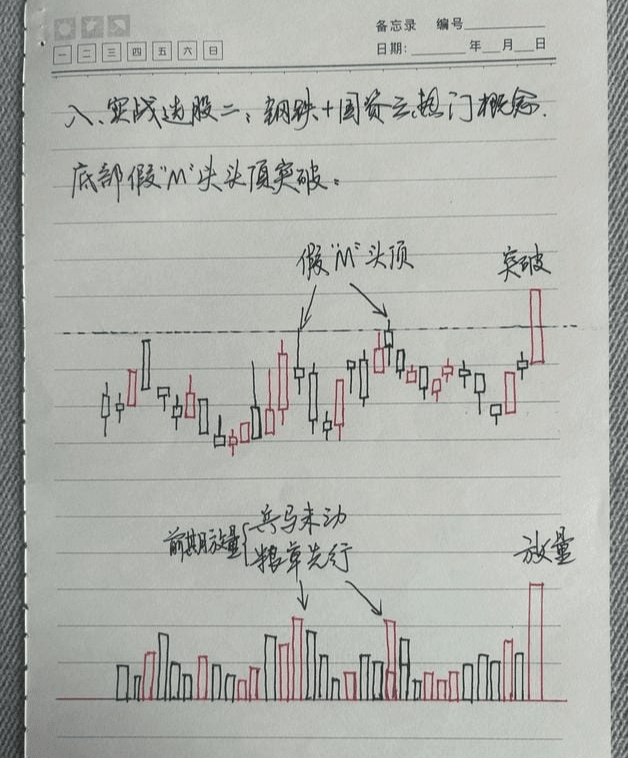
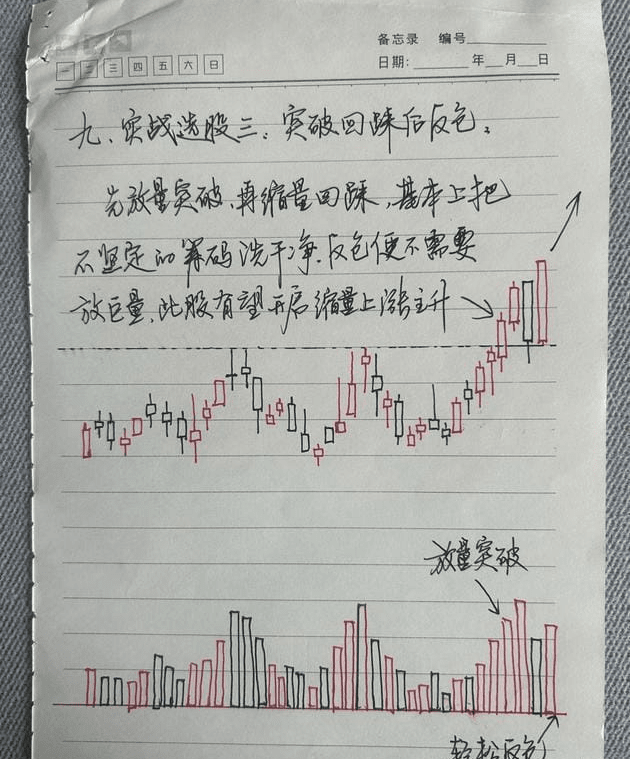 Investing is like hunting. To succeed, you must know yourself and your opponent; if you don't want to become a lamb for slaughter, you must have the spirit of a wolf, learn to persevere and endure, and when the time comes, decisively strike to obtain your own prey. The path of investment requires guidance from teachers, and teachers may not always be right, but following professional teachers will certainly allow you to learn something.
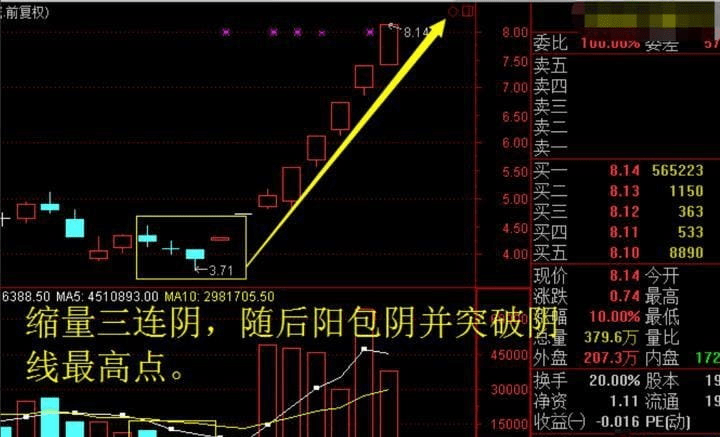
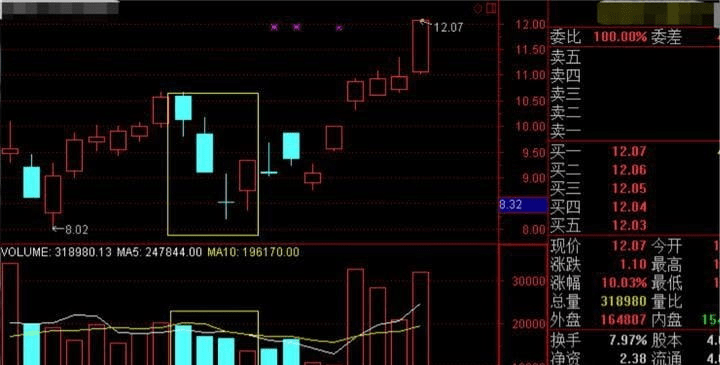
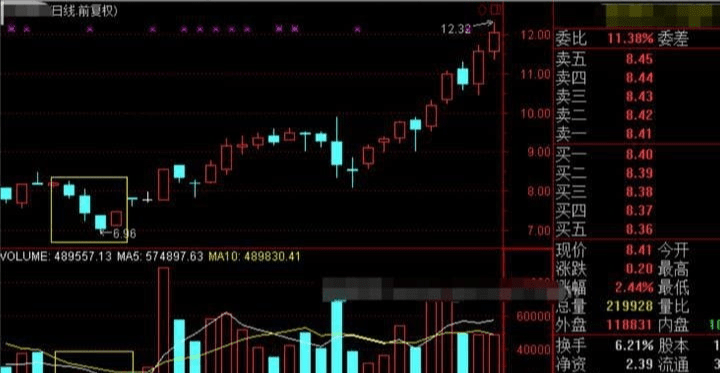
When I encounter stocks with the "bullish engulfing three black crows" pattern, I will decisively enter and wait for the limit up. If you also want to steadily and easily catch the limit up, then I suggest you study it seriously until you master it!
"Bullish engulfing three black crows" is a typical limit-up pattern; brave absorption usually catches big bull stocks!
I. What is the bullish engulfing three black crows pattern?
When a stock drops in volume for three days and the downward momentum weakens, on the next day, if it closes above the highest point of the previous day's bearish candle, the bullish strength begins to increase while the bearish strength weakens. This is the best judgment method for a trend change after a downturn. This K-line pattern, which is a bullish engulfing of three bearish candles, is called the bullish engulfing three black crows!
Market transactions create stock price fluctuations, and stock price fluctuations form K-line patterns. K-line pattern combinations lead to trends. Volume and price are inseparable; beginners look at price, experienced traders look at volume, and experts look at both volume and price together. Volume comes before price, and volume and price are one family. If used properly, you can seize opportunities and perceive the timing of stock movements and initiations.
II. Key technical points of the bullish engulfing three black crows pattern:
1. Three consecutive bearish candles with low volume, false negatives and positives do not count!
2. After three consecutive bearish candles, the closing price of the bullish candle on the next day breaks the highest point of the previous bearish candle, and you can enter at the end of the second day!
3. When the lowest point of the third bearish candle and the fourth bullish candle breaks down and cannot recover, stop loss.
4. Short-term profit taking at the high point where the decline begins, after breaking through the last high point of the decline, look for a higher level starting point of decline.
5. Short-term profit taking around 10-30%, medium-term around 50-100%.
Every K-line pattern and technical analysis can easily be re-utilized by major players. We must be flexible and follow the trend to achieve profits!
No matter what method, do not change its essence. Methods are standards, and standards are rules. Follow the methods: if it conforms, do it; if it doesn't, wait. Strictly take profits and stop losses. Today I have organized the essence of selecting stocks for the "bullish engulfing three black crows" into text and images, and I sincerely hope everyone will understand it seriously, grasp the essence, and apply it. It will be very helpful for your stock trading career!
 Buying and selling are all for profit. Coming in and going out are all for benefits.
The human heart is restless; strange and cunning techniques. Seeking methods and paths can be unknowable.
The mystery here is simple and ridiculous. It's only because you haven't broken through that you keep going in circles.
If I say it, you can smile.
There is a saying on Wall Street: "If you can survive in the stock market for ten years, you should be able to make money continuously. If you can last twenty years, your experience will be extremely valuable; if you last thirty years, then you will undoubtedly be extremely wealthy." Time will verify whether you are suitable for the stock trading industry. The stock market itself does not create wealth; it is merely a place for wealth redistribution. Those who pay for tuition to gain experience will harvest the inexperienced new entrants. New entrants pay for tuition to gain experience, and this cycle continues in the stock market.
Finally, taking advantage of the weekend, I have compiled the stock trading maxims I have summarized over the years. If you do not plan to leave the stock market within three to five years and want to treat stock trading as your second profession, you can remember the following stock trading maxims. You will applaud after reading it!
Although stock trading maxims are good, being able to use them reasonably is what elevates your level. I write each word while contemplating, applying them to practical operations is like water to a fish! Mastery comes from diligence; the maxims are like the fuel tank of a car. Relying on them helps you go further.
I rack my brains every day, wanting to selflessly share years of experience with friends in need! If you don't believe it, you can look at the notes I took, each word is sincere; I am an honest person, saying what I mean. Just like my early aspirations! I strive to write each piece diligently. If I'm not satisfied, I delete it and try again. If you understand, you will gain a lot! (The photo is a bit blurry, taken years ago.)
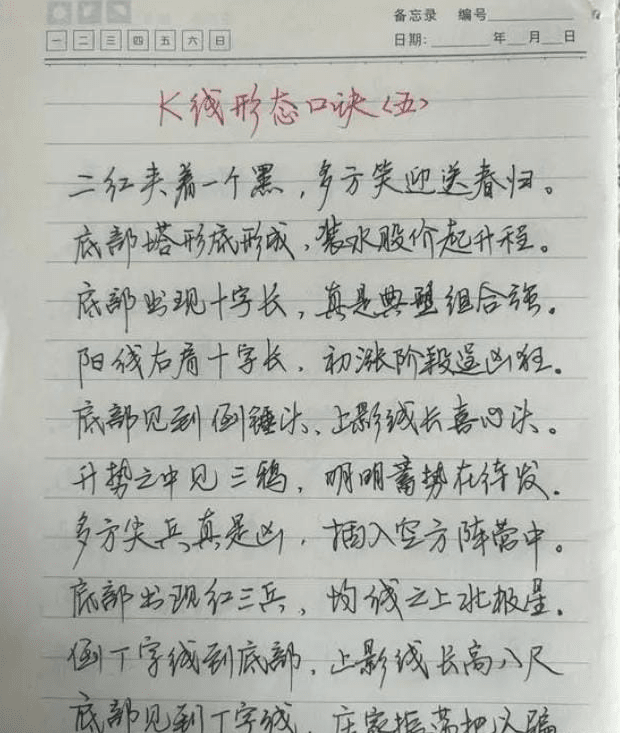
Many retail investors are torn between value investing and technical investing. In fact, understanding the stock market can only be known after enlightenment. No matter how you view the market, it only has two logics: rising and falling.
There are hundreds of methods in the market, and any one of them seems correct, but none of them is entirely right. You need to find one that you are familiar with or that suits you among these myriad methods. Then continuously summarize under what circumstances this method has a high success rate and under what circumstances it has a low success rate. After continuous summarization, it will become your own stock trading logic, and at that point, you will probably suddenly have an epiphany. If you are truly confused, remember the three maxims given by Buffett.
Follow the right people: Get close to those who are more capable than you. Even if you secretly learn a bit of their skills, it is enough for your progress.
Do the right thing: Find something you love, even if you still need to maintain your survival, but do not give up exploring. Only by doing what you love can you persist long-term.
Learn the right path: Maintain lifelong learning and stay curious throughout life to prevent your brain from degrading. These principles seem simple, but not many can truly implement them.
Buffett himself spent a lifetime verifying these experiences. We ordinary people should not expect to get rich overnight. By gradually integrating these three points into our lives, we can definitely live more clearly and steadily! As he often says: "The most important investment in life is investing in yourself and those around you."
I am Little Egg Tart, a professional analyst and educator, a mentor and friend on your investment journey! As an analyst, my fundamental job is to help everyone make money. I solve confusion and trapped positions, speaking with strength. When you are lost and don’t know what to do, follow Little Egg Tart, and I will guide you.