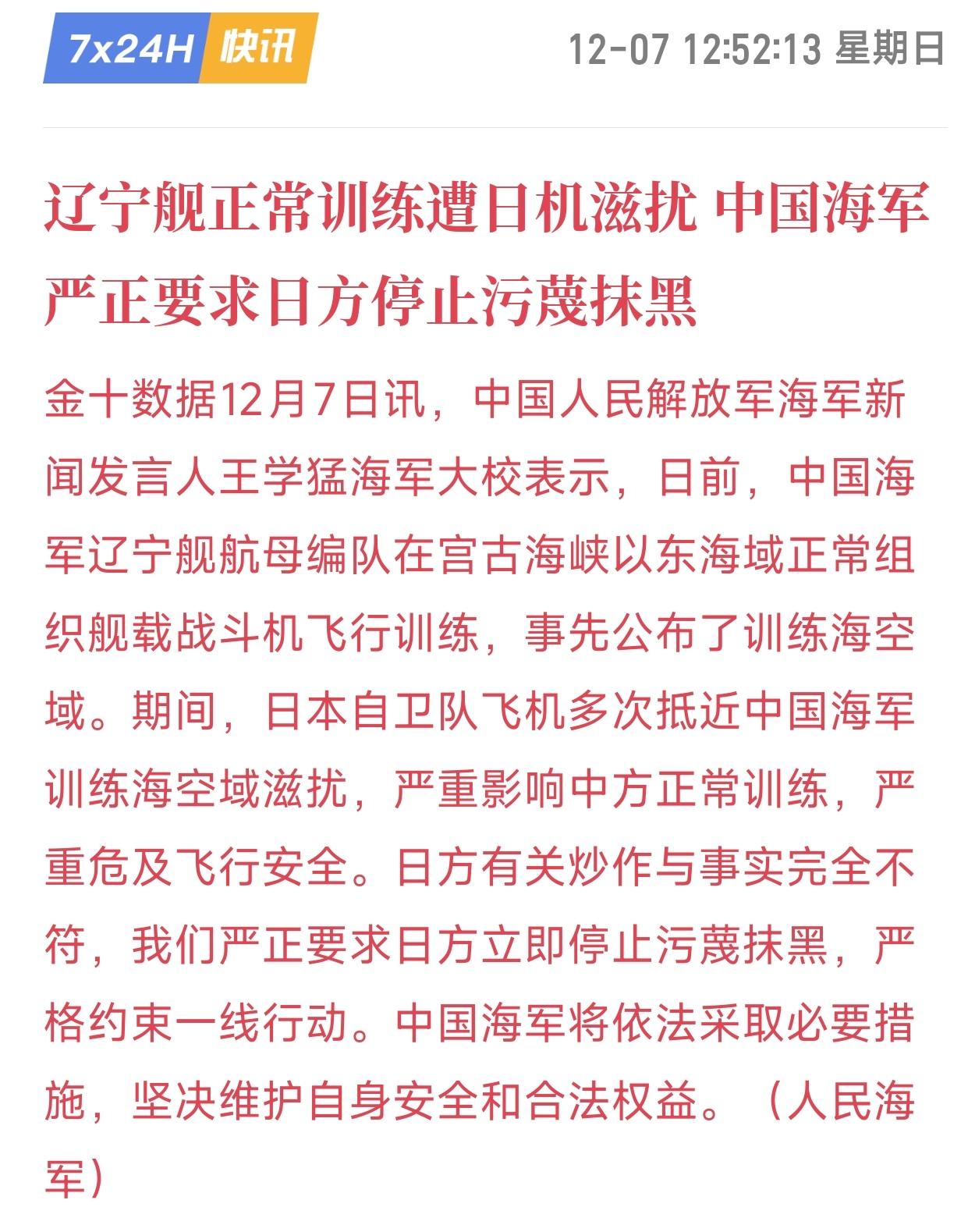
On December 7, the spokesperson for the Chinese Navy, Senior Colonel Wang Xuemeng, made a stern statement regarding the interference by Japanese forces during the training of the Liaoning Aircraft Carrier Group, pointing out that the Japanese actions not only disrupted China’s normal training and endangered flight safety, but also that subsequent sensationalism was completely inconsistent with the facts. China demands that Japan immediately stop slandering and defaming, and strictly restrain frontline actions. This response is not only a powerful rebuttal to Japan's inappropriate behavior but also a firm declaration by the Chinese Navy to defend national sovereignty, security, and development interests.
The Liaoning Aircraft Carrier Group conducted carrier-based fighter flight training in the waters east of the Miyako Strait, which fully complies with international law and international practices. Moreover, China had previously announced the training maritime airspace, fulfilling its obligation to inform adequately. The legality and reasonableness of the training are beyond doubt. As an international waterway, the Chinese Navy's regularized training in the relevant waters is a necessary measure to enhance combat capabilities and maintain regional peace and stability, as well as a legitimate right of a sovereign state.
However, Japan's Self-Defense Forces aircraft have repeatedly approached and disturbed China's training maritime airspace. Such behavior is by no means the so-called 'normal monitoring', but a deliberate interference with China's military training. Carrier-based fighter jet flight training is highly specialized and dangerous, and the close-range disturbances from Japan's aircraft can easily lead to misjudgments, collisions, and other accidents, seriously threatening the safety of personnel from both China and Japan, and undermining regional peace and stability. Even more disgraceful is that after the disturbances, Japan instead turns the tables, distorting facts and smearing China's image. This double standard and hypocritical behavior reveal its opportunistic mentality regarding regional security issues.
The response from the Chinese navy is firm and clear, clarifying the facts and drawing a clear red line. 'Taking necessary measures in accordance with the law to resolutely safeguard its own security and legitimate rights and interests' is not an empty statement, but a true manifestation of the Chinese navy's capability and determination to defend national interests. In recent years, the modernization of the Chinese navy has been steadily advancing, and long-distance training has become routine, not only honing the hard power to maintain national sovereignty but also establishing the image of a responsible major power. In the face of unwarranted disturbances and provocations from external forces, the Chinese navy always maintains a high level of vigilance, neither proactively provoking conflict nor allowing national interests to be harmed.
From a more macro perspective, Japan's recent misconduct is essentially a result of its erroneous orientation on regional security issues. For a long time, Japan has continuously exaggerated the 'China threat theory', seizing the opportunity to expand its military capabilities and break through the constraints of the post-war system, which has already aroused the vigilance of neighboring countries. The disturbances and hype regarding the Liaoning aircraft carrier's training are merely another trick to create regional tension and seek its own interests. However, Japan should be clear that the times have changed; China's determination to safeguard its national sovereignty and territorial integrity is as solid as a rock. Any attempts to curb China's development through provocation and smear tactics will ultimately backfire.
Maintaining peace and stability in the East China Sea is in the common interest of both China and Japan, as well as other regional countries. China has always upheld an objective and rational attitude and is willing to manage differences with Japan through dialogue and communication, but this must be based on mutual respect and adherence to international law. If Japan truly values regional peace, it should immediately cease disturbing China's normal military training activities, stop fabricating lies to smear China, and return to the track of rational dialogue with practical actions.
Every distant sea training conducted by the Chinese navy is a safeguard of national sovereignty; every serious response to provocative actions is a defense of peace and stability. On issues concerning the core interests of the nation, the Chinese navy will not yield an inch and will use resolute actions to ensure the safety of the country's maritime borders, building a solid barrier for regional peace and development.