


Vitalik Buterin promotes a prediction market on chain and allows Ethereum users to lock in future gas costs without trust.
This incentive comes despite gas prices sitting at their lowest levels in several years, which is claimed to potentially lead to over-satisfaction as activities move to layer two networks.
Industry analysts say this model could fill a structural gap, although some warn that classic derivatives may be susceptible to validator manipulation.
Ethereum founder Vitalik Buterin encourages a new mechanism to alleviate sudden spikes in transaction costs on the network.
His latest proposals clarify an independent forecast market on-chain designed to assist users in securing future gas prices and managing volatility rather than reacting to it.

Buterin supports the gas pricing market for Ethereum.
On December 6th, Buterin argued that $ETH needs a market-based signal for future demand for block space.
The mechanism will structure exposure trading to the base network fees by allowing participants to buy or sell gas commitments associated with a future window.
According to him, it aims to provide developers and large users a way to lock in costs and plan even when the spot gas price remains low.
The proposal comes at an unusual time, as gas prices are near their lowest levels in several years.
Etherscan data shows that the average gas price for Ethereum is around 0.468 Gwei, which is approximately three cents. This is because much of the retail network activity has moved to cheaper layer two networks like Base and Arbitrum.
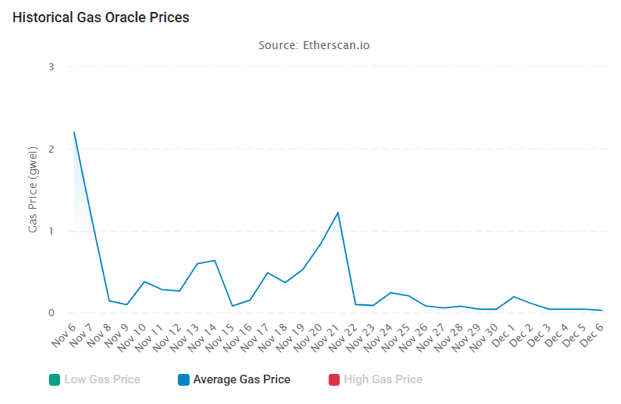
The average gas fee for Ethereum in the last 30 days. Source: Etherscan.
However, Buterin argues that the current calm leads to complacency.
He confirms that the futures curve on-chain will provide a clear signal for long-term market expectations. It will allow users to prepay for block space and lock in costs regardless of future increases.
Buterin stated that people will get a clear signal regarding their expectations for future gas fees, and they can even hedge against future gas prices by prepaying for any specified amount of gas within a specified timeframe.
Industry experts share their opinions.
Supporters of the proposal see it as an undervalued pillar in long-term $ETH design. They argue that the futures market for gas not reliant on trust will fill a structural gap instead of introducing new novelty into decentralized finance (DeFi).
They see that the BASEFEE market will align expectations with transparent pricing and provide the ecosystem with a common reference point for future network conditions.
Therefore, a liquid market for gas exposure could change this dynamic by allowing developers to purchase gas insurance to reduce operational costs before critical events. Heavy users may also be able to offset future fee spikes by taking the opposite position in the market.
The analyst stated that "if Ethereum becomes the settlement layer for everything, then gas itself becomes a financial asset. Therefore, a trustless gas futures market is not a luxury option." It seems like a natural evolution for a chain aiming for global coordination.
Meanwhile, an industry consultant at Titan Builder pointed out that operating this as a classic derivatives market would be challenging because validators can manipulate outcomes by producing empty blocks.
He added that the market for futures contracts delivered for block space with a liquid secondary market remains feasible. Such a structure could be sufficient to support general price discovery and hedging.
#Ethereum #ETH(二饼) #BinanceSquare #BinanceSquareFamily #NewsAboutCrypto
