
I keep emphasizing one thing:
The cryptocurrency world is not about luck, but about logic and execution.
Many people think that making money in the cryptocurrency world is just about making a lucky bet, but that's wrong.
The ones who can turn the tables are never those who just 'go all in', but those who have a clear position management strategy and rolling position mindset.
Let's take the simplest example:
I've seen too many people who only have 1000u, yet they go all in with their entire position, and when the market pulls back, they get liquidated to zero. But the same 1000u in my hands can be divided into 3-4 tiered positions, first locking in the base position, then using small funds to roll through waves, controlling risk tightly, yet being able to maximize profits.
The crypto world is actually quite simple:
For those with small capital to turn their fortunes around, the key is not gambling, but rather controlling risk and maximizing the odds of winning.
To avoid being taken advantage of, you must first learn to understand key support and resistance zones, rather than blindly following the crowd.
The logic behind turning the tide isn't about being fully invested every day, but about finding the "key moment," striking it with a single blow, and letting profits snowball naturally.
Why do many people feel that they are working very hard but still losing money?
Because they lack a mentor who truly understands the market and can clearly explain the risks.
There was no logic, no review, and no long-term strategy.
But I'm different—I never tell you nonsense about "making big money steadily." I only talk about solid operational logic and position sizing strategies.
Many people who have used my method know that following my rhythm...
Whether you have 300u or 3000u, at least you can survive and won't be wiped out overnight like a leek.
You need to understand that the only shortcut in the cryptocurrency world is to follow the right people and take the right path.
If you're on the right track, the money will come naturally.
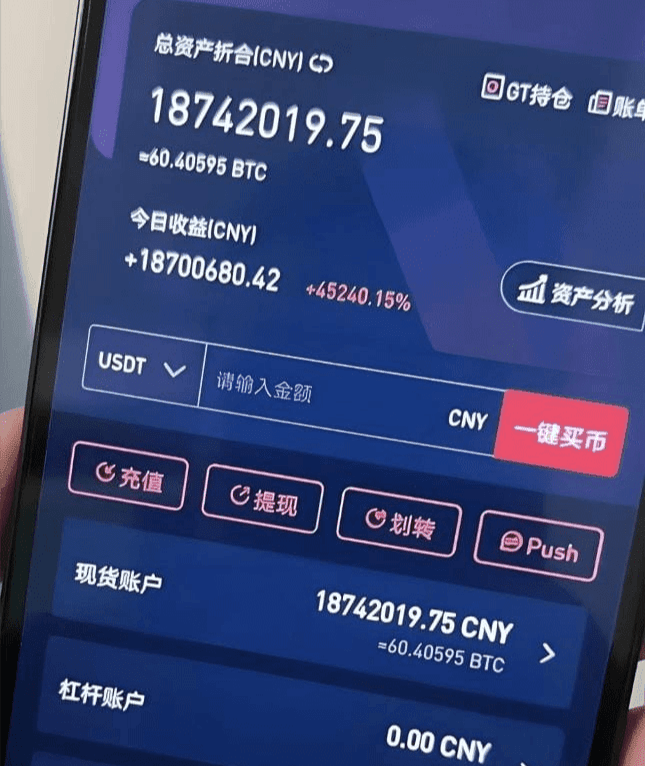
Lessons learned the hard way! Three counterintuitive rules for stable profits in cryptocurrency – how many people have failed because of them!
I've been in the cryptocurrency world for 10 years, from being severely liquidated by leverage to now achieving a stable monthly return of 15%.
I have come to a profound and cruel truth: in the cryptocurrency world, only a minority of people ever make money.
They are not exceptionally gifted or brilliantly intelligent, but rather they dare to defy human instincts and strictly adhere to the rules.
Treat technology as a "shield" for survival in the cryptocurrency world.
Today, I am determined to tear away the glamorous facade of all "get-rich-quick" myths and tell everyone with my own painful and hard-won lessons: if you want to establish yourself in the cryptocurrency world for the long term and make steady money, you must master these three "anti-instinctive" rules.
Technology isn't some mysterious thing; it's your "safety armor"—99% of people who lose money don't even understand the basics of candlestick charts!
What's the most common mistake newcomers to the cryptocurrency world make? They immediately shout "I'm going all in!" and only focus on whether the price is going up or down when watching the charts, without even understanding basic concepts like "support levels" and "resistance levels."
I've seen too many people like this. When Bitcoin rises to 60,000, they get incredibly excited, thinking it will definitely hit 100,000, so they buy in like crazy. When it drops to 30,000, they panic and sell at a loss. In the end, they realize they're just "puppets" in the hands of big money, manipulated at will.
Those who truly understand technical analysis will treat candlestick charts as a "health monitoring chart" for analysis. Don't blindly believe in so-called secrets like "golden crosses and silver crosses." Remember these three practical and hardcore operations:
Trend lines determine direction: Use the 30-day moving average to define key boundaries. When the price is above the moving average, only consider going long; once the price falls below the moving average, immediately go short and patiently wait for the next opportunity. Take Ethereum's price action last year as an example, rising from 1800 to 2800. I locked in 80% of my profits using this 30-day moving average.
Support and resistance levels are crucial "life-or-death switches": use Fibonacci retracements to find previous highs and lows. For example, when Bitcoin fluctuated around the 30,000 level (the 0.618 Fibonacci retracement level), I dared to buy the dip every time the price broke below this level. This is because historical data shows that 90% of crashes do not break through key support levels in one go. This is like taking out insurance for your investment, reducing risk.
MACD + Bollinger Bands = "Top-Selling Secret": When the MACD shows a high-level death cross and the upper Bollinger Band opens downwards, no matter how strong the upward trend is, you must immediately liquidate your position. In May of this year, when Bitcoin surged to 30,000, I used this method to successfully escape before the crash, while those "die-hard bulls" around me who were blindly bullish are still trapped and have suffered heavy losses.
Remember, technical analysis isn't about predicting the future; it's about helping you understand the warning signals the market sends. Those who don't understand technical analysis are like driving blindfolded in the dark—they're not just bound to crash sooner or later, they're likely to have an accident the moment they get in.
Position management is more important than technical skills—a 10% increase in greed can lead to a 30% faster account wipeout!
The craziest thing I've ever seen is someone putting all their savings into buying altcoins, eagerly adding to their position when it rises by 10%, and then getting liquidated and losing everything when it drops by 20%. This kind of "gambler's trading" essentially means completely handing over one's fate to the market, instead of taking control of it.
To truly achieve stable profits, the key is "pyramid-style position management." How exactly does this work?
Initial position should not exceed 10%: No matter how bullish you are on a coin, when you first buy, use no more than 10% of your funds to test the waters. For example, if you have 100,000 in capital, buy a maximum of 10,000 for the first time. If the price rises after purchase, use a "decreasing averaging down" method—add 5% to your position when it rises by 10%, add 3% when it rises another 10%, and keep the remaining 2% to "pick up bargains" at the right time. If the price falls after purchase, immediately cut your losses. Never blindly add to your position, otherwise you will only get deeper into trouble.
Dynamic stop-loss = a lifesaver: Don't believe the nonsense that "holding long-term will make you money." The cryptocurrency market changes extremely quickly, almost daily. My principle is: set a 5% stop-loss for short-term trades, 10% for medium-term trades, and 20% for long-term holdings (more than 3 months). Last year, when I held ADA (Cardano), I successfully preserved my principal and avoided greater losses because I set a 15% stop-loss in advance, before it plummeted by 30%.
Always keep 30% cash on hand: When the market is at its most frenzied, cash is your "secret weapon." This March, when Silicon Valley Bank collapsed and Bitcoin plummeted by 25%, I decisively used my reserved 30% cash to buy at the bottom, earning 40% in just half a month. Those who were fully invested could only watch the opportunity slip away, filled with regret.
Remember, the core of position management is "survival first." You might think that making a 100% profit requires doubling your capital, but in reality, losing 50% only requires another 50% loss to wipe out your account. "Where there's life, there's hope"—this is an ironclad rule in the crypto world!
Human nature is the biggest "culprit" - 90% of losses are caused by "reckless actions" and "impulsiveness"!
I used to be a fool swayed by my emotions: seeing others post about making a 50% profit, I couldn't resist immediately buying in at the peak; when my account balance turned positive, I'd get carried away, thinking I was an investment genius; when it turned negative, I'd panic and lose sleep, wanting to sell at a loss immediately. It wasn't until I lost 50% of my principal that I finally woke up: the biggest enemy in the crypto world isn't the market, but the "greedy ghost" and "fear monster" within myself.
So, how do we overcome human nature? Remember these three "counter-instinct" techniques:
Write your "trading script" in advance: Before the market opens each day, write down in detail the "logic for buying or selling, position sizing, and stop-loss settings" on paper. For example: "Buy ETH because it broke through the 2000 resistance level; position sizing is 5%; stop-loss is set at 1950." In the afternoon, no matter how wildly the market rises or falls, strictly follow this "script" to execute your trades. Those who can't control themselves don't deserve to make money in the crypto world.
"Forced shutdown" during market crashes: I have three market data apps on my phone, but when the market drops by more than 10%, I uninstall them without hesitation. Then I go for a run or play games to calm myself down before checking the market again. Last year, Bitcoin dropped 20% in one day, and after I shut down my phone, I found it had rebounded by 5% the next day. Those who couldn't resist cutting their losses suffered far more than I did.
When making a profit, I "hypnotize" myself: Don't get too excited if you earn 10%, and don't get overconfident if you earn 50%. I regularly transfer a portion of my profits out of the crypto market because I know that much of the money in the crypto world is just "paper wealth," and only what is actually in my pocket is real money.
Remember, in the cryptocurrency world, "rationality" is the rarest and most valuable quality. If you can control your emotions, you can control your account; if you can restrain your desires, you can control your life.
Finally, let me tell you the most honest truth:
The cryptocurrency market is never a "casino for overnight riches," but rather a "battleground that tests human nature." Technical skills are merely tools for survival in this market, position management is a strategy to ensure profitability, but human nature is the fundamental factor determining our ultimate success or failure. Stable profits are never achieved through blind gambling, but rather through a well-developed system.
If you are still losing money in the cryptocurrency market, it's not because you're not smart enough, but because you haven't learned to "go against your instincts": against greed, against fear, and against laziness.
Remember, those who survive in the crypto world in the long run are always the ones who "fight the rules to the death and respect the market."
I hope my experience can help everyone avoid pitfalls in the cryptocurrency world and achieve stable profits as soon as possible!
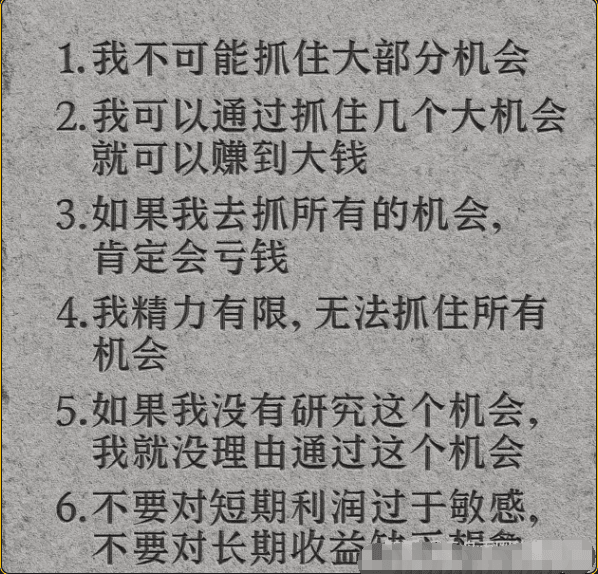
Trading secrets that allow ordinary people to make big money: The Turtle Trading Rules, which are so simple that they only require 4 steps!
In short: What is the Turtle Trading Rules?
"Don't try to predict whether prices will rise or fall, just follow the trend; make big profits and small losses, and you'll consistently win in the long run."
Like surfing: you don't predict the waves, but when you see a big wave coming, you jump on it, and when the wave gets smaller, you get off.
II. The core of making money: mathematical probability (even elementary school students can understand it)
Suppose you are playing a game:
Flip a coin: heads you win 10 yuan, tails you lose 8 yuan.
If you play 100 times, you'll likely win about 50 times (+500) and lose about 50 times (-400).
A net profit of 100 yuan (this is a "positive expected value")
The secret of sea turtles:
Use the same logic to trade, ensuring that you **make more money when you win and lose less when you lose**.
III. How exactly do I do it? (4-step, foolproof tutorial)
Step 1: When to buy?
Breakout method (look at the highest price in the last 20 or 55 days):
For example, if the highest price of Moutai in the past 20 days was 1800 yuan, and it rose to 1801 yuan today, buy it immediately (just like an athlete breaking a historical record, it is highly likely to continue to rise).
Step 2: How much to buy?
official:
How many lots to buy = (1% of your principal) ÷ (volatility risk of the instrument)
For example:
If you have 1 million, 1% is 10,000.
Gold has been fluctuating by an average of 10 yuan/gram per day recently. One lot = 1000 grams → Volatility risk = 10 x 1000 = 10,000 yuan.
Buy 1 lot (10,000 ÷ 10,000 = 1)
Step 3: When to sell?
Stop loss: Cut your losses when you lose 2% of your principal (for example, if you lose 20,000 out of 1 million), then exit the position.
Take profit: Only sell when the price falls below the 10-day low (short-term) or the 20-day low (long-term).
Step 4: Techniques for Adding to Your Position
Add to your position every time the price rises slightly (but a maximum of 4 times):
First time buying a new
Add one more lot for every 5% increase (or at fixed intervals) (like a snowball effect, the stronger the trend, the more you earn).
IV. Why do most people lose money?
Three ways to court death:
1. "This time is different" → Disregarding the rules and operating recklessly.
2. "Just wait a little longer and you'll break even" → Stubbornly holding on without cutting losses
3. "All in" → gamble with a large bet on luck
The turtle's advice:
"Making money doesn't depend on divine predictions, but on making fewer mistakes."
V. How can ordinary people use it? (Simplified version)
1. Choose a product (stocks/futures/foreign exchange/cryptocurrency are all acceptable).
2. Check the price every day:
Breaking the 20-day high → Buy
Falling below the 10-day low → Sell
3. Always remember:
Invest only 1% of your principal each time.
Cut your losses at 2%.
The last truth
"The turtle principle is like losing weight—the method is simple, but 90% of people fail because they can't control their spending."
If you can strictly follow the instructions, you can beat most of the "experts" who just mess around.
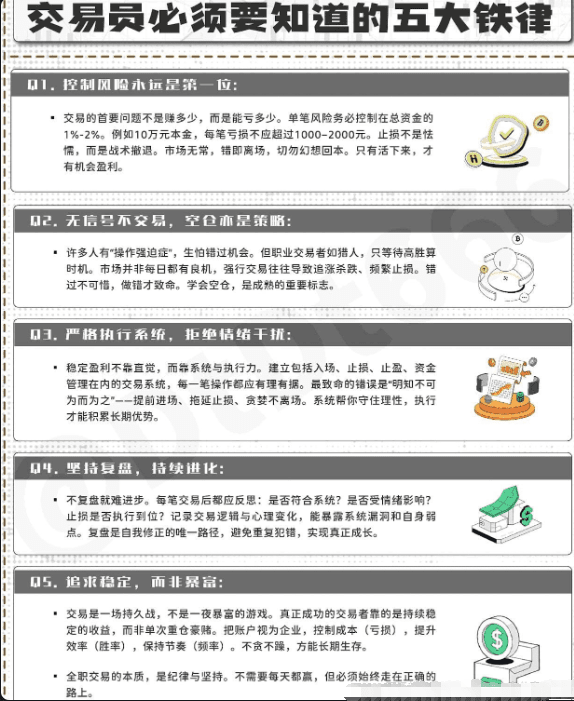
Lessons learned the hard way! 7 trading mistakes that can wipe you out in the end!
1. Unclear overall trend (chaotic cycles)
The market has only three states: rising, falling, and fluctuating.
Shorter timeframes (such as hourly charts) often contradict each other, but the direction is clearer on longer timeframes (daily/weekly charts).
Remember: A large tree falls more slowly than it grows, and major trends don't suddenly reverse.
Countermeasure: Only trade the trend direction on the monthly/weekly chart.
2. Randomly firing shots (entering the field at will)
The market walks like a drunkard: sometimes it makes sense (fundamentals), sometimes it goes on a drunken rampage (emotions).
The bubble can last a long time, just like a drunk person can walk a long way before collapsing.
Don't be a "street warrior": Don't try to short a stock that's skyrocketing, and don't try to buy the dip after a crash.
Countermeasure: Wait until the drunkard starts leaning against the wall (a sign of weakening trend) before considering a reversal.
3. Excessive trading (itchy hands)
High-frequency trading is like a gambling machine: exciting but money-draining.
You think you're playing Temple Run, but it's actually a squid game.
The profits gained in a volatile market are often less than the losses in a trending market.
Solution: Limit trading to no more than 3 times per day; if you miss a trade, wait until tomorrow.
4. Failing to back down when one should, and failing to be aggressive when one should (emotional mismatch)
Common mistakes made by retail investors: "It's fallen so much, it should go up now" (catching a falling knife); "It's risen so sharply, it should fall now" (missing out on the market).
The Smart Man Trap: Using the Logic of a PhD Thesis to Stir Up a Market
Correct posture:
In an uptrend: Be willing to buy on pullbacks (but not wait for the absolute bottom).
In a downtrend: Be willing to short on a rebound (but don't wait for the highest point).
5. Impatience (lack of waiting)
Good opportunities are like buses: if you miss this one, there's always the next one.
Market data is a buffet for institutional investors; retail investors can only pick up the scraps.
Two correct postures:
Radicals: Following the trend within 5 minutes of the data release
Conservatives: Let's wait until the next day.
6. Stubbornly refusing to admit mistakes (an obstacle to stopping losses)
Human nature flaw: Take profits quickly and run; hold on to losses stubbornly.
Market Truth: A Cure for All Dissent
Stop-loss is like buying insurance: paying money for peace of mind.
Remember: If an alligator bites your hand, don't give it your whole arm.
7. Mystical stock trading (due to lack of knowledge)
Mistaking ignorance for metaphysics: "I was just unlucky this time"
Trading is not enlightenment, it's a mathematical game.
Essential knowledge:
Position control (each bet should not exceed 2% of the principal).
Probabilistic thinking (nothing is 100% certain)
Sentiment Cycle (The market goes crazy in a frenzy that even the market itself is afraid).
Survival Rules:
1. Use a long-period telescope to determine direction.
2. Wait for the opportunity like a sniper.
3. Stop-loss is more important than take-profit.
4. Controlling your position size is like controlling your diet.
5. Record every transaction, like keeping a diary.
Understanding the cryptocurrency trading process: These steps are all you need.
To succeed in cryptocurrency trading, first understand these eight key steps; following them will lead to greater efficiency:
1. Choosing a currency pair: First, select the currency pair you want to trade, such as the common BTC or ETH. Once you have a clear target, there's no need to be greedy.
2. Control funds: Plan your holdings carefully, taking into account your own money management style and risk tolerance. Don't invest too much at once.
3. Determine the direction: Next, determine whether to buy or sell. Don't rely on feelings; you must refer to market trends and technical analysis to make a decision.
4. Find the right opportunity: Then determine the entry price, such as by looking at technical indicators, support or resistance levels, and find a suitable entry point before taking action.
5. Set a stop loss: It is essential to set a stop loss price, which means to exit the market immediately when the loss reaches this amount to control the risk. It is generally set below the entry price.
6. Set a profit target: You also need to set a profit target price. Once you have earned the profit you expect, you should exit the market and protect the money you have made. Set the profit target price according to your pre-planned target price.
7. Prepare contingency plans: Think ahead about what to do in case of emergencies, such as major market news or sudden and significant price fluctuations, and know how to respond.
8. Make a summary: After the transaction is completed, it is important to wrap things up properly, such as keeping a trading log, summarizing the lessons learned, and then adjusting the subsequent strategy as needed.
Once the strategy is set, execute it according to the plan. Be patient, strictly adhere to your trading rules, and don't let your emotions get the better of you. Just wait quietly for the market to move in the direction you expect.
Over time, there are only two possible outcomes for a transaction:
If you lose money, summarize your experience and learn from your mistakes. Don't be discouraged—losses are normal in trading, so there's no need to dwell on them.
If you've made a significant profit, it's best to secure it first. You can also consider increasing your position size or adjusting your stop-loss order to see if you can earn even more.
Wenjing is focusing on spot trading of Ethereum futures contracts; the team still has spots available, so get on board quickly! #加密市场观察 $ETH

