
In the cryptocurrency world, there is indeed a way to quickly earn 1 million, far better than putting your principal in USDT and earning interest at an annual rate!
Rolling positions, a strategy that is only used when major opportunities arise, does not require frequent operations. As long as you seize a few such opportunities in your lifetime, you can accumulate from zero to tens of millions. And having tens of millions in assets is enough to elevate an ordinary person into the ranks of the wealthy and achieve financial freedom.
I have been in the cryptocurrency world for 10 years, and I have already achieved financial freedom with a total asset of over 40 million. Let me tell you a super simple trading method:

If you want to learn how to roll over positions, or how to grow from a few thousand to millions, then you should read the following content carefully.
Since the Federal Reserve cut interest rates, many newcomers have flocked to the cryptocurrency market. The cryptocurrency world is a place of survival of the fittest. The entry barrier is low; anyone can enter, but not everyone can make money. If you plan to enter the cryptocurrency world, please remember that it's not a place for overnight riches, but rather a field that requires long-term accumulation and continuous learning.
Many people enter the cryptocurrency world dreaming of getting rich overnight, fantasizing about turning a few thousand dollars into a million. While some have succeeded, in most cases it can only be achieved through "rolling over" the position. Although rolling over is theoretically possible, it is by no means an easy path.
Turn your money around 100 times in 3 months and easily earn 10 million.
I. Determining the Timing of Rolling Over Positions
Rollover trading isn't something you can just do on a whim; certain background and conditions are required for a higher chance of success. The following four situations are most suitable for rollover trading:
(a) Breakout after a long period of sideways movement: When the market has been in a sideways state for a long time and the volatility has dropped to a new low, once the market chooses a direction to break out, rolling over positions can be considered.
(ii) Buying the dip during a bull market: In a bull market, if the market experiences a sharp rise followed by a sudden drop, you can consider using a rolling position strategy to buy the dip.
(iii) Weekly breakout: When the market breaks through a major resistance or support level on the weekly chart, consider using rolling positions to seize the breakout opportunity.
(iv) Market sentiment and news events: When market sentiment is generally optimistic or pessimistic, and there are major news events or policy changes that may affect the market in the near future, the use of rolling position operation can be considered.
Rollover operations have a relatively high success rate only in the four situations mentioned above; otherwise, caution should be exercised or the opportunity should be avoided. However, even when the market appears suitable for rollover operations, strict risk control and setting stop-loss points are necessary to prevent potential losses.
II. Technical Analysis
Once you've confirmed that the market meets the conditions for rolling over positions, the next step is technical analysis. First, you need to confirm the trend using technical indicators such as moving averages, MACD, and RSI. If possible, combine multiple technical indicators to confirm the trend direction; after all, it's always good to be prepared.
Secondly, it's crucial to identify key support and resistance levels to determine the validity of any breakouts. Finally, utilize divergence signals to capture reversal opportunities.
(Divergence signal: When the price of a coin reaches a new high, but the MACD does not, forming a top divergence, it indicates that the price will rebound, and you can reduce your position or go short; similarly, when the price reaches a new low, but the MACD does not, forming a bottom divergence, it indicates that the price will rebound, and you can add to your position or go long.)
III. Warehouse Management
After completing this step, the next step is position management. Sound position management involves three key steps: determining the initial position size, setting rules for adding to the position, and developing a strategy for reducing the position. Let me give you an example to help you understand the specific operations of these three steps:
Initial position: If my total capital is 1 million yuan, then the initial position should not exceed 10%, that is, 100,000 yuan.
Adding to your position: You must wait until the price breaks through the key resistance level before adding to your position. Each addition should not exceed 50% of the original position, that is, a maximum of 50,000 yuan.
Position reduction strategy: Gradually reduce positions after the price reaches the expected profit target; don't hesitate when it's time to let go. Each reduction should not exceed 30% of the existing position to gradually lock in profits.
As ordinary people, we should deposit more money when there are more opportunities and less when there are fewer opportunities. If we are lucky, we can make millions, and if we are unlucky, we can only accept our losses. But I still want to remind you that when you make money, you should withdraw the principal you invested and then use the profit to play. You can not make money, but you cannot lose money.
IV. Adjusting Positions
After completing position management, the most crucial step is figuring out how to achieve rolling over of positions through position adjustments.
The operation steps are undoubtedly just those few steps:
1. Timing: Enter the market when the conditions for rolling over positions are met.
2. Opening a position: Open a position based on technical analysis signals and choose a suitable entry point.
3. Adding to positions: Gradually add to positions as the market continues to move in a favorable direction.
4. Reduce positions: Gradually reduce positions when the predetermined profit target is reached or when the market shows a reversal signal.
5. Closing the position: When the profit target is reached or a clear reversal signal appears in the market, close the position completely.
Here I will share with you my specific steps for rolling over positions:
(a) Adding to positions with floating profits: When the invested assets appreciate, you can consider adding to your position, but the premise is to ensure that the cost of holding the position has been reduced, thereby reducing the risk of loss.
This doesn't mean you should add to your position every time you make a profit, but rather do so at the right time. For example, you can add to your position during a breakout from a consolidation pattern and then quickly reduce it after the breakout. You can also add to your position during a trend pullback.
(ii) Base position + T+0 trading: Divide assets into two parts, one part remains unchanged as the base position, and the other part is used for...
Buying and selling during market price fluctuations aims to reduce costs and increase profits. The following three ratios can be considered as a reference:
1. Half-position rolling: Half of the funds are used for long-term holding, and the other half is used for buying and selling when prices fluctuate.
2. 30% base position: 30% of the funds are held long-term, and the remaining 70% is used for buying and selling when prices fluctuate.
3. 70% core position: 70% of the funds are held long-term, and the remaining 30% is used for buying and selling when prices fluctuate.
The purpose of this is to optimize holding costs by taking advantage of short-term market fluctuations while maintaining a certain level of position.
V. Risk Management
Risk management mainly consists of two parts: overall position control and capital allocation. It's crucial to ensure that the overall position does not exceed the acceptable risk level, and capital allocation must be reasonable; avoid putting all funds into a single trade. Real-time monitoring is also essential, closely observing market dynamics and changes in technical indicators, and adjusting flexibly according to market changes, including timely stop-loss or position adjustments when necessary.
Many people who hear about rolling over positions are probably both scared and eager to try it, wanting to give it a shot but also afraid of the risks. In fact, the rolling over strategy itself is not very risky; the risk lies in leverage, but even with proper use of leverage, the risk is not very high.
For example, if I have 10,000 yuan in capital and open a position in a cryptocurrency at 1,000 yuan, using 10x leverage and only using 10% of my total capital (1,000 yuan) as margin, this is effectively equivalent to 1x leverage. Setting a 2% stop-loss means that if the stop-loss is triggered, I will only lose 2% of that 1,000 yuan, which is 200 yuan. Even if the liquidation conditions are eventually triggered, you will only lose that 1,000 yuan, not your entire capital.
Those who suffer margin calls often do so because they used higher leverage or larger positions, making them susceptible to liquidation even from slight market fluctuations. However, with this method, even if the market moves against you, your losses will be limited.
So you can use 20x leverage, 30x leverage, or even 3x leverage, or even 0.5x leverage. Any leverage is possible; the key is to use and control your position size appropriately.
The above is the basic process of using the rollover method. Friends who want to learn can watch it several times and think about it carefully. Of course, there will be different opinions, but I only share my experience and do not try to persuade others.
So how can someone with a small amount of capital grow it into a large enterprise?
Here, we must mention the effect of compound interest. Imagine you have a coin whose value doubles every day; after a month, its value will become astonishing. The value doubles on the first day, doubles again on the second, and so on, eventually resulting in an astronomical figure. This is the power of compound interest. Even a small initial investment can grow to tens of millions through continuous doubling over a long period.
For those looking to enter the market with a small amount of capital, I suggest focusing on larger goals. Many people believe that small capital should be used for frequent short-term trading to achieve rapid growth, but this is actually more suitable for medium- to long-term investments. Rather than focusing on earning small profits every day, you should focus on achieving several times the growth with each trade—using multiples as the unit, exponential growth.
When it comes to position sizing, the first thing to do is to diversify risk and not concentrate all your funds in a single trade.
You can divide your funds into three or four parts, and only use one part for each trade. If you have 40,000 yuan, divide it into four parts and use 10,000 yuan for each trade. Secondly, you should use leverage appropriately. My personal suggestion is not to use more than 10 times leverage for Bitcoin and Bitcoin 2, and not more than 4 times leverage for altcoins. Furthermore, you should adjust your strategy dynamically. If you lose money, supplement with an equal amount of funds from external sources; if you make a profit, withdraw funds appropriately. The key is to avoid losing money altogether.
Finally, you can add to your position, but this should only be done if you are already in a profit. As your capital grows to a certain level, you can gradually increase the amount of each trade, but don't add too much at once; transition slowly.
I believe that with proper position management and sound trading strategies, even small amounts of capital can gradually achieve significant growth. The key is to patiently wait for the right opportunity and focus on the big goals of each trade, rather than small daily profits.
Of course, I've also experienced margin calls, but I still had profits from my spot trading to offset my losses. I don't believe you haven't made a single penny from your spot trading. My futures only account for 2% of my total capital, so no matter how much I lose, I won't lose it all, and the amount of loss has always been within my control.
Finally, I hope that each of us can accumulate knowledge and skills and eventually make a fortune, earning hundreds of millions.
I. Rollover Operation Steps
1. Choose a target: Select a cryptocurrency that you believe will appreciate in value in the future.
2. Initial Purchase: Buy the cryptocurrency with all your funds. 3. Set Stop-Loss: Set a stop-loss order below the purchase price to limit your losses. 4. Monitor the Market: Continuously monitor market movements. 5. When the Price Rises: If the price rises to the preset target, use part of the profits to add to your position and buy more. 6. Repeat Steps 4 and 5: Continue to monitor the market and add to your position when the price rises.
Many people believe that rolling over positions is risky, but compared to opening futures positions, the risk is actually more controllable.
The following will be taught from a practical perspective.
II. Understanding Rollover Through Case Studies
A review of the 2020-2021 Bitcoin bull market. From October 2020 to March 2021, Bitcoin rose from $10,000 to $60,000. Using this market movement as an example, we will review how rolling over positions can help capital grow rapidly.
This is a one-sided upward trend within a bull market. We will review the rolling position operations during this period, focusing on how to effectively roll positions to achieve rapid compound growth of capital.
First entry (Figure 1)
Looking at the candlestick chart indicated by the arrow below, we can see that after a period of medium- to long-term consolidation, Bitcoin has formed a converging triangle pattern. At this point, a large bullish candlestick broke through the descending trendline above, giving us a bullish signal.
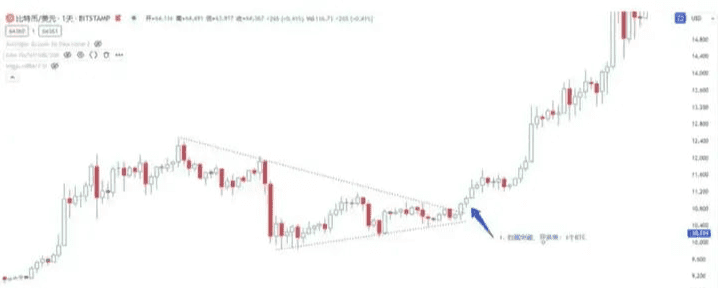
Figure 1
A large bullish candlestick breaking out of the right side of the converging triangle pattern signals a bullish trend.
Therefore, at the location indicated by arrow one, after BTC issued a bullish signal on the right side, we can track the breakout on the right side. Let's assume we opened a long position in BTC at this point.
Second entry (Figure 2)
The market then entered a very strong upward trend. At the point where the mouse is pointing, we can see that Bitcoin has formed a converging ascending triangle pattern.
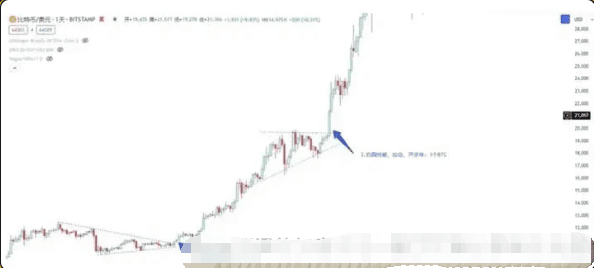
Figure 2
(Figure 3) This position, located at the point indicated by arrow 2, represents the opportune moment for "couch potato" trading, specifically the time to roll over positions. If we were to enter a long position in BTC at this position, following a breakout on the right side, we would see that after several medium-to-long-term consolidations, Bitcoin broke through the previous high with a large bullish candle. This position aligns with the three key elements of "couch potato" trading: right-side trading, chasing breakouts, and adding to winning positions.
Additionally, at the converging triangle formed by arrow 2, there is also a point where you can increase your position, which is indicated by arrow 3.
We can consider this as a support level for the upward trend line. At this point, according to the strategy defined by "Fat Otaku," it's feasible to increase positions during pullbacks. When the price falls to near the upward trend line and forms a small-bodied candlestick followed by a large bullish candlestick, this is also an opportunity to increase positions and simultaneously a process of rolling over positions.
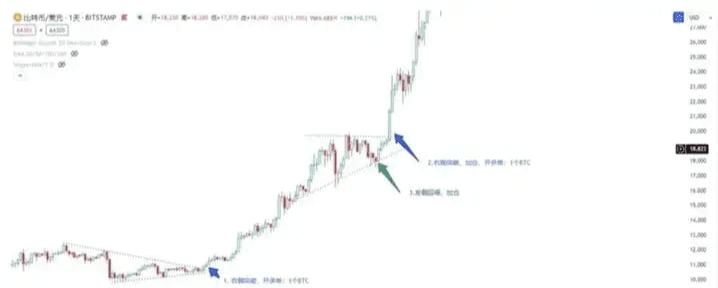
Figure 3
(Figure 4) It's important to note that the position indicated by arrow 3 represents a relatively left-side trade. Left-side trades are riskier, but offer a better risk-reward ratio. The second position, relative to the first, is a profit-adding position (also known as rolling over). As you can see, the market subsequently experienced a strong upward trend, reaching approximately $40,000 for Bitcoin in January 2021. Then, a significant pullback occurred, and the price formed a converging triangle pattern.
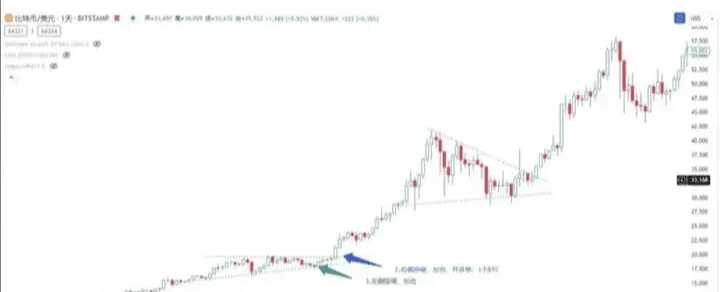
Figure 4
III. (Figure 1) Let's review our previous two entries. Assume our candlestick chart has now reached a position before a significant pullback, with a price of approximately 40518. We can see that the unrealized profit-taking (rollover) at point 2 resulted in a 101% increase.
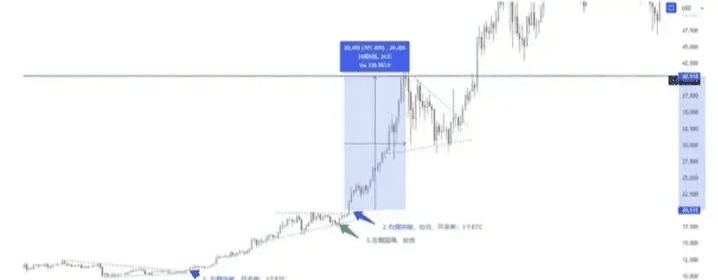
Figure 5
(Figure 2) The long position initially opened at point 1, if held until that point, would have seen a gain of 261%.
After completing the rollover operation, the long position at point 2 has already captured the subsequent main upward wave. When the price reaches a point of resistance, this portion of the position can be quickly reduced. In other words, the one-BTC long position at point 2 can be closed directly at the pullback point of 40518.
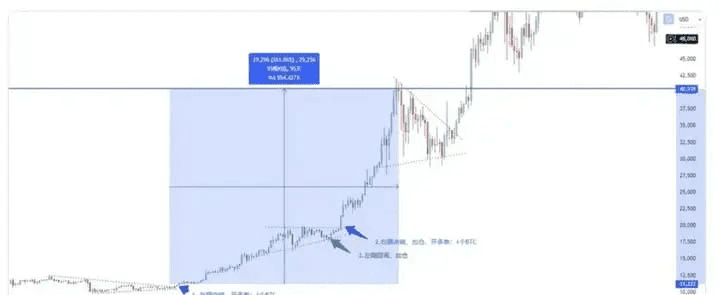
Figure 6
IV. Third opportunity to add to positions
Looking back from the price of 40518, we can see that opportunities for rolling over positions also appeared later. As shown in the chart, point 4 is a right-side breakout entry point, suitable for rolling over positions. Similarly, point 5 is a left-side pullback entry point for adding to positions (similar to point 3, adding to positions on the left side offers a better risk-reward ratio).
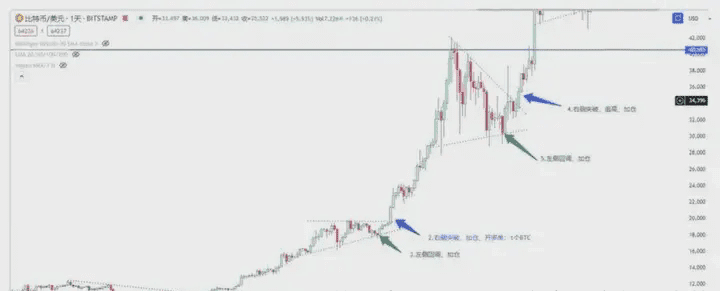
Figure 7
Rolling over positions using a left-side trading strategy at points 3 and 5 requires a higher level of technical skill. When buying at low points or moving averages, it's essential to combine this with more indicator or strategy signals to form a basis for the trade.
For example, we can look at a daily-level medium-term moving average, the MA30. At arrow 3, we can see it's at the support level of the first consolidation triangle, and a bullish candlestick has formed, closing above the daily MA30. Therefore, this position can be used as a basis for judgment.
For example, at point 5 (arrow 5), if we open the Fibonacci retracement of the previous uptrend, we can see that the low of the candlestick at point 5 essentially retraces to the 0.5 level of the previous uptrend. This means that once an uptrend is established, secondary retracements to the 0.5 level, or even the extreme 0.618 level, are very important levels. After a bullish candlestick closes at this point, point 5 (arrow 5) can also be considered a suitable entry point for rolling over positions.
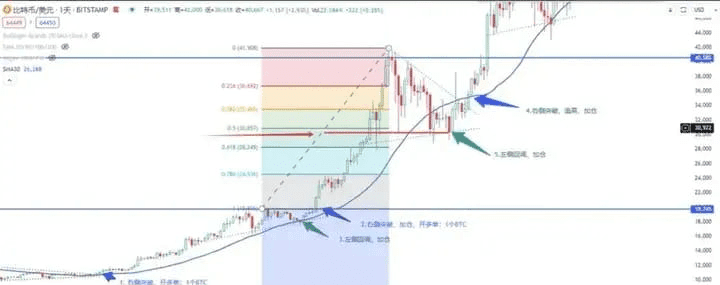
Figure 8
Next, at position 6, we can see a large bullish candlestick breaking through the previous high, which is a suitable position for rolling over positions.
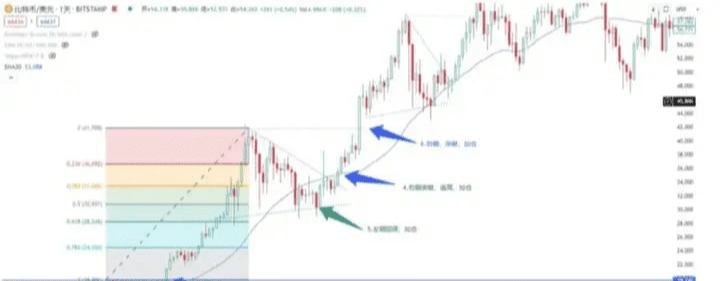
Figure 9
Subsequently, the price reached position 7.
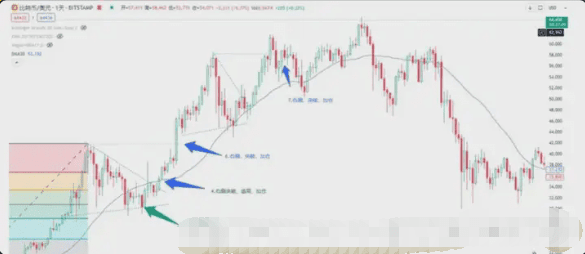
Figure 10
On this day, a large bullish candlestick broke through the previous high. Therefore, at position 7, we can use it as a basis for right-side trading and rollover operations.
After a large bullish candlestick appears, chasing the breakout seems like a reasonable choice. However, as we later saw, the breakout at point 7 was actually a false breakout. If a position was rolled over at point 7, subsequent signals indicated that this operation failed. Even though a new high was formed after point 7 and a breakout occurred, the price subsequently fell, confirming it was also a false breakout.
Therefore, if we roll over the position at position 7 and the signals thereafter, this rollover operation will fail.
V. Suppose you only have 50,000 yuan, how would you use this money to start your investment journey?
First of all, this 50,000 should be your profit. If you are still losing money, then don't rush to read on.
If you buy Bitcoin for 10,000 yuan, set 10x leverage, and use isolated margin trading, only opening 10% of your position (5,000 yuan) as margin, this is equivalent to using 1x leverage. With a 2% stop-loss, even if the stop-loss is triggered, you will only lose 2%, or 1,000 yuan. So how do those who get liquidated actually lose their entire account? Even if you are liquidated, you only lose 5,000 yuan, right? How could you possibly lose everything?
If you guessed correctly and Bitcoin rose to 11,000, and you continued to open a position with 10% of that amount, also setting a 2% stop-loss, even if the stop-loss was triggered, you would still have made an 8% profit.
What about the risks? Wasn't it said that the risks were very high?
Following this line of reasoning...
If Bitcoin rises to $15,000, and you keep adding to your position, capturing 50% of that move, you should earn around $200,000. Capturing two such moves would grow your account to around $1 million. There's no need for compound interest; a 100x increase is achieved through two 10x increments, three 5x increments, and four 3x increments, not through daily or monthly 10% or 20% compound interest. That's nonsense. Rolling over positions isn't suitable for all cryptocurrencies. Choosing cryptocurrencies with good liquidity and active trading can reduce risk. Don't over-leverage, as this can easily lead to liquidation. Setting stop-loss and take-profit orders can help you control risk and lock in profits.
Stay calm during market volatility and avoid impulsive decisions. If market fluctuations are severe, rolling over positions is not advisable, as it's easy to be swayed by emotions and make poor decisions.
VI. How to mitigate risks when rolling over positions
The initial additions to the position went smoothly, but in reality, things might not be so easy. Let's look back at the first two trades.
1. Initial Entry: At position 1, we initiated a right-side chase, opening a long position in BTC. 2. Adding to Position: At position 2, we again added to our position upon the right-side breakout, opening another long position in BTC.
After completing trades at positions 1 and 2, our average cost has shifted upwards, now roughly between positions 1 and 2. We can see that the market did indeed establish an upward trend after breaking through position 2. However, after adding to our position at position 2, the market might not continue upwards, but instead form a reversal pattern. This is entirely reasonable, as we cannot accurately predict market movements.
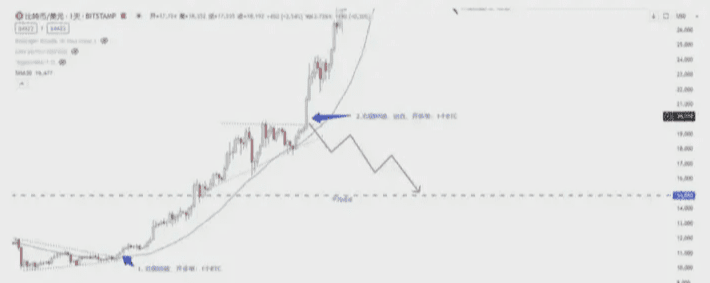
Figure 11
When this happens, we experience a profit pullback. The trade at position 1 was initially profitable, but adding to the position at position 2 increased risk, causing a profit pullback when the price falls. Once the price falls below the average cost of our two trades, the profit pullback will turn into a loss, triggering a trailing stop-loss.
Rolling in positions increases risk while allowing profits to run. To control risk after rolling in positions, trailing stop-loss orders are necessary. Beginners can use volatility indicators such as ATR (Average True Range), while experienced traders can use technical indicators and price action to find favorable stop-loss levels.
For example, after rolling over the position at position 2, we can set the stop-loss for the new position below the trailing stop-loss/take-profit curve related to the ATR volatility indicator.
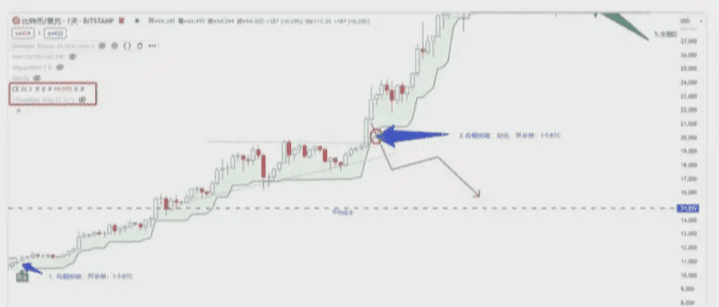
Figure 12
The specific operation is as follows: Open a long position in BTC at position 2. If this is a false breakout (i.e., the price falls back after the breakout), we can reduce this newly added position based on the price given by the trailing stop-loss/take-profit curve. This way, even if the rollover fails, we can at least reduce the newly added position and minimize losses.
VII. Disadvantages of Rollover
Through the simple examples above, I think everyone should be able to understand the definition of rolling over positions, which is adding to a profitable position, and the appropriate points for rolling over positions, such as at the breakout point or low point of a secondary pullback.
Some people might think that if rolling over positions is so simple, then making money is too easy.
Actually, that's not the case. We're just using a simple example to illustrate the concept. In reality, rolling over positions demands a very high level of skill from the trader. Rolling over positions is only suitable for use in a one-sided trending market, specifically when the price continues to rise after adding to a position, or after a pullback and subsequent rise.
In fact, 90% of market conditions are range-bound. In this situation, if you keep adding to your position, you will only continue to lose money. For example, if you roll over your position during a range-bound market, the result will be continuous losses. If you had rolled over your position during the range-bound market of the past four months, you would have continuously lost money. Unless you have a large amount of capital, you will lose all of it.
Therefore, rolling over positions is only suitable for approximately 10% of one-sided trending markets. Furthermore, rolling over positions must be combined with very strict and scientifically sound trailing stop-loss orders; otherwise, the overall risk will be extremely high.
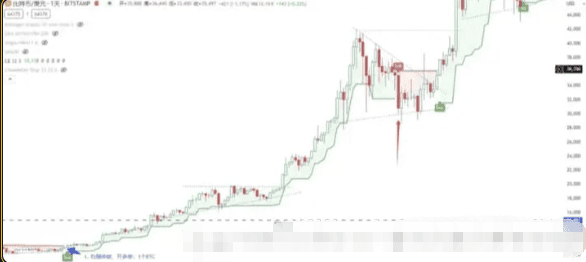
Figure 13
After hitting a stop-loss on this trade on January 20, 2021, Fatty chose to stop trading. Looking back, his withdrawal was very wise and intelligent. This is Fatty's trading style: no particularly amazing moves, but it's this kind of system that brings huge long-term profits.
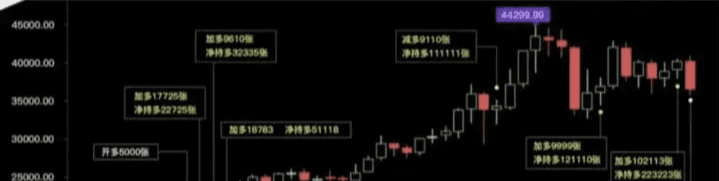
Figure 14
Summary of trading records for "fat otaku rolling over accounts"
However, judging from the overall trading record of the "fat otaku," his overall win rate is very low, for the following three reasons:
1. Breakout Trading: This trader focuses on breakout trading, even though most breakouts fail. Despite this, he continues breakout trading because the loss from a failed breakout is small, perhaps only 1% to 2% of his capital. However, if the breakout succeeds, his account could double or even more, resulting in a very high risk-reward ratio, sometimes reaching tens of times. Even though breakouts are likely to fail, this risk-reward ratio makes him willing to try.
2. Focus on Major Trends: This type of person only chases major trends, often refusing to exit even after making substantial profits. Their goal is to capture the big picture, resulting in a lower win rate. While focusing on smaller trends would significantly increase their win rate, they wouldn't achieve the same results. They accept the lower win rate because their aim is the substantial profits from major trends.
3. No Missing Out: This "couch potato" (a term referring to a man who is overly attached to a stock) doesn't want to miss any major trend. Without accepting the possibility of missing out, he constantly tries to enter the market whenever there's a breakout signal. Only in this way can he ensure that he's in the market once a trend starts, thus capturing the profits from the major trend.
The "Fat Otaku" trading method emphasizes risk control, adherence to breakout trading, and focus on major trends, ensuring the capture of every potential major trend through continuous experimentation. Although the win rate is low, his high profit-loss ratio and clear strategy have enabled him to achieve remarkably high returns over the long term.
8. Rolling over positions and pyramid averaging down
If you're interested in rolling over positions, you should definitely learn about pyramid averaging. Pyramid averaging and rolling over positions are both common trading strategies. You can think of pyramid averaging as a more conservative form of rolling over positions. They have many similarities: > Trend following: Both involve adding to positions when a market trend is clear, taking advantage of the profit opportunities brought by the trend. > Gradual averaging: Neither involves adding to the position all at once, but rather gradually increasing the position based on market movements. > Profit-based: Adding to positions is based on existing profits, not on averaging down when there are losses.
The pyramid averaging method is a technique that can exponentially increase profits. Essentially, it involves adding to a position while the market is trending upwards, using existing profits to potentially generate future gains – a sophisticated trading strategy.
Both this method and rolling over positions are only suitable for strong one-sided market trends, which can be either rapid upward or rapid downward trends. As shown in the diagram below, the steps of pyramid-style position averaging are clearly visible (Figure 1).
The pyramid-style averaging-up method is a gradual, trend-following approach to adding to a position, but it is by no means the "averaging down" method used by many stock investors. The most direct difference is:
We will not add to our positions when we are losing money—adding to positions against the trend is the cause of many people's serious losses, and can even lead to many people's "margin calls".
Pyramid averaging and rolling over positions (adding to winning positions) are very similar, the main difference being the size of the added position. In pyramid averaging, the percentage of additional positions decreases as you progress.
As a trend continues for longer, the likelihood of an unfavorable reversal increases, and psychological pressure also gradually rises. Using the pyramid averaging method is more conservative compared to rolling over positions.
Gradually reduce the amount of new positions added: The total position grows more slowly, and even if the market reverses, the total loss is kept within a smaller range. > Add the same amount of position each time: The total position grows rapidly, and even a slight adverse market fluctuation can lead to large losses, posing a higher risk.
IX. Practical Suggestions for Rolling Position Strategy
Rolling over positions isn't complex, but its high risk and high reward make it a strategy for experienced professionals, especially suitable for trending markets. The core of rolling over positions lies in position management and trend judgment, thus requiring the combination of sound money management and trailing stop-loss strategies. The framework below will explain the practical steps of the rolling over strategy in detail, helping you capture trends and steadily add to your positions in the market.
Basic knowledge and preparation
Basic understanding of leveraged trading
In rolling over positions, leverage can amplify returns, but it also carries significant risk. Therefore, it is recommended to use leverage in isolated margin mode to avoid the risk of margin calls from full-margin trading. Full-margin trading is extremely risky and is particularly unsuitable for rolling over positions strategies. Set trading goals.
The goal of rolling over positions is to achieve compound growth through adding to existing positions, but this only works in trending markets. In most market conditions (90% of range-bound markets), the rolling strategy is not applicable. Therefore, we need to be patient and wait for a clear trend to emerge. Setting a goal of doubling a small amount of capital can help you stay focused, but more importantly, it's about waiting for the trend to be confirmed before making any moves.
Technical Indicator Selection: To accurately determine the trend, the following indicators can help you find the best time to roll over positions > MA (Moving Average): The main tool for judging the major trend and pullback.
MACD: Confirms trend strength and potential reversal signals. Converging Triangle: A common oscillation pattern; a breakout from it may signal the start of a new trend.
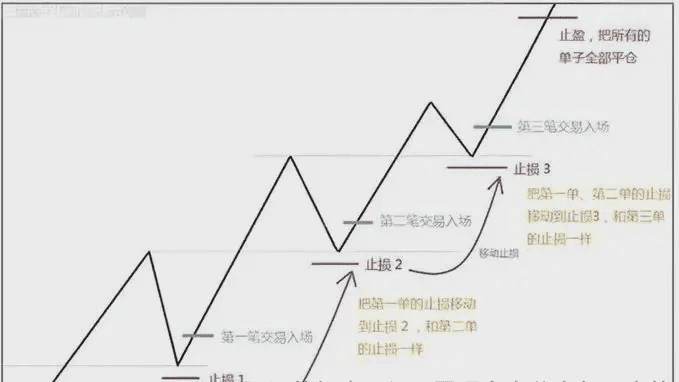
Figure 15

Figure 16
10. Core Strategies for Rolling Over Positions
Applicable conditions: One-sided market trend
The core condition for the rolling position strategy is its applicability in a one-sided market, that is, a clearly defined trend. In a range-bound market, the rolling position strategy may lead to frequent stop-loss orders or even losses. Therefore, you must wait for a clear trend signal in the market, such as a breakout after a long period of sideways trading, before you can engage in rolling position operations.
Mindset and Timing
Rolling over positions not only tests your technical analysis skills but also your mindset. When faced with opportunities with huge profit potential, you must have sufficient patience to wait for high-certainty moments. Rolling over positions is not suitable for frequent trading. We only add to positions on confirmed trend opportunities, such as breakouts of long-term resistance levels or one-sided trends after consolidation patterns. Core logic: Position management and trend judgment.
The core of rolling over positions lies in position management and trend judgment.
When judging trends, you need to be able to distinguish between true and false breakouts, identifying when it's a pullback and when it's a trend reversal. This requires not only technical analysis skills but also strict money management and a trailing stop-loss strategy. After each additional position is added to, the stop-loss level should be moved up to ensure that unrealized profits are not eroded by market fluctuations. The timing of adding to positions and the proportion of rolling over positions are crucial. Typically, adding to positions in the direction of the trend after a breakout of the trend line, or adding to positions against the trend when the trend pulls back to near the moving average, should be done in a pyramid-shaped pattern, with the proportion of each additional position gradually decreasing as the number of additions increases, to avoid excessive risk from subsequent additions.
Practical steps
Step 1: Initial Entry
Establish a position at a breakout point after sufficient consolidation, such as a breakout of a significant resistance level. Initial position size should be controlled at 10%-20% of total capital to mitigate the impact of large market fluctuations. Stop-loss orders are typically placed 2%-3% below key support levels.
Step 2: Add to your position in line with the trend
When the initial position shows a floating profit, you can choose to add to the position on the next pullback or breakout point. Generally, a pullback to near the moving average followed by a rebound, or around a breakout, can be a signal to add to the position. The amount of capital added each time should not be too large; it is generally recommended that the amount added each time not exceed 30% of the original position.
Step 3: Risk Control and Profit-Taking Strategies
Risk control is paramount when using a rolling position strategy. With each additional position added, you need to use a trailing stop-loss, gradually moving the stop-loss level up to the previous entry point to ensure that unrealized profits are not swallowed up by market fluctuations. When a reversal signal appears, promptly reduce or close the position to avoid significant drawdowns.
Step 4: Accumulate compound interest
After each successful rollover, you can reinvest the profits to add to your position, creating compound interest. However, avoid frequent trading; rollover is suitable for medium- to long-term trends, not for frequent short-term position additions. The goal of rollover is to continuously increase your position size as the trend continues, maximizing returns.
Trading frequency
Rollover trading is suitable for breakouts of significant resistance and support levels on daily or weekly charts, rather than frequent short-term trading. Frequent adding to positions carries extremely high risk in volatile markets, potentially leading to substantial losses. While rollover strategies can amplify profits, adding to positions with unrealized gains inherently increases leverage and risk. Therefore, it is recommended to use a pyramiding approach when adding to positions, decreasing the amount added later. When profits are substantial, consider gradually reducing positions rather than continuously adding to them. Fund and stop-loss management are crucial in rollover strategies. Failure to adjust stop-loss levels promptly after adding to positions can turn unrealized profits into losses. Before each addition to a position, always pre-determine the specific position size and trailing stop-loss strategy.
XI. Frequently Asked Questions and Answers
Is the roller tray suitable for beginners?
Rollover strategies carry significant risk. Beginners are advised to start with low-leverage, stable trend trading to gain experience before considering rolling over.
How to determine the right time to add to your position?
Adding to a position typically occurs after a trend breakout from a key level, or during a pullback to a support level followed by a rebound. Technical indicators such as moving averages, MACD, and converging triangles are used to help determine this.
How should one trade in a volatile market?
Rolling over positions is not suitable for range-bound markets. When encountering range-bound markets, you should reduce the frequency of operations and patiently wait for a trend to emerge.
Can I roll over my position immediately after opening a new one?
Whether you can roll over a position immediately after opening it, or wait until the position is profitable before using the profits to add to the position, depends on your trading strategy and market conditions. The core idea of rolling over a position is to continuously increase the position size in a trending market, using unrealized profits to increase the position size and achieve compound growth. Therefore, rolling over a position is usually done on top of existing profits. This way, you can use the money already earned in the market to cover the risk of adding new positions, reducing the risk exposure of your personal funds.
Here are two common methods for rolling over positions:
Opening and rolling over positions after trend confirmation: After confirming a trend, open a position and then gradually increase the position size by rolling over profits as the trend develops. This method leverages the power of the trend and uses unrealized profits to achieve higher returns. A typical approach is to open a position after the market breaks through a key level, and then gradually add to the position as profits are realized. The risk is relatively low at this stage because subsequent position additions use profitable funds.
Immediately rolling over a position: In some strategies, traders immediately roll over their positions upon opening a new one, typically relying on significant leverage. This method is high-risk because without initial profits as a buffer, directly adding to the position can lead to even greater losses. It is suitable for very experienced traders and should be used when the trend is extremely clear.
The rolling position strategy discussed in this article tends to leverage profits to add to positions, as emphasized by figures like "Fat Otaku Bitcoin" and "Master Li Tonv," which involve adding to positions based on unrealized gains within a trend and controlling risk through stop-loss mechanisms. Therefore, it is generally recommended to wait until the position has achieved a certain level of profit before using the rolling position strategy to reduce risk and effectively amplify profits.
Finally, I'd like to offer some advice to beginners or those who want to imitate this approach.
1. Reduce the profit/loss ratio:
Beginners often find it difficult to tolerate prolonged unrealized losses and constant stop-loss orders while trying to capitalize on major trends, potentially losing everything or experiencing a mental breakdown before the trend even emerges. Therefore, I recommend beginners lower their risk-reward ratio, but not too low. Generally, a ratio of 2 to 3 is suitable. The specific ratio should be adjusted based on market conditions. If the market is favorable for a 2 or 3x ratio, use it. If the market is exceptionally favorable, you can boldly try a 4x or even 5x ratio. This approach brings the win rate closer to 50%, between 45% and 55%, making it easier to maintain a good mindset. A 20% win rate, like the one I'm currently aiming for, is difficult for most people to maintain. If you aim for a 10x or even 20x ratio, you'll have to endure prolonged stop-loss orders and unrealized losses.
2. Accept missing out:
Trying to catch every big market move without missing out inevitably sacrifices win rate. New traders should accept missing out and sacrifice some opportunities to capture higher-probability moves. For example, if there are 10 market movements in a year, capturing only 2-3 is sufficient. This still yields substantial profits and a smoother profit curve with fewer stop-losses. Focus on market context rather than technical details: Instead of studying numerous technical books and videos, learn to judge market context. Invest more energy in favorable market conditions and rest during unfavorable ones, only earning easy profits. This is crucial. The "fat guy's" operation is very simple; most of his profits come from the last two trades. If he hadn't consistently followed this strategy and given up early, he wouldn't have achieved this. Therefore, it's easier to make money in favorable market conditions, while continuous trading in unfavorable conditions won't generate profits. For example, most people struggled to profit in 2022, so one should rest during unfavorable market conditions and trade more during favorable ones to earn more money.
I hope that everyone who enters the cryptocurrency world with dreams can maintain a clear head, invest rationally, arm themselves with knowledge, and use wisdom to avoid risks in this volatile field. Remember, accumulating wealth is a long marathon, not a short sprint. May everyone protect their assets and reap their own success amidst the waves of the cryptocurrency world.
Wenjing is focusing on spot trading of Ethereum futures contracts; there are still spots available in the team, so hurry and join! #美股2026预测 $BTC