

The Argentine central bank is reviewing its plans to allow banks to provide regulated trading and custody services for cryptocurrencies, ending a long-standing ban.
This shift in policy comes in response to the widespread use of stablecoins and Bitcoin by Argentinians as protection against rampant inflation and currency pressures.
The Central Bank of Argentina is approaching one of the largest financial shifts in recent years. The Banco Central de la República Argentina is currently reviewing plans that would allow banks to offer trading and custody services for digital currencies. If approved, this decision will end the long-standing ban that prevented traditional banks from entering the digital asset sector. For years, banks have been barred from dealing with digital currencies in any form.
This barrier may now fall. Instead of preventing digital assets, regulators aim to supervise them. The focus is shifting from prohibition to oversight. This change also aligns with President Javier Milei's pro-market stance. His administration has supported financial reforms and shown a tolerant attitude towards adopting digital currencies. Now, it seems that regulators are ready to take concrete steps on the policy front.
Digital currencies are already a daily tool in Argentina
This shift in policy comes from economic reality, not publicity. Argentinians widely use digital currencies. Inflation has crushed the value of the peso for years, and capital controls have limited access to the US dollar. Thus, people have turned to $BTC and stablecoins to protect their savings. Stablecoins, especially those tied to the dollar, now act as a digital lifeline. Many workers receive their salaries in digital currencies. Others save with it, and some spend using it. The parallel economy of digital currencies is no longer on the fringes; it has become part of daily life.
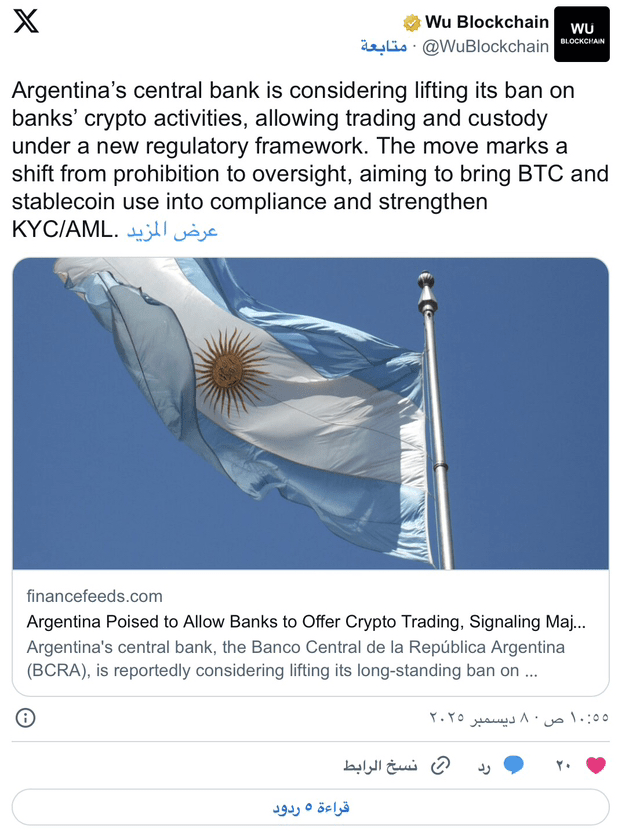
Now, the central bank wants to bring this activity into the formal system. If banks provide digital currency services, users can trade through regulated accounts, enhancing consumer protection and strengthening Know Your Customer (KYC) and Anti-Money Laundering (AML) measures. At the same time, it allows the government to track flows that were moving outside the system. In short, digital currencies are already present in the economy, and the law is only chasing reality.
Banks vs. platforms: the beginning of a new competition
If banks enter the digital currency space, competition will change rapidly. Today, local and global platforms dominate the market, controlling most of the trading volume and setting fees and custody standards. Banks offer something different: they already have millions of customers, manage risks daily, and deal with massive capital. Once banks enter, trading may become cheaper, spreads may narrow, and trust among users who previously avoided platforms may increase.
However, this transition will not be smooth. Banks must comply with new capital and liquidity rules for volatile assets. $BTC and stablecoins are entirely different from loans or bonds. Risk models need to be adjusted, custody systems updated, and security standards tightened. Nevertheless, the benefit is clear: increased competition often means better services, and for users, more options mean reduced friction.
What this move means for adopting digital currencies
This proposal does more than update banks. It affirms the role of digital currencies as part of the financial infrastructure, not just a speculative tool. Argentina is not adding digital currencies for fun, but to combat inflation and pressures on the local currency. By allowing banks to trade and hold digital assets, regulators acknowledge that digital currencies are indeed functioning as a store of value for millions of people, and that stablecoins play a role in local payments and savings.
If approved, this change could redraw the map of digital currencies in Latin America. Argentina will move from being one of the most stringent banks in banning to one of the most regulated digital currency markets in the region. Practically, this means safer entry paths for users, a new source of income for banks, and a clear message to the digital market: even under pressure, digital assets are penetrating the heart of traditional finance.
#BinanceSquareFamily #BinanceSquare #NewsAboutCrypto #newscrypto #argentina
