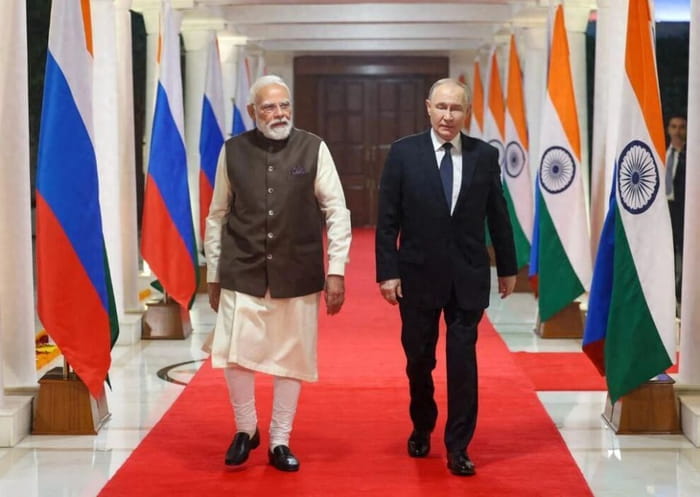
The moment Putin stepped onto the red carpet in India, everyone was stunned.
Modi not only personally welcomed him at the airport but also gave Putin a big hug, and then directly took him back to the official residence for a private dinner — they chatted for a full three hours.
Such a specification left even the West dumbfounded: after the Russia-Ukraine conflict, this was Putin's first visit to India, and he received such high honors?
The British media were frantic, and the Americans were even more anxious, like ants on a hot pan.
But what truly shocked the outside world was that before attending the dinner, Putin suddenly mentioned China during an interview.
China and India are both Russia's closest friends, and Moscow cherishes them greatly. Russia has no right to intervene in Sino-Indian issues, and believes that the two countries will resolve them on their own.
This statement seems polite, but in reality, it's like a sharp scalpel—
It cuts the underlying logic of the China-Russia-India triangular relationship very clearly
Putin's visit is to enhance Russia-India relations
Not to mediate the Sino-Indian contradictions
And certainly not to take sides
Someone asks: This doesn't seem like Putin; in the past, he dared to stir in the Middle East, Syria, Nagorno-Karabakh, Afghanistan, what made him take a step back here?
Why did he choose to step back when it comes to China and India?
The answer is very realistic:
The Sino-Indian contradictions are too deep, too sensitive, and too critical; outside interference will only become a target.
What Russia needs is—
No favoritism, no sides, a stable third point.
But the real focus is on what Putin said before:
"Long-term friendship and strategic cooperation closely connect Russia, China, and India."
A single sentence reveals the secret—
Putin's visit to India is not to incite discord, nor to mediate,
But to rebind Eurasian power together.
Because he knows better than anyone:
There is no structural contradiction between China and Russia
China has never rejected India
What really needs to change is India
In the past decade, India's biggest problem is not a lack of strength—
But that its vision is locked by nationalism and the U.S. narrative framework.
The U.S. says it wants to pull India to balance China, but what is the result?
The military and economic power of the U.S., Japan, and Australia crushes India
Key negotiations never allow India to sit in the middle
It fundamentally will not solve India's border issues
And it certainly won't go to war with China for India's sake
India in the U.S.'s small circle—just a pawn to make up the numbers, not the core.
But what can Russia offer?
Energy, weapons
Strategic security
Diplomatic buffer
Eurasian strategic space
These, the U.S. can never provide.
The more critical reality is:
If China, Russia, and India truly band together
China manufacturing center
India's population and growth engine
Russian energy and resources
The combined power of the three countries is enough to shake the entire Western strategic center.
This is not imagination; it is hard power.
Therefore, Putin's embrace, Modi's red carpet, China's restraint,
Seemingly stage actions, but behind them is a signal of the new Eurasian pattern being activated:
The more the U.S. wants to split,
China, Russia, and India have more reason to band together.
Putin's visit to India is really about laying out the continental pattern for the next 10-20 years.
The only question left is:
Is India willing to break out of the Western narrative and move towards true great power maturity?
The chessboard has been set up,
It just depends on when India understands.#美SEC推动加密创新监管 #美联储重启降息步伐 #加密市场观察