
There’s a storm rising in crypto — and its name is the Injective Multiverse. Dazai has been watching silently, but now dazai can’t hold back the excitement: what’s unfolding with Injective (and its native token INJ) isn’t just another upgrade. It’s a paradigm shift. MultiVM isn’t a feature — it’s a rebirth of what a blockchain can be, and dazai feels like we’re at the dawn of a new crypto era.
A few weeks ago, Injective unveiled its native EVM mainnet, embedding the Ethereum Virtual Machine directly into a high-speed Cosmos-based Layer-1 chain. This isn’t some half-baked compatibility layer. This is full EVM support built into the core. Developers accustomed to Ethereum tooling can now build on Injective without rewriting code; at the same time, the chain retains its blazing-fast finality, sub-second block times (around 0.64 seconds), and practically negligible gas fees (as low as $0.00008 per transaction).
Before this, Injective was already celebrated for its Cosmos-native architecture, modular financial infrastructure, and DeFi-first design. But now, with the EVM integrated, it has bridged two worlds that often feel like parallel universes: the Cosmos/WASM world and the Ethereum/EVM world. This is the heart of the “MultiVM” — a blockchain that doesn’t ask developers to choose lanes, but instead lets them drive on whichever lane they prefer, while keeping everyone on the same road.
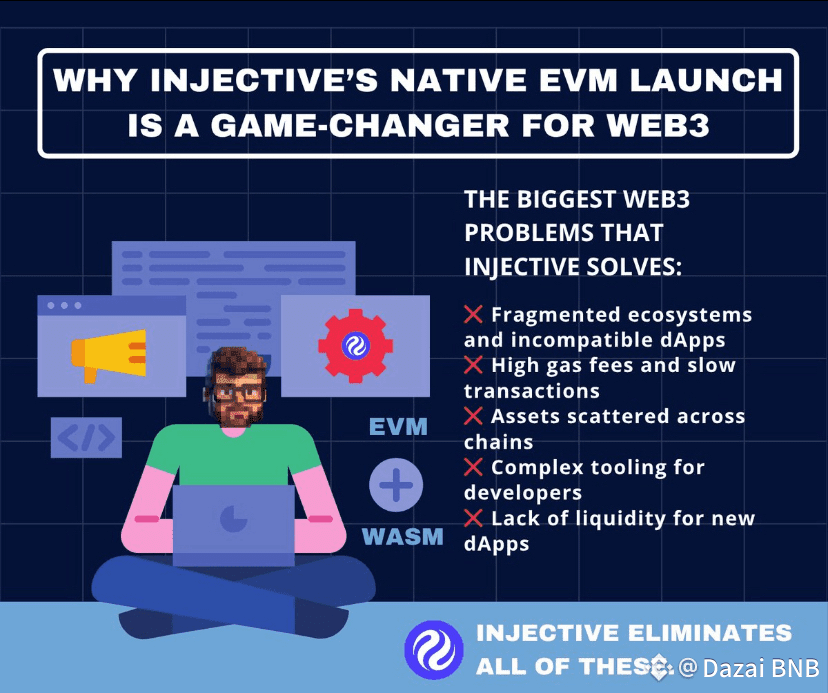
Midway through this transformation, the community launched a fresh wave of innovation. On Day 1 of the MultiVM mainnet, over 30 projects went live on Injective’s EVM layer. The floodgates opened — decentralized exchanges, lending protocols, yield platforms, even bridging bridges (ironically enough) — all now plug into the same liquidity pool, same state, same network. No more liquidity fragments, no more awkward cross-chain gymnastics, no more separate token versions scattered across chains.
One of the hidden stars of this shift is the introduction of a unified token standard, known as the MultiVM Token Standard (MTS). Under MTS, a token — native or created — has a single canonical identity and balance, whether it lives in the EVM environment or the Cosmos-native environment on Injective. What this means is simple but deep: no more wrapping, no more bridges, no more duplicate token versions. You and everyone else share the same liquidity, the same value, and the same tokens. That kind of unity is rare in crypto.
As for INJ itself, this upgrade isn’t just aesthetic. The shift to MultiVM and native EVM drastically improves INJ’s utility. The wrapped version of INJ — called wINJ — now works across both EVM and non-EVM parts of Injective thanks to MTS. So whether you interact with a Solidity-based DEX or a Cosmos-native module, wINJ behaves as a seamless 1:1 representation of INJ.
Injective’s ambition doesn’t stop at EVM + WASM. The roadmap hints at a future where even more virtual machines — like those compatible with Solana — could join the party. Imagine a blockchain that speaks multiple smart-contract languages natively, where liquidity flows freely across every kind of environment, where developers and users from Ethereum, Solana, Cosmos all meet and build side by side.
This new identity of Injective — as a multi-VM global finance hub — is already rippling across the crypto world. On major platforms you see Injective popping up in RWA discussions, DeFi updates, institutional investor reports; its growing importance is being recognized beyond just the crypto-native crowd. For traders, builders, and speculators, this convergence may well mark the start of a new “liquidity supercycle.”
Dazai thinks of it like a multiverse: many different chains, languages, and ecosystems — but all converging into one shared reality. On Injective, a token, a liquidity pool, a liquidity provider or a trader doesn’t need to worry which VM they choose: their value and position travels with them across the multiverse
If there’s a shot for INJ to shine — to become more than just “another DeFi token” — this is it. MultiVM doesn’t just change Injective. It challenges the way we think about blockchains, about interoperability, about value itself. Dazai expects that once this wave hits full momentum, we’ll look back at November 2025 as the moment the multiverse opened — and everyone rushed in.
