

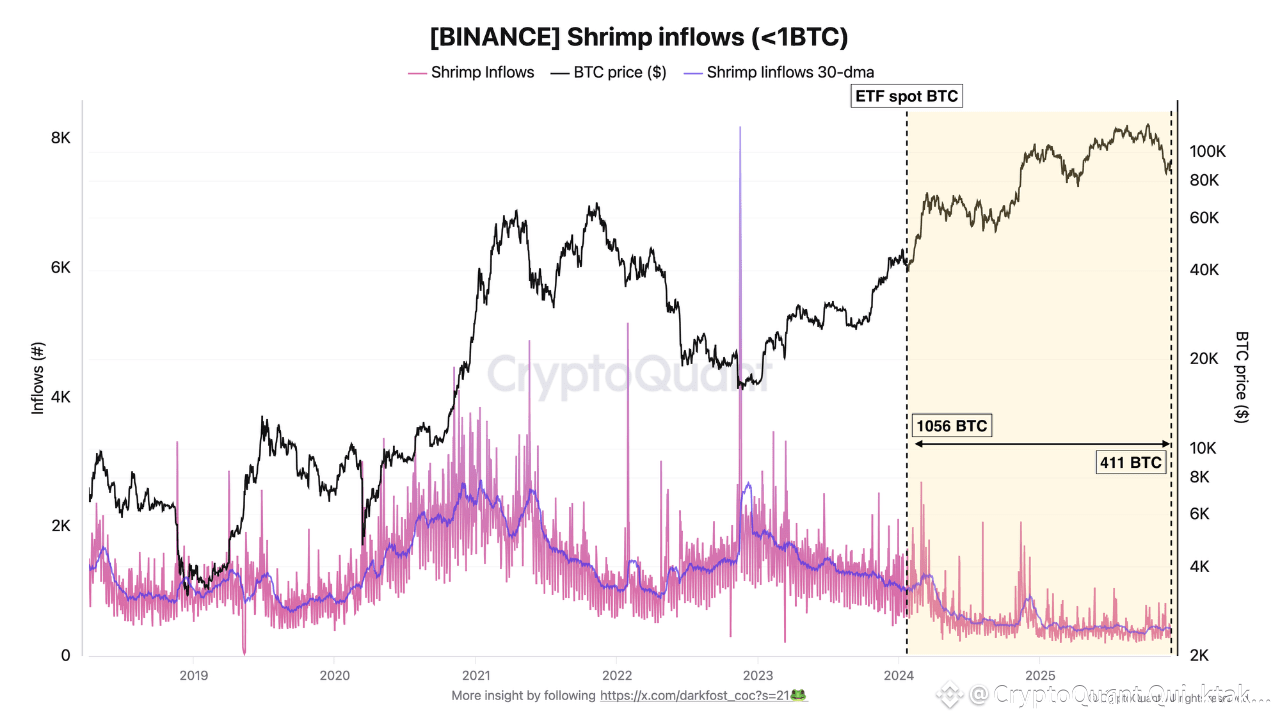
The activity of shrimps, meaning small Bitcoin holders (<1 BTC), has dropped to one of the lowest levels ever recorded. In the chart, this behavior is measured through their Bitcoin inflows to Binance, shown with a 30-dma to smooth out noise and short term volatility.
Back in December 2022, at the end of the post-FTX panic, these small holders were still sending around 2675 BTC to Binance. Today, those inflows have collapsed to just 411 BTC, marking one of the lowest level ever observed. It’s not a simple pullback, it’s a structural decline.
Historically, these retail sized holders tend to become more active when the market turns bullish. For example, during the 2020 to 2021 rally, they rushed into exchanges as prices pushed higher.
In this cycle however, the exact opposite is happening. Bitcoin is rallying, yet small investors are becoming less visible on exchanges. Their absence stands out sharply compared to past cycles.
One key factor behind this shift is the arrival of spot Bitcoin ETFs in early 2024. Since these products became available, the shrimps’ inflows to Binance have dropped from 1056 BTC to 411 BTC, a decline of more than 60%. ETFs have provided a frictionless way to gain exposure to Bitcoin without dealing with private keys, wallet security, exchange accounts or the risk of mismanaging custody.
Of course, ETFs are not the only explanation, but they clearly contribute to a profound change in how retail participates in the market.
And this does not necessarily mean small investors are less interested. Instead, it may reflect a more mature attitude. Rather than chasing short term price action through exchanges, many may be now opting for long term exposure with could strengthen Bitcoin’s market structure.
Written by Darkfost
