
Hello, all family members of the E family army.
As the new week begins, the Bitcoin market remains shrouded in cautious sentiment. Although last Friday (December 5), the spot ETF recorded a net inflow at one point, the overall momentum is weak, and the price has failed to effectively break through. Currently, Bitcoin is fluctuating around $90,000, having retraced nearly 30% from the historical high in October. Before the Federal Reserve's significant interest rate decision is announced tomorrow (December 10), prudent friends choose to sit tight.
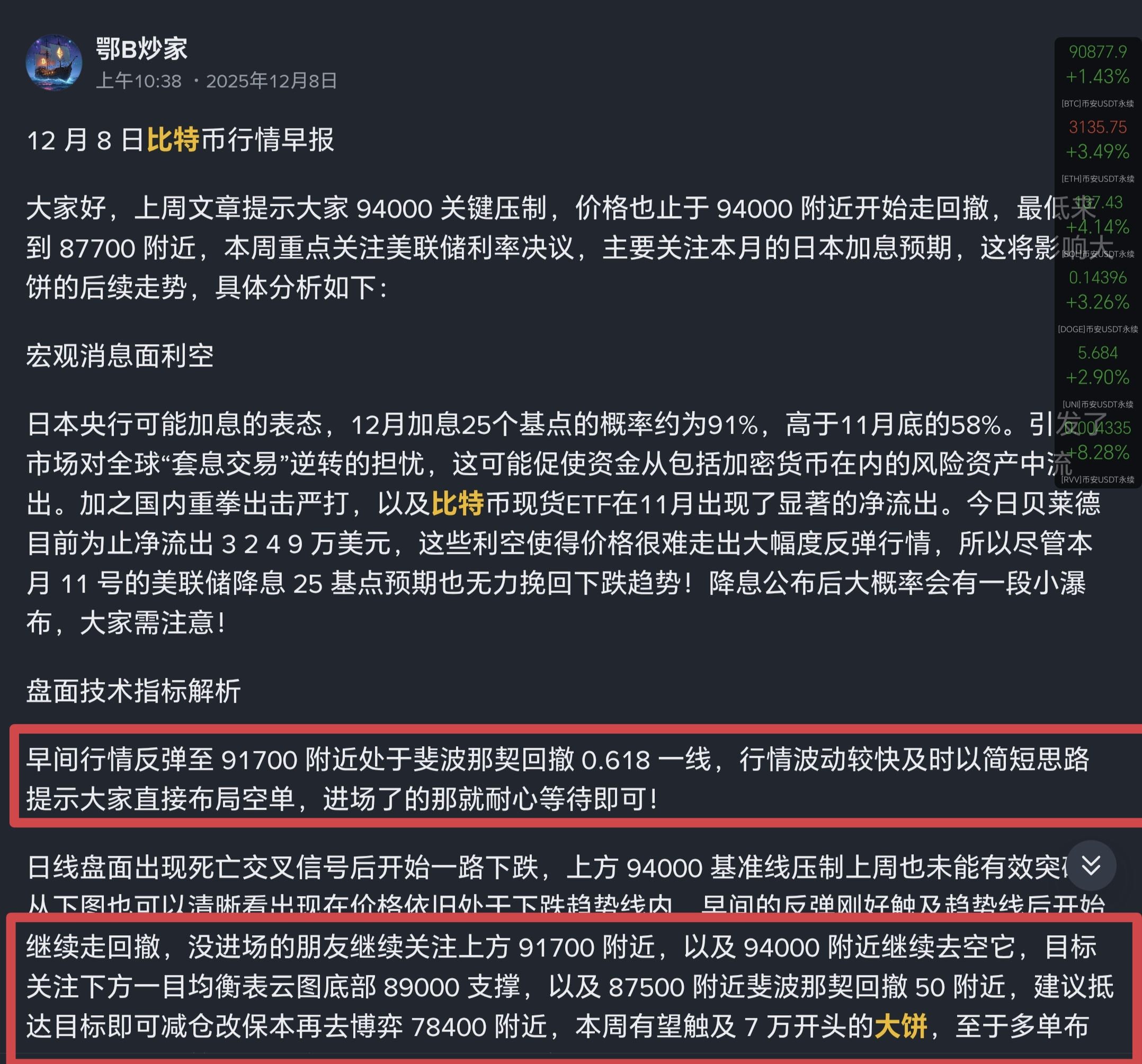
In yesterday's analysis, we clearly pointed out that the overall trend remains bearish and provided a short position strategy near $91,700. The market has moved down as expected, reaching a low of $89,550, bringing us a profit space of over 2,000 points. Although today's early price rebounded to $91,438, it quickly fell back again, and the bearish pattern remains clear.
1. Macroeconomic bearish factors are gathering: the market is focusing on three major pressures.
Currently, in addition to the factors we are continuously monitoring such as the Bank of Japan's shift, strict domestic regulations, and the post-halving cycle, the short-term market is facing several real macro and funding headwinds:
1. The risk of a 'hawkish cut' from the Federal Reserve: Although tomorrow's Federal Reserve decision to cut interest rates is highly probable, it has become the market consensus. The real risk lies in the possibility that the Federal Reserve may implement a 'hawkish cut'—that is, while lowering interest rates, it maintains caution regarding the path of rate cuts for next year in its statements. If so, the liquidity gift package that the market previously anticipated will be significantly discounted, potentially triggering disappointing sell-offs. Some analyses warn that in a pessimistic scenario, it could stimulate Bitcoin to fall towards the $70,000 to $80,000 support zone.
Internal funding structure is weak:
Institutional demand stagnation: The inflow of funds into Bitcoin ETFs in the U.S. has almost come to a halt recently, failing to provide effective support for the market. As the core buying force in this cycle, its 'cessation' lacks an engine for price increases.
Leverage sentiment is retreating: Although the funding rate for perpetual contracts remains positive, the growth momentum has significantly weakened, indicating that the enthusiasm for long positions is waning.
Market depth is poor: Order book data shows that there are dense sell orders in the $91,800 to $92,200 area, forming strong resistance; while the buy order support below is relatively weak. This structure makes the market very susceptible to declines due to small sell orders.
3. The chain reaction of high-leverage liquidations: In the market volatility, high-leverage long positions are being continuously liquidated. In the past 24 hours, nearly 100,000 traders have been liquidated, with a total liquidation amount exceeding $280 million. This chain liquidation can self-reinforce and exacerbate price declines.
2. Technical aspects: Bears dominate, with key support levels.
From a technical perspective, the bearish trend has been confirmed across multiple time frames:
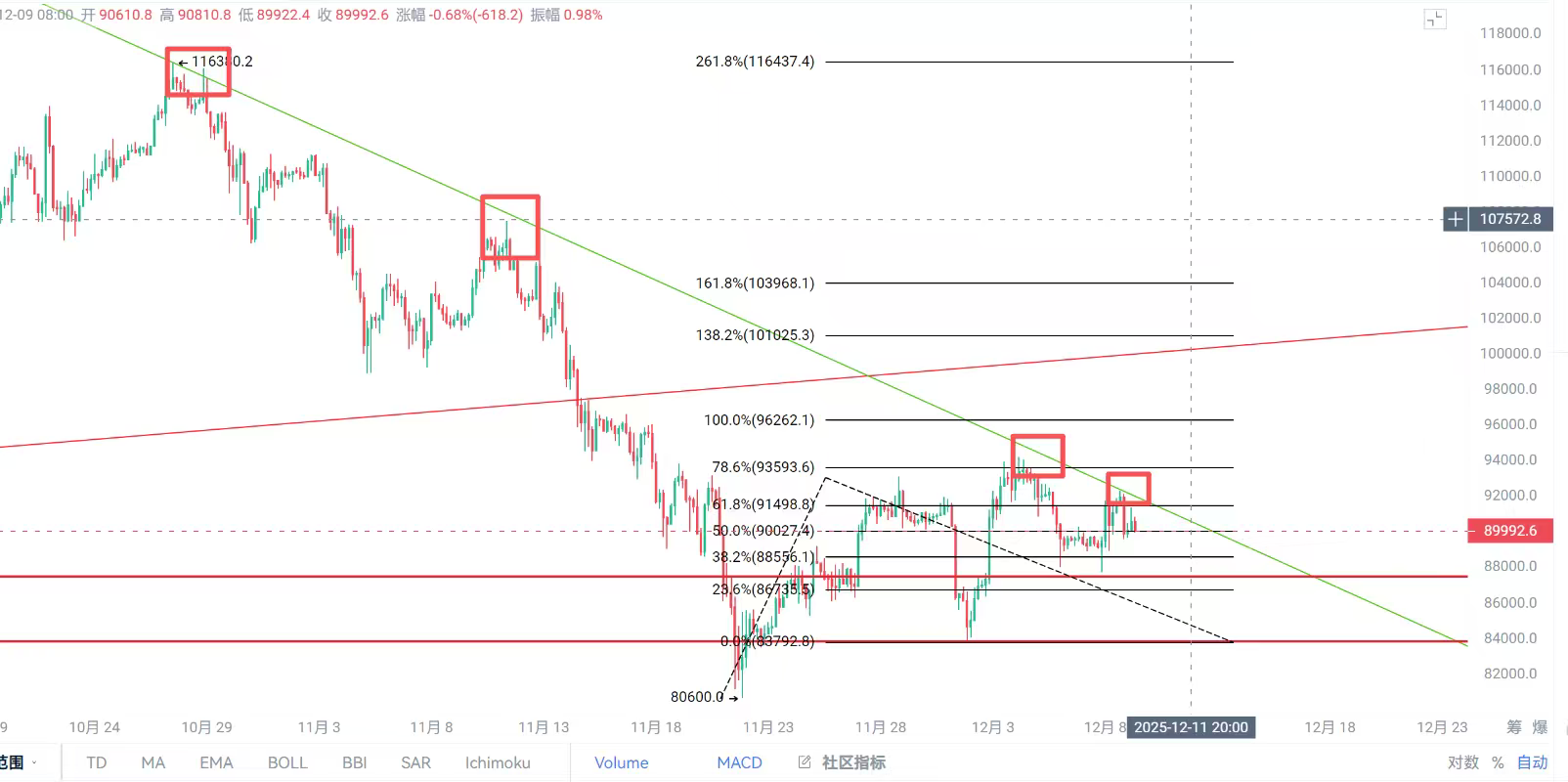
Daily level: Prices are still constrained by the Ichimoku cloud, remaining within a downtrend channel. Since the 'death cross' formed when MA50 crossed below MA200 on November 15, the bearish trend has continued.
Key position:
Upper resistance: $91,500, $93,000-$94,000 (trend line and previous congestion area).
Lower support: the primary focus is on $89,000 (the bottom of the four-hour chart cloud and psychological level), followed by $88,500 (expansion line support). If it breaks down, the next targets will be $87,500 and the Fibonacci retracement support near $83,800.
3. Future market strategies and operational recommendations.
Before macro risks materialize, market sentiment is unlikely to fundamentally reverse. Therefore, our core strategy remains: follow the trend and short on highs.
For holders: The short position entered near $91,700 yesterday has been reduced near $90,000; the remaining position can continue to be held, with the stop loss moved up to near the entry price. The ultimate target can still be seen at the $83,800-$80,600 area, or even the mid-term structure level of $78,500.
For new traders: it is recommended to pay attention to the resistance area of $91,500-$92,000. If there is a rebound to this level, you can gradually open short positions, with a stop loss reference above $94,500. Target levels are successively $89,000, $88,500, $87,500, $83,800, $80,600, $78,500.
Risk warning: Tomorrow's Federal Reserve decision will be a major trigger for volatility. If the decision result unexpectedly leans dovish, it may trigger a strong rebound. All trades must set stop losses and control positions.
Disclaimer: The above is solely the personal analysis of an individual trader, for discussion reference only, and does not constitute any investment advice. The volatility of digital currencies is severe, and the risks are extremely high. Please make rational decisions; profits and losses are self-responsible.


