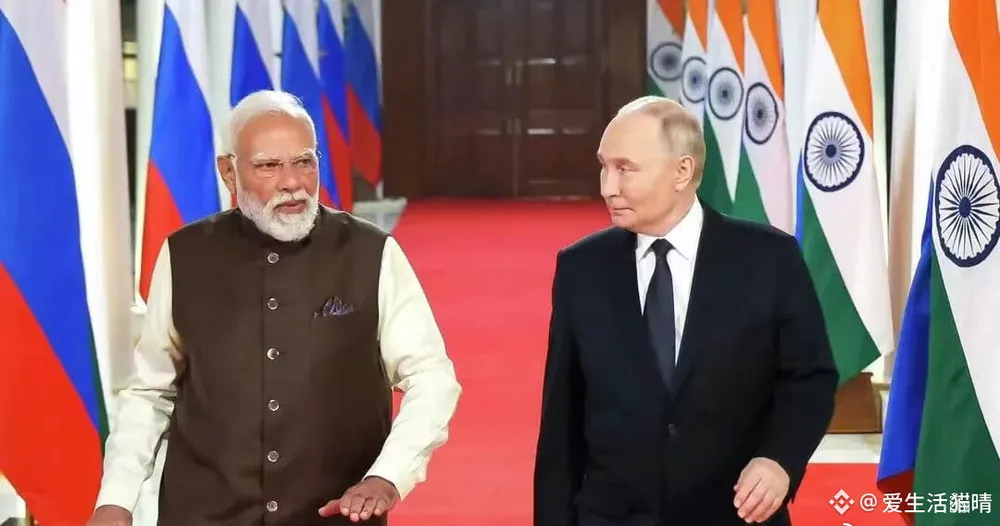
The following is a summary of the logic behind this event.
A meticulously arranged diplomatic appearance
Putin's visit to India this time is highly significant in terms of timing and form. This is his first trip to India since the escalation of the Ukraine crisis, which itself breaks the West's attempt to isolate Russia. The Indian side accorded an exceptionally high level of reception: Prime Minister Modi not only personally went to the airport to welcome him with a warm hug but also arranged a private dinner lasting three hours, without any reporters present. These details collectively send a strong signal: no matter how much pressure the West exerts, India still views Russia as a crucial strategic partner and deliberately emphasizes its diplomatic autonomy at this moment.
Key statement: Defining boundaries for trilateral relations.
What truly set the tone for this visit was Putin's statement during an interview with Indian media after arriving in India and before the dinner with Modi12. When asked how to balance relations with China and India, he clearly stated:
• Cherishing friendship: Both China and India are Russia's 'closest friends', and Russia values its relationship with both countries23. • Maintaining neutrality: Russia 'has no right to interfere' in the relationship between China and India, believing that the two countries can resolve all differences on their own111.
This seemingly neutral diplomatic rhetoric is, in fact, a clever strategic positioning14. It simultaneously conveys a clear message to all three parties:
• To China: It is a 'reassurance', indicating that Russia will not sacrifice its strategic mutual trust with China to strengthen ties with India, nor will it intervene in the China-India disputes25. • To India: It defines the boundaries of Russia-India cooperation, implying that India should not expect Russia to help balance China, breaking any potential 'hope of using Russia to counter China'110. • To the international community: It declares Russia's position of maintaining balance between China and India, emphasizing that the China-India issue is a matter for the two countries themselves, and external forces should not interfere1.
Putin's stance stems from his clear understanding of the complexities of China-India relations. He understands that any rash mediation or taking sides could put Russia in an awkward position, even offending both important partners simultaneously. Therefore, proactively 'stepping back' and announcing non-interference is, in fact, the most beneficial choice for maintaining its own strategic interests14. The realistic considerations of Russia-India cooperation.
After clarifying the boundaries, the talks between Putin and Modi achieved substantial results, mainly focused on two major traditional areas68:
• Energy security: Putin promised to supply India with 'uninterrupted' oil, natural gas, and other energy sources, which is crucial for India against the backdrop of global energy market turmoil46. • Defense cooperation: Both sides agreed to go beyond a simple buyer-seller relationship and encourage joint production of Russian-style weapons and components in India through technology transfer and joint ventures26.
These cooperations are essentially driven by pragmatic interests and are a way of huddling together26. For Russia, after the breakdown of relations with the West, India is an important source of fiscal revenue and diplomatic breakthrough space67. For India, the energy and defense cooperation provided by Russia are key chips for maintaining 'strategic autonomy' and avoiding excessive dependence on the West610. The future of the 'iron triangle': potential and challenges coexist.
Putin's visit has once again brought the grand topic of 'China-Russia-India trilateral cooperation' to the forefront. In terms of potential, the three countries account for over 40% of the world's population and nearly a quarter of the global economy25. If deep cooperation can be achieved, China's manufacturing, Russia's energy, and India's market will form a powerful complementarity, potentially creating a 'continent-level power center' that transcends Western influence, effectively promoting global multipolarity19.
However, the road to the 'iron triangle' remains fraught with thorns:
• China-India trust deficit: There are long-standing border disputes between China and India, and deep-rooted strategic suspicion of China within India911. Indian diplomacy has long pursued 'multi-directional hedging', wanting to benefit from cooperation with China and Russia while also finding it difficult to completely sever ties with the West; this wavering is the main obstacle to deepening trilateral cooperation910. • Western interference: The West will not sit idly by as China, Russia, and India form a stable cooperative pattern, and will inevitably use various means to restrain and divide911. The reshaping of the pattern and India's choice.
Ultimately, Putin's visit to India is not primarily aimed at immediately establishing a close alliance, but rather at conducting a critical 'tuning' and 'layout' for future great power relations14. Through clear statements, he stabilized the bilateral relations between Russia and China, as well as Russia and India, and cleverly passed the ball on how to handle mutual differences and whether to seize cooperation opportunities to India110.
In the current accelerated evolution of a century-old change, the strategic pattern of the Eurasian continent is being reshaped. Whether to continue to waver among major powers or to show true strategic foresight and jointly create a multipolar world that better aligns with its long-term interests with China and Russia is indeed a topic that India needs to think seriously about19. This diplomatic drama suggests that the focus of future great power games will be increasingly concentrated in the Eurasian continent, and the strategic choices of various countries will be more decisive than ever.