
Apro (AT)
Push Feeds, Pull Feeds, and Beyond
Blockchains addressed a trust issue: once the rules are agreed upon you can independently validate the ledger. However soon as a contract relies on information beyond that ledger such as a price, financial statement, shipping documentation or the result, from an AI model the original problem reemerges in a different form:
On whose credibility do you rely for the information underpinning your "trustless" system?
APRO’s answer is to stop thinking of an oracle as a simple price pipe and instead treat it as a full data infrastructure layer: AI that can read messy real-world information, a two-layer network that audits it, and delivery rails that adapt between constant streams (push) and precise questions (pull).
It’s not much "give me the cost" as it is "assist my contracts in comprehending the environment. And demonstrate your reasoning as you proceed.”
Why the Concept of "Trustless Data" Is More Challenging Than It Appears
The expression appears tidy. It conceals a strain.
Blockchains operate as systems; reality does not. Legal agreements, custody statements RWA prospectuses, insurance policies or AI risk assessments are inherently ambiguous, contextual and frequently unstructured. Converting these into, on-chain data involves:
finding the right sources,
deciphering the meaning behind their words
detecting manipulation or omissions, and
writing a simplified but honest version to the chain.
Conventional oracle networks were primarily designed for data delivery: they retrieve figures from APIs combine them across nodes then release a feed. This approach was adequate, for spot prices and basic DeFi primitives.
APRO is explicitly framed as a third-generation oracle architecture where the primary goal is high-fidelity data: extreme accuracy, timeliness, and explainability even when the input is messy legal PDFs, proof-of-reserve attestations, bank statements, images, AI outputs.
That shift in emphasis is subtle but important. When contracts start automating real-world risk complex RWAs, institutional credit, BTC-based collateral stacks the cost of a single bad data point is no longer just a liquidation; it can be reputational damage, regulatory consequences, and systemic contagion.
Push Feeds: The Market’s Constant Heartbeat
Push feeds represent the known component of APRO’s framework. Numerous protocols prefer not to request data instead they seek a steady stream sent at regular intervals.
Lending platforms, decentralized exchanges, options vaults. They all operate based on thresholds: whether the price remains within a secure range if volatility has surged or if a funding rate has surpassed a boundary. These systems depend on an oracle to deliver updated data frequently enabling the contracts to respond.
APRO’s push feeds follow this pattern well yet each update is supported by more extensive machinery:
off-chain aggregation across multiple sources, a AI workflow capable of detecting anomalies or unusual variations.
a multi-chain network of nodes that sign off before the data is committed.
The result is still “here is the latest price or index,” but the path to that number is more rigorous. For BTC-centric DeFi (BTCFi), where APRO is increasingly positioned as a core oracle provider, that rigor becomes part of the safety story: the oracle isn’t just fast, it’s designed to be difficult to quietly nudge.
In effect this moves oracles nearer to functioning as a market infrastructure service. To a benchmark administrator or data provider, in conventional finance yet relying on transparency and cryptographic assurances instead of contractual trust.
Pull Feeds: Questions Instead of Firehoses
The intriguing aspect of APRO’s architecture lies in its pull feeds. In this setup the oracle does not broadcast; it receives.
A pull request represents a query structured as a contract invocation:
“At this moment does this RWA pool continue to meet its requirements?”
“Parse this proof-of-reserve report and give me the effective backing ratio.”
“Examine these, off-chain documents. Verify if a shipment has passed through all checkpoints.”
For this class of questions, constantly pushing updates would be wasteful or even impossible. They often require heavy computation, AI interpretation, or multi-source reconciliation. APRO instead lets contracts trigger that work only when needed at settlement, rebalance, expiry, or dispute.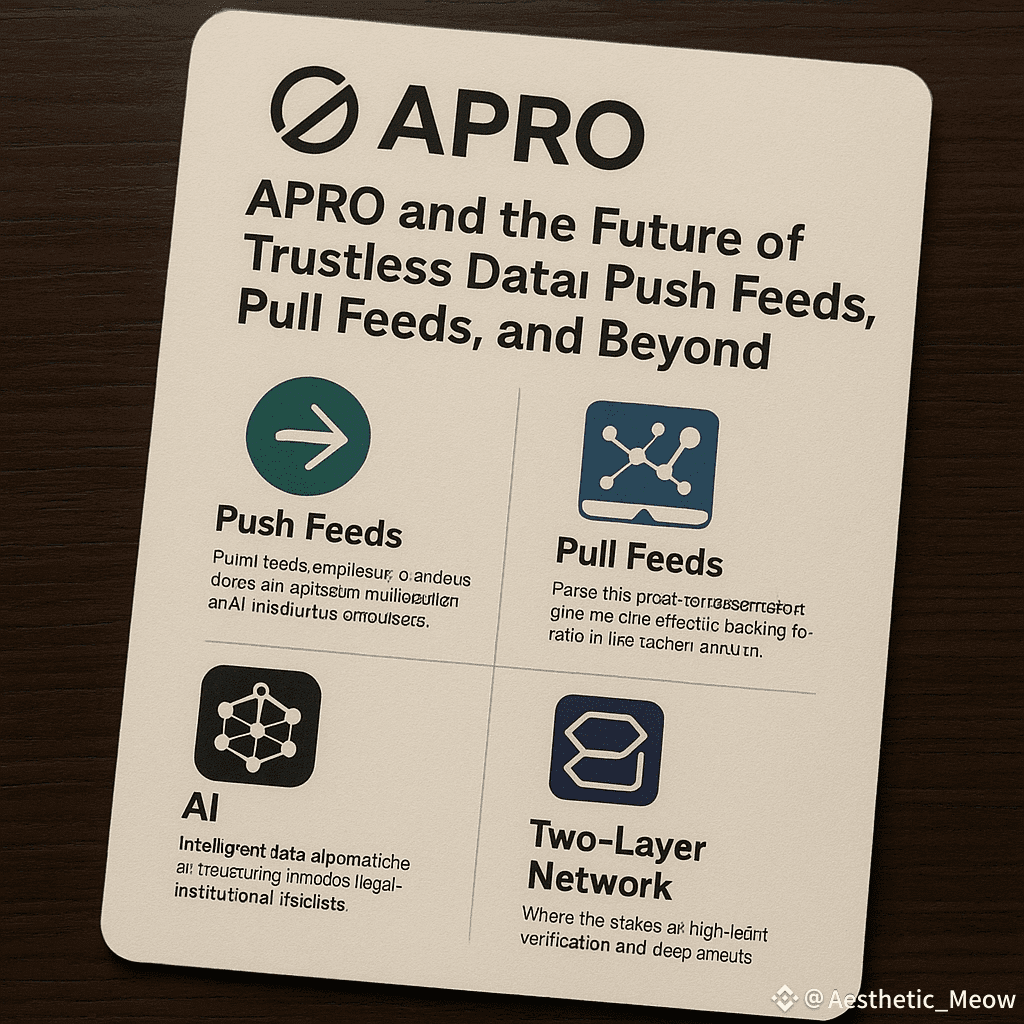
Typically a pull request proceeds behind the scenes, in the manner:
1. The agreement outlines its requirements, in a manner.
2. APRO’s AI layer. Processes the pertinent, off-chain data. Documents, APIs, images, logs.
3. The AI transforms that into a suggested response.
4. The oracle network verifies, challenges, or re-constructs that answer until consensus is reached, then anchors it on-chain.
The strength lies not in cost-effectiveness but also in accuracy: every pull result represents a concise verifiable narrative regarding a specific real-life claim, featuring a transparent link from original evidence to, on-chain fact.
The Two-Layer Network: AI as Analyst, Nodes as Auditors
The center of APRO’s architecture is a two-layer system:
an initial layer in which AI "interprets the world".
a second layer where humans’ role is replaced by a decentralized network of verifiers.
On Layer 1, multi-modal AI models are used to ingest unstructured data: PDFs, contracts, KYC documents, bank statements, oracle-of-record feeds, images, potentially even sensor or logistics data. The job here is not just extraction but interpretation: what clauses matter, what numbers belong together, which sections define risk.
At Layer 2 a collection of nodes receives the AI-generated representation. Approaches it with doubt. They have the ability to:
cross-check the same sources independently,
recompute critical pieces,
enforce fixed criteria
reach consensus on what will be written on-chain as the canonical fact set.
In principle APRO distinguishes between analysis and decision-making. The AI functions, as a junior analyst who reads all the information and generates a preliminary report; meanwhile the network of nodes acts as the review panel that withholds approval until the figures are reasonable.
This design acknowledges something uncomfortable: AI is powerful but fallible. Rather than asking users to simply “trust the model,” APRO tries to wrap that model in a verification game that preserves the core crypto principle: don’t trust, verify even your own automation.
High-Fidelity Data as a Public Good
Most DeFi users think about oracles in terms of composability can this feed be plugged into lending, perps, vaults, restaking, and so on. APRO’s narrative leans toward something broader: high-fidelity data as a kind of public good for the multi-chain economy.
Several pieces of that vision are already visible:
multi-chain coverage across dozens of networks, so data is not siloed by ecosystem,
explicit focus on RWAs, proof-of-reserve, and non-standard assets rather than just blue-chip prices,
positioning as a “data substrate” not only for DeFi, but also for AI agents and institutional risk systems that need verifiable signals.
This is the moment when oracles cease to appear as infrastructure for DeFi and begin to resemble more of an impartial data backbone for any platform seeking cryptographic guarantees regarding, off-chain information.
Should that position become established, APRO and similar entities find themselves in a situation: they are no longer merely instruments used by DeFi protocols; they evolve into joint overseers of what is considered the "truth" across whole, on-chain economies.
BTCFi, RWAs, and AI Agents: Where the Stakes Are Highest
APRO’s positioning around the Bitcoin ecosystem and real-world assets is not an accident. Those are precisely the domains where the gap between code certainty and data uncertainty is the most dangerous.
Within BTCFi a significant share of value is held in assets that are indirectly linked to the underlying BTC. Including wrapped tokens, structured financial products, cross-chain liquidity pools or derivatives. An incorrect data feed, in this context doesn’t merely cause some traders to be liquidated; it can damage trust in the connection bridging Bitcoin with the broader crypto ecosystem.
For RWAs, the stakes are even more obvious. Tokenized treasuries, private credit pools, trade-finance receivables, or fund-style products all depend on off-chain enforcement and reporting. If the oracle misreads a covenant, underestimates a default rate, or fails to detect a mismatch between promised and actual collateral, the on-chain representation becomes fiction.
AI agents add a third layer of risk and opportunity. As strategies become more automated portfolio reallocations, credit risk scoring, liquidity management agents may end up making decisions entirely on oracle-supplied signals. In that world, the oracle becomes the sensory system of the agent economy. If the senses are compromised, everything built on top behaves irrationally.
APRO’s integration of AI ingestion two-tier verification and push/pull delivery essentially represents a wager that these three areas. BTCFi, RWAs, AI agents. Will require a rigorous standard of oracle quality than the market had been accustomed to before.
The Trade-Off Triangle: Latency, Cost, Assurance
Beneath all the branding is an economic triangle:
quick active data incurs expenses;
deep, heavily verified data costs more;
bypassing verification leads to increased risk, than monetary charges.
APRO’s combined approach explicitly reveals those trade-offs:
Push feeds are optimized for latency: they feed markets with continuous data, assuming that frequent updates and source diversity provide enough safety for price-sensitive use cases.
Pull feeds are optimized for assurance: they run heavier logic AI parsing, document comparison, constraint checking but only when the cost is justified by an important decision.
The two-tier framework spans both focusing the robust assurances where intricacy is greatest. Unstructured RWAs, institutional validations, multi-stage procedures. Gradually markets may begin to regard APRO outputs similarly to data tranches: some are inexpensive and common others costly and thorough each accompanied by clear guarantees.
Such a level of detail is typical of an evolving data infrastructure: than one "oracle feed " there is a selection of verifiability options that developers can pick based on their budget or risk tolerance.
Beyond Feeds: Oracles as Governance Over Reality
The title suggests "Push Feeds, Pull Feeds and Beyond”. The term "beyond" refers less, to introducing a feature and more to acknowledging the consequences when this type of oracle is extensively integrated.
When a sufficient number of protocols, agents and institutions depend on the oracle layer for their perception of reality that layer transforms into a governance platform:
With the addition of a data source whole industries begin to perceive risks in a different way.
An imperfect approach is amended; thousands of agreements begin to act cautiously.
A disputed RWA assessment is settled; capital. Moves in or withdraws correspondingly.
In that sense, APRO is not just building pipes; it is designing a shared epistemology for on-chain finance and AI systems a set of norms about what counts as an acceptable fact, how it must be justified, and how dissent is handled when sources disagree.
This role holds authority yet is equally challenging. It demands:
transparency about methodologies,
robust incentives for node operators,
careful handling of AI model updates and biases, and
constant pressure-testing of the dual-layer design against adversarial scenarios.
APRO will be evaluated by the market not for the sophistication of its design but for its performance under pressure: in times of market volatility incomplete data disruptions, conflicting off-chain information or deliberate strikes, on particular feeds.
Final Thoughts: Rendering Reality Understandable Thoughtfully
“Trustless data" will never imply that the world itself turns flawless or predictable. What it could signify. Assuming systems like APRO’s fulfill their goals. Is that the journey from reality to on-chain resolution is clear, verifiable and immune, to covert tampering.
APRO combines AI-powered ingestion, dual-layer verification and a push/pull delivery approach representing one of the more daring efforts to create that pathway:
push feeds to keep markets breathing,
pull feeds to answer hard, infrequent questions with care,
and a dual-layer network whose job is not just to deliver data, but to interrogate it before code is allowed to act.
If the upcoming phase of on-chain finance resembles risk governance RWA mechanisms and self-governing agents rather than meme-inspired speculation then the true infrastructure competition isn’t merely, about quicker chains or increased liquidity depth. It revolves around who can translate reality into code. Accurately, consistently and minimizing reliance on trust.
APRO is an early, opinionated answer to that question. The rest of the ecosystem now has to respond, refine, or propose something better because as more value depends on what oracles say, the quality of trustless data stops being a detail and becomes the story.

