
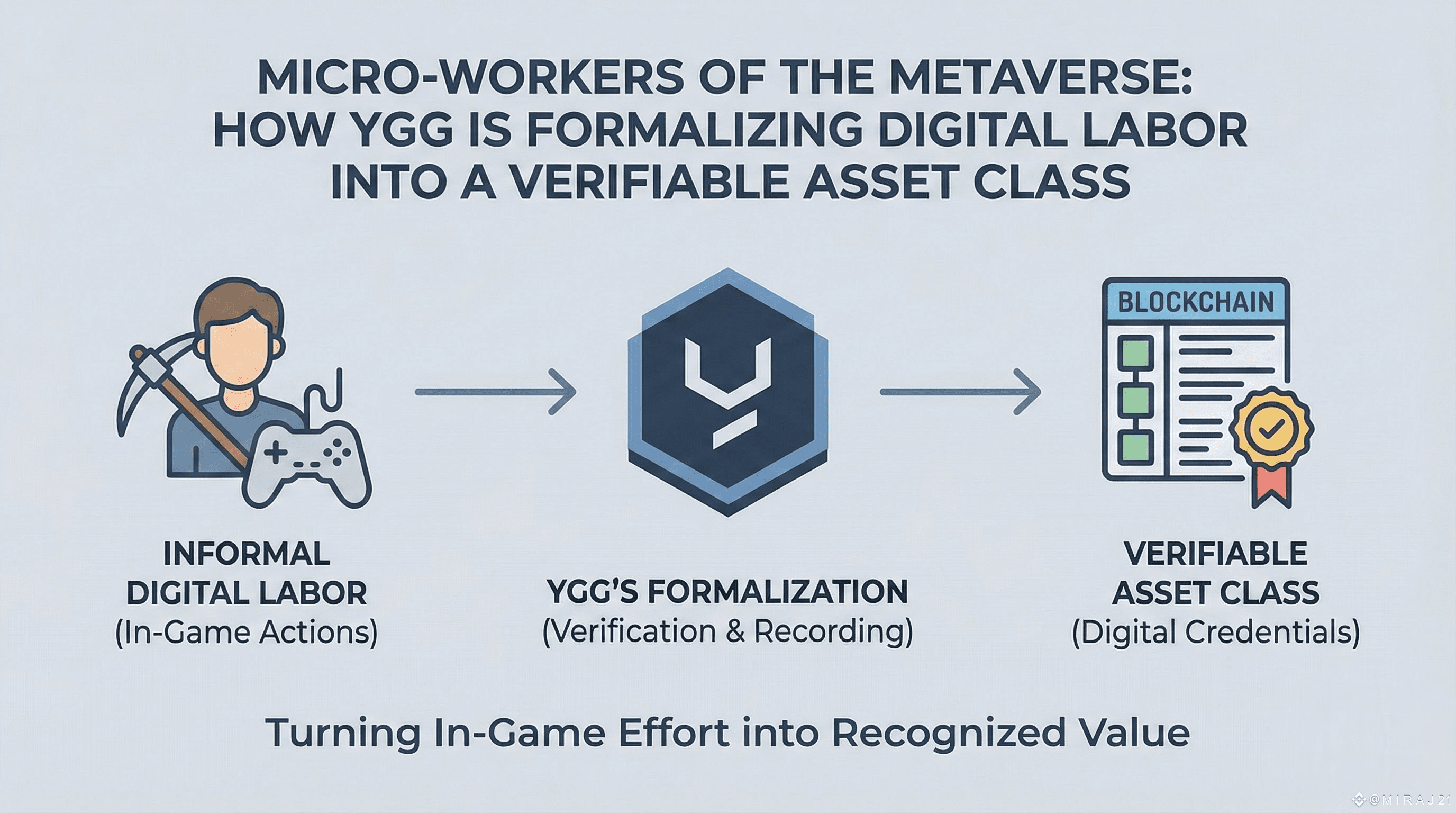
 The metaverse is no longer a playground it’s an emerging labor economy. YGG is turning its workers into a new on-chain asset class.
As digital worlds grow more complex, they require players who perform tasks, generate value, maintain economies, and contribute to virtual production loops. These “micro-workers” of the metaverse players completing quests, testing mechanics, farming resources, moderating communities, or participating in events are increasingly performing real labor.
Yield Guild Games (YGG) is formalizing this labor into something measurable, tradable, and verifiable: an asset class defined by contribution, skill, and economic output.
Digital work has been present, for years. Yet it remained unnoticed, unmeasured and unpaid. YGG transforms this reality.
MMOs, social realms and digital economies have consistently depended on player participation however:
there were no qualifications available
performance couldn’t be demonstrated consistently across games
measuring value proved difficult
abilities lacked transferability
the contribution did not receive acknowledgment
YGG unveils the infrastructure tier that converts player actions into a provable, on-chain identity. Evidence of effort, expertise and output.
Tasks transform into employment agreements. Segments of labor that produce quantifiable economic outcomes.
YGGs quest system standardizes tasks:
resource collection
testing gameplay loops
verifying new features
creating content
performing participation tasks
economic balancing activities
daily and seasonal missions
Each quest logs:
completion
consistency
difficulty
earned reward
skill classification
behavior quality
Together these data points create a work record. To a professional resume, for the metaverse.
Performance metrics turn players into economic participants.
Game developers and environments can presently assess gamers according to:
reliability
retention patterns
output quantity
job specialization
success rates
quest difficulty tiers
team-based performance
economic contribution metrics
This renders digital work measurable and comparable which's essential for it to qualify as an asset class.
SubDAOs act as decentralized labor unions and micro-work agencies.
Every SubDAO oversees an game-targeted collection of micro-workers:
matching talent with tasks
facilitating onboarding
verifying performance
distributing rewards
highlighting high-value contributors
discovering specialized workers
These SubDAOs become decentralized labor funnels, connecting supply (players) with demand (game studios and Web3 ecosystems).
Reputation becomes collateral in the digital labor economy.
Just as DeFi uses assets as collateral, the micro-worker economy uses reputation:
reliable players gain access to higher-paying quests
studios request contributors with proven track records
talent becomes tiered and ranked
credentials unlock specialized roles
long-term contributors receive premium opportunities
Reputation turns into an economic asset that compounds over time.
YGG presents the idea of "labor liquidity”. The capability to direct talent to where it generates the value.
In economies capital aims for expansion.
Within the metaverse economy work aims for realms.
YGG routes micro-workers to:
growing games
emerging economies
ecosystems with high demand for player activity
new launches requiring crowdsourced testing
quests needing specialized skills
This establishes a market, for digital workforce fluidity enabling talent to move between ecosystems.
Micro-work becomes a financial primitive when rewards are measurable and performance is verifiable.
For the first time, micro-labor can be priced accurately:
cost per quest
ROI per contributor
difficulty-adjusted rewards
retention-adjusted output
performance-weighted compensation
This enables:
structured labor markets
tiered reward systems
predictable workforce supply
value-based task assignment
The digital workforce becomes programmable.
As Web3 games mature, studios will depend on verifiable labor more than token incentives.
Token emissions cannot bootstrap sustainable economies.
Human contribution can.
Games need:
testers
creators
strategists
economic participants
event organizers
guild coordinators
quest completers
YGG provides these roles at scale, backed by verifiable performance history.
This is the real infrastructure layer that Web3 gaming was missing.
Micro-workers become an investable workforce when their performance generates compounding economic value.
In traditional markets, asset classes emerge when:
value can be quantified
productivity can be measured
performance can be verified
risk can be priced
returns can be forecasted
YGG enables all five for digital labor.
Players transition from participants to valuable, on-chain resources, whose involvement enhances game ecosystems and generates reliable financial outcomes.
The long-term vision: a global, interoperable labor graph powering the entire metaverse economy.
As more games integrate YGG:
credentials become portable
labor value becomes universal
performance data becomes an identity layer
talent becomes discoverable across chains
quests become standardized micro-contracts
In this world, YGG is not just a guild.
It is the labor infrastructure layer of the metaverse the system that classifies, verifies, and routes digital human capital.
The metaverse doesn’t scale through graphics or hype.
It scales through labor.

