
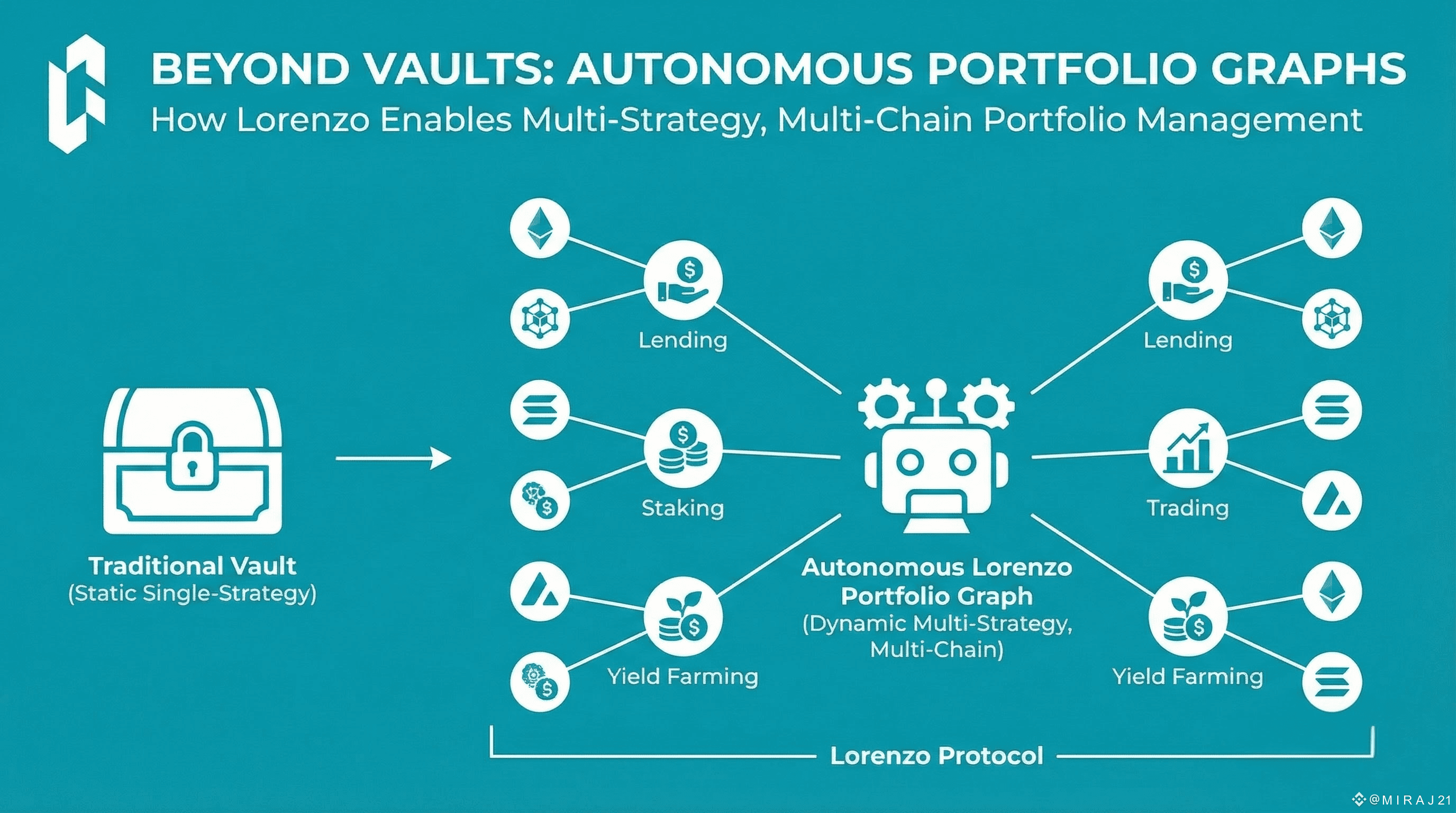
 Vault models were the first real step toward simplifying yield in DeFi, but they still feel static compared to what the landscape now demands. Most vaults operate like sealed containers. Capital enters, a predefined strategy executes, returns accumulate, and users wait until the logic updates or market conditions force a manual strategy shift. That model helped lower barriers, yet it leaves immense efficiency untapped. Markets move faster than vault governance cycles can respond, and capital often remains locked into suboptimal pathways for far longer than necessary. It looks like Lorenzo aims to take things a step further by turning vaults into lively portfolio graphs. These graphs would be able to adjust themselves in real time, adapting across different chains and strategies.
The concept of a portfolio graph changes how we think about managing assets. Instead of treating each investment separately, it emphasizes how they’re all connected in a decision-making network. Each investment strategy acts like a point in a flexible system that directs money where it’s needed. Funds shift between strategies on their own, reacting to things like performance, market liquidity, volatility, yield differences across networks, bridge conditions, fees, and on-chain risks. If one strategy starts to lag, the money doesn't sit around waiting for approvals or manual changes. It simply moves to stronger options in the network. This approach turns portfolio management from waiting around to rebalance into a process of ongoing optimization.
Multi-chain capability is the crucial enabler. Yield opportunities do not cluster neatly on a single network. They appear across rollups, app-specific chains, sidechains, and composite ecosystems, all operating under different cost structures and liquidity profiles. Lorenzo’s architecture can absorb this fragmentation by acting as a high-level allocator rather than a chain-specific participant. Capital doesn’t “belong” to any one chain; it belongs to the portfolio graph, which deploys it wherever real risk-adjusted returns exist. Chains become execution venues, not strategic anchors.
Autonomy kicks in when decisions don’t depend on human input anymore. Models can evaluate how strategies relate to each other, spot when liquidity is drying up, change position sizes when volatility hits, and rebalance between different types of strategies—like delta-neutral or directional ones—all on their own. Humans still play a role in setting the overall rules for acceptable risk, which assets to include, and how much to spend, but the machines take care of moving the money around within those limits. So, instead of picking strategies every now and then, it becomes an ongoing process.
This shift really transforms how users experience DeFi investment. Rather than picking individual vaults by looking at historical APY numbers, participants now just hold portfolio tokens that represent a mix of strategies. Their exposure adjusts naturally over time, and they don’t have to do anything to make that happen. They remain positioned for stability during turbulent markets and transition toward growth phases as conditions normalize. Participation feels closer to professionally managed investment funds than to yield mining tactics.
Systemically, portfolio graphs reduce one of DeFi’s persistent weaknesses: synchronized crowd behavior. In static vault systems, everyone tends to go after the same annual percentage yields (APYs) at the same time. This can create sharp inflows, squeeze liquidity, and cause chaotic exits that can really hurt yields and raise risk. Using graph-based allocation can help ease these cycles. It spreads capital more evenly across different strategies and allows for smoother rebalancing instead of rushing from one opportunity to another. Markets stabilize because flows become smoother and intelligence driven rather than emotionally reactive.
Lorenzo’s approach also elevates composability. Each node in the graph remains an interoperable on-chain module accessible to other protocols. Lending platforms can collateralize portfolio tokens. Insurance protocols can underwrite graph risk exposures. Derivative systems can hedge basket volatility. What begins as asset management quietly becomes systemic financial infrastructure.
Of course, genuine autonomy introduces new challenges model accuracy, black-swan risks, regulatory uncertainty surrounding cross-chain managed products, and the ongoing necessity of transparent reporting to maintain trust. Yet these challenges are far less severe than those created by unmanaged retail risk exposure and fragile incentive economies that dominated early DeFi.
Beyond vaults lies a different vision of decentralized finance. One where portfolio construction behaves adaptively rather than rigidly. Where capital flows intelligently instead of emotionally. And where participation becomes accessible without stripping away sophistication. Lorenzo’s trajectory suggests it’s moving toward becoming not just a platform of vaults, but a decision engine powering fully autonomous, multi-chain investment graphs capable of reshaping how yield, risk, and opportunity interact across the decentralized financial world.


