
The earliest days of play-to-earn often felt like a crowded market street—noisy, disorganized, full of possibility and confusion in equal measure. Players were discovering that their time in virtual worlds suddenly carried financial weight, while game studios were scrambling to manage a new category of user who wasn’t there just for fun. Somewhere in that chaos, Yield Guild Games began sketching something more durable: a framework for coordinating thousands of participants without smothering the spontaneity that made the movement exciting in the first place.
For a while, the guild model was enough. A central treasury acquired assets; players deployed them; rewards flowed back into the ecosystem. But like any structure grown under pressure, its limitations became clear. A single treasury making decisions for a global network of players was too narrow, too slow, too dependent on the intuition of a few people trying to interpret the needs of many. The community had more insight than the core team could process. Games were evolving faster than any centralized strategy could keep up.
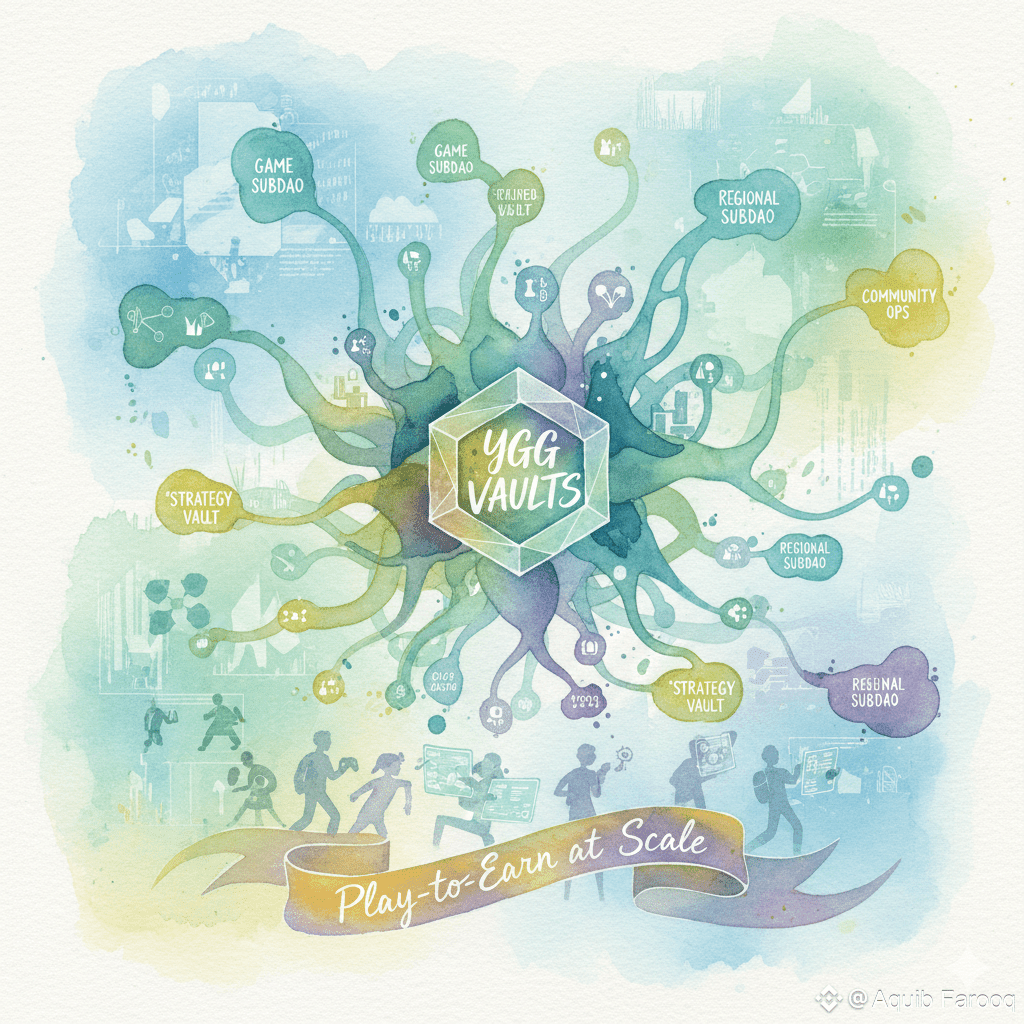
That’s where the Vaults and SubDAO architecture entered quietly at first, then as a deliberate redesign. If the original guild was a house, then Vaults were the load-bearing beams that allowed it to expand without collapsing. Each Vault became both a container and a signal: a place where assets for a specific game or vertical could be managed with clarity, and a mechanism for the community to express interest, allocate capital, and take responsibility.
A Vault isn’t just a bucket of tokens. It’s a governance boundary. If a new game emerges with promising mechanics or unusual yield patterns, a Vault can form around it without waiting for approval from some distant oversight body. The community votes, funds flow, operations begin. It feels more like an organism adapting than an organization expanding.
SubDAOs extend that logic outward, giving shape to the community’s diversity rather than flattening it. A SubDAO isn’t a franchise or a chapter; it’s more like an economic micro-culture. Regional SubDAOs respond to local player habits and constraints. Game-specific SubDAOs develop expertise that would be impossible to coordinate at scale. Some experiment with alternative reward structures; others refine onboarding processes to suit the games they specialize in. The point isn’t to split YGG into fragments it’s to let intelligence grow where it naturally accumulates.
Taken together, Vaults and SubDAOs create a network that behaves less like a company and more like an ecosystem. Decisions flow sideways as much as they flow upward. Authority shifts based on contribution, not proximity to a central office. And instead of treating players as interchangeable units, the infrastructure acknowledges their differences and uses them as fuel. In traditional gaming economies, hierarchy is inevitable: the studio builds, the players consume. Here, hierarchy becomes porous. Contribution travels in both directions.
There is a financial sophistication beneath this decentralized surface that often gets overlooked. Vaults help isolate risk. If one game collapses or its economics spiral, its failure doesn’t infect the entire system. SubDAOs can scale up or down without dragging the whole organization into the turbulence of a particular market cycle. And because governance occurs at multiple layers, incentives become more tightly aligned players who understand a game’s yield dynamics directly influence how that game’s assets are deployed.
Still, the most compelling effect of this architecture isn’t the efficiency or the risk management. It’s the way it reshapes identity within the guild. People don’t just join YGG; they join the pockets of YGG that match their energy, their skill, their regional context, their playstyle. The experience becomes more personal, less monolithic. Someone in a SubDAO can be both a stakeholder and a strategist. A player who once viewed gaming as a side activity can end up running treasury discussions or coordinating regional training sessions.
The core team no longer presumes to understand every game or region equally well. Instead, expertise is distributed. Authority is earned. People closest to the activity make the decisions that matter. For a global gaming economy where cultural context shapes everything from play patterns to communication styles—that shift is not just efficient; it’s honest.
The architecture isn’t perfect, of course. DAOs rarely are. Governance can be slow, and coordination costs appear in unexpected places. SubDAOs sometimes experiment too aggressively; Vaults occasionally over-allocate in excitement. But mistakes are easier to correct in a modular system. A misstep in one corner doesn’t compromise the whole map.
What YGG seems to understand, perhaps better than many early Web3 gaming projects, is that scalability isn’t just about increasing numbers. It’s about increasing coherence. A guild can grow in size, but a DAO grows in complexity—and that complexity needs structure without rigidity.
As play-to-earn matures, the infrastructure behind it will matter more than the hype cycles that once defined it. The shiny promise of early P2E—earn money by playing a game—was never sustainable on its own. What was sustainable was coordination: people pooling knowledge, distributing opportunity, and managing value collectively. Vaults and SubDAOs turn that idea into a system. Not flawless, not finished, but functional in ways the first wave of P2E never managed.
Years from now, when gaming economies look more like miniature nations than entertainment products, the architecture YGG is refining today may be seen as an early blueprint—a reminder that scale doesn’t come from size alone, but from giving people the tools to build alongside you.
It’s easy to forget in the noise of tokens and governance proposals, but this entire structure exists for one reason: people found meaning in being part of something larger than themselves. Vaults and SubDAOs simply give that meaning a place to live.

