Disclaimer: In compliance with MiCA requirements, unauthorized stablecoins are subject to certain restrictions for EEA users. For more information, please click here.
Binance Margin provides users with the flexibility to choose different leverage multipliers based on their risk tolerance and trading strategies. Depending on the product, leverage can range from 3x to a maximum of 10x.
When the liquidation threshold is reached, a user’s margin position will be liquidated, and their collateral will be sold to repay any liabilities and interest owed. Liquidation thresholds vary by margin mode and leverage:
Margin Mode | Leverage Multiplier | Liquidation Thresholds |
3x | Margin Level ≤ 1.1 | |
Cross Margin Classic Mode | 5x | Margin Level ≤ 1.1 |
3x | Margin Level ≤ 1.18 | |
Isolated Margin Mode | 5x | Margin Level ≤ 1.15 |
Isolated Margin Mode | 10x | Margin Level ≤ 1.05 |
Binance uses a single forced liquidation process, which includes:
This liquidation method applies to Cross Margin and Isolated Margin modes.
High-level steps
1. Calculate the total net asset and net debt before liquidation (netting same-asset collateral against same-asset debt).
2. Calculate the total amount pending settlement (net debt plus applicable fees).
3. Apply the Risk-Based Liquidation Adjustment to NET collateral values.
4. Settle the liquidation by liquidating collateral in priority order until the total amount pending settlement is covered.
Important notes:
Example liquidation snapshot:
| Token | Collateral Quantity | Margin Debt (principal + interest) | Index Price (USDT) |
| USDT | 10,000 | 1,000 | 1 |
| USDC | 500 | 5,500 | 1 |
| BTC | 0.1 | 0.5 | 100,000 |
| ETH | 5 | 0 | 4,000 |
| XYZ | 20,000 | 0 | 2 |
1. Calculate the total net debt and net assets before liquidation.
| Token | Net Asset | Margin Debt (principal + interest) | Index Price (USDT) |
| USDT | 9,000 | 0 | 1 |
| USDC | 0 | 5,000 | 1 |
| BTC | 0 | 0.4 | 100,000 |
| ETH | 5 | 0 | 4,000 |
| XYZ | 20,000 | 0 | 2 |
2. Calculate the total amount pending settlement.
Liquidation Clearance Fee of Margin Debt = Margin Debt Amount * Clearance Fee Rate = (1,000 * 1 + 5,500 * 1 + 0.5 * 100,000.0) * 2% = 1,130
Net Debt = 5,000.0 * 1.0 + 0.4 * 100,000 = 45,000
Total Amount Pending Settlement = Liquidation Clearance Fee + Net Debt = 1,130 + 45,000 = 46,130
3. Apply the Risk-Based Liquidation Adjustment to net assets.
| Token | Liquidated Asset | Index Price (USDT) | Risk-Based Liquidation Ratio | Risk-Based Liquidation Adjustment quantity * price * (1 - Risk-Based Liquidation Ratio) |
| USDT | 9,000 | 1 | 0.01% | 9,000 * 1 * (1 - 0.01%) = 8,999.1 |
| ETH | 5 | 4,000 | [0, 10000) 5% [10000, 99999999) 10% | 2.5 * 4,000 * (1 - 5%) + 2.5 * 4,000 * (1- 10%) = 18,500 |
| XYZ | 11,644.3125 | 2 | 20% | 11,644.3125 * 2 * (1 - 20%) = 18,630.9 |
where:
4. Liquidation settlement:
Remaining Collateral after Liquidation = Net Assets - Liquidated Assets
Remaining Collateral = (20,000 - 11,644.3125) = 8,355.6875 quantity of token XYZ
Summary
In this example, high-liquidity assets are liquidated first during liquidation to minimise market impact and reduce the overall risk-based liquidation adjustment.
According to the Margin Service Terms of Use, a liquidation fee (which is a percentage of the liquidated assets) will be charged on both regular liquidation and takeover liquidation:
| Margin Mode | Rate | Fee Base |
| Cross Margin Classic Mode | 2% | Liquidated Assets* |
| Isolated Margin Mode | 2% | Liquidated Assets |
Liquidation fees are deducted from the users’ remaining assets in their Margin Accounts. Based on the scenarios illustrated above, since the total amount of liability at the point of liquidation is 400,000 USDC, the liquidation fee will be 8,000 USDC (2% * 400,000 USDC) for Cross Margin Classic mode.
* The liquidated assets are calculated by the Margin Account snapshot taken at the start of the liquidation.
Please note: For full terms and conditions regarding liquidated assets, please refer to the Margin Service Terms of Use.
In margin trading, forced liquidations can result in significant losses. To reduce the risk of a forced liquidation, we recommend the following risk management strategies:
1. Monitor margin levels and collateral values
For more details, please refer to Binance Margin Level and Risk Control.
2. Take note of margin calls
Margin Mode | Leverage Multiplier | Margin Call Ratio |
Cross Margin Classic Mode | 3x | 1.3 |
Cross Margin Classic Mode | 5x | 1.16 |
Isolated Margin Mode | 3x | 1.22 |
Isolated Margin Mode | 5x | 1.19 |
Isolated Margin Mode | 10x | 1.1 |
3. Use the Auto Top-Up function
Users can also use the Auto Top-Up function to reduce the risk of forced liquidations. After enabling the function, the system will automatically transfer available assets from the Spot Account to the Margin Account. For more details, please refer to What is Auto Top-up and How to Use It.
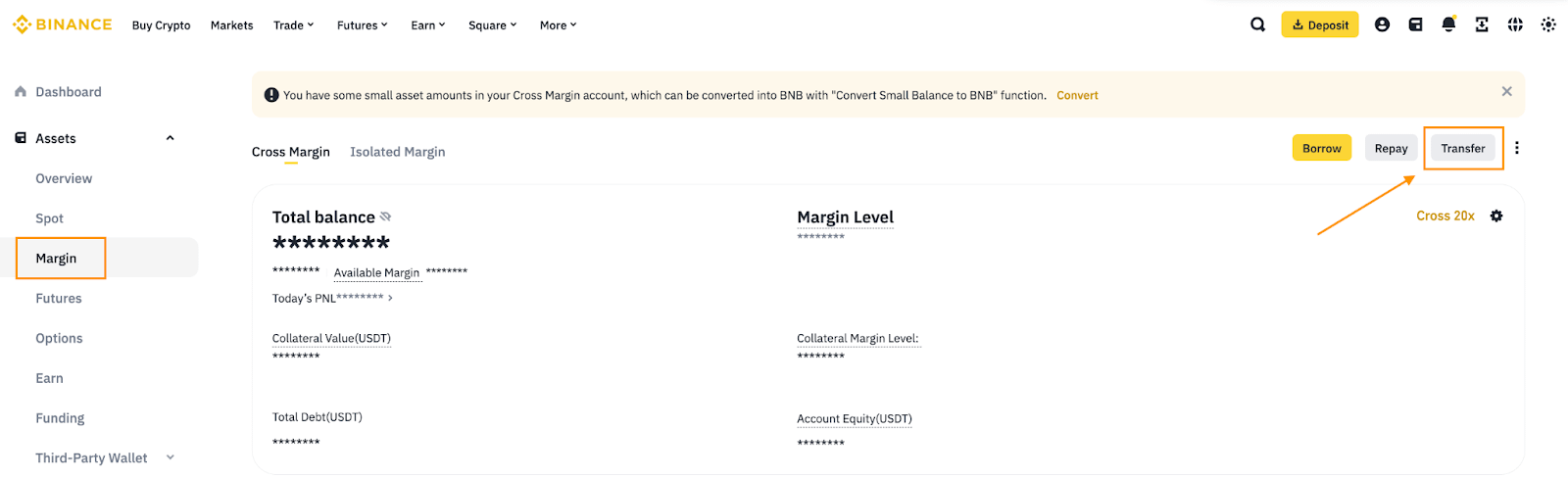
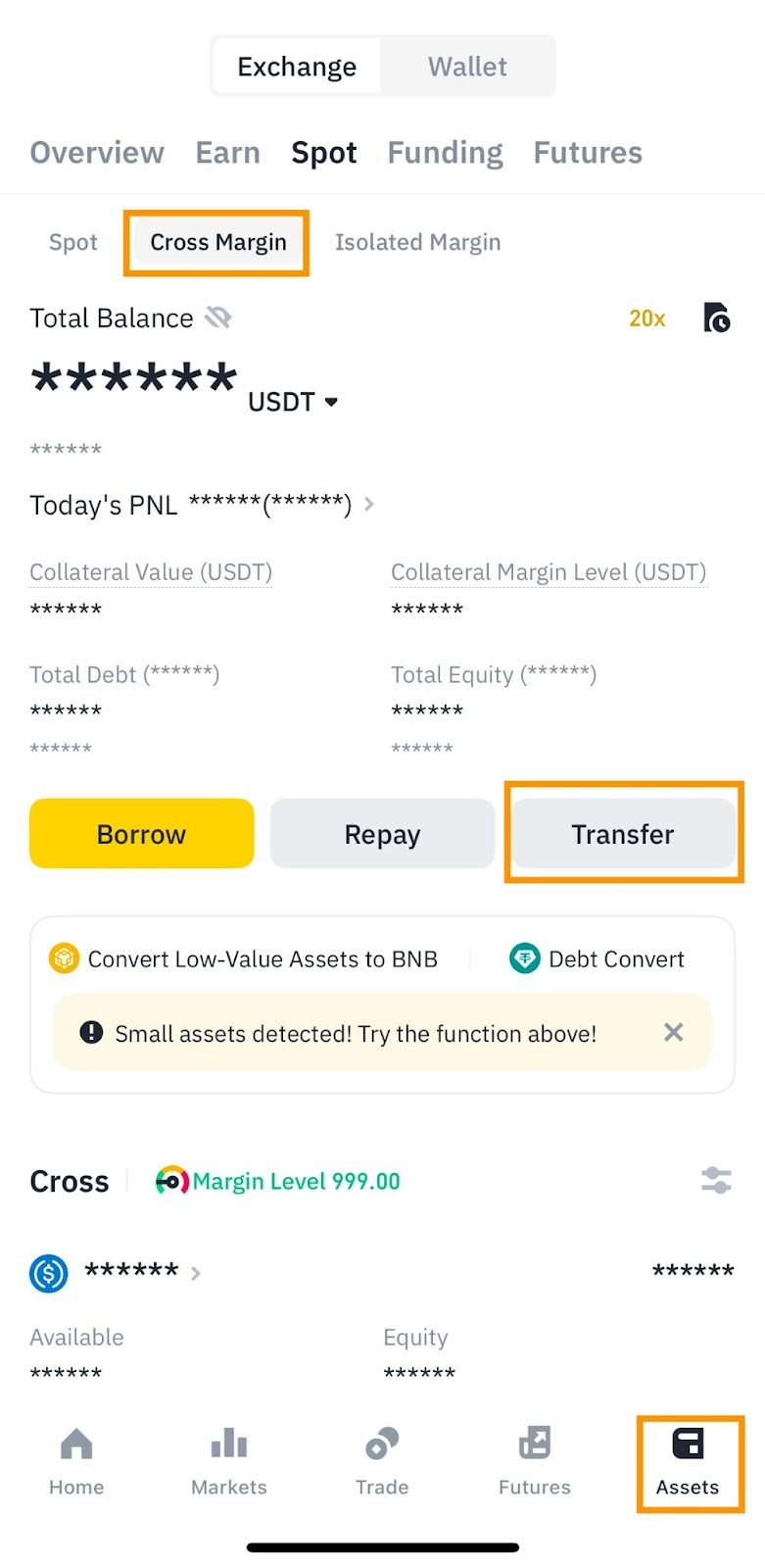
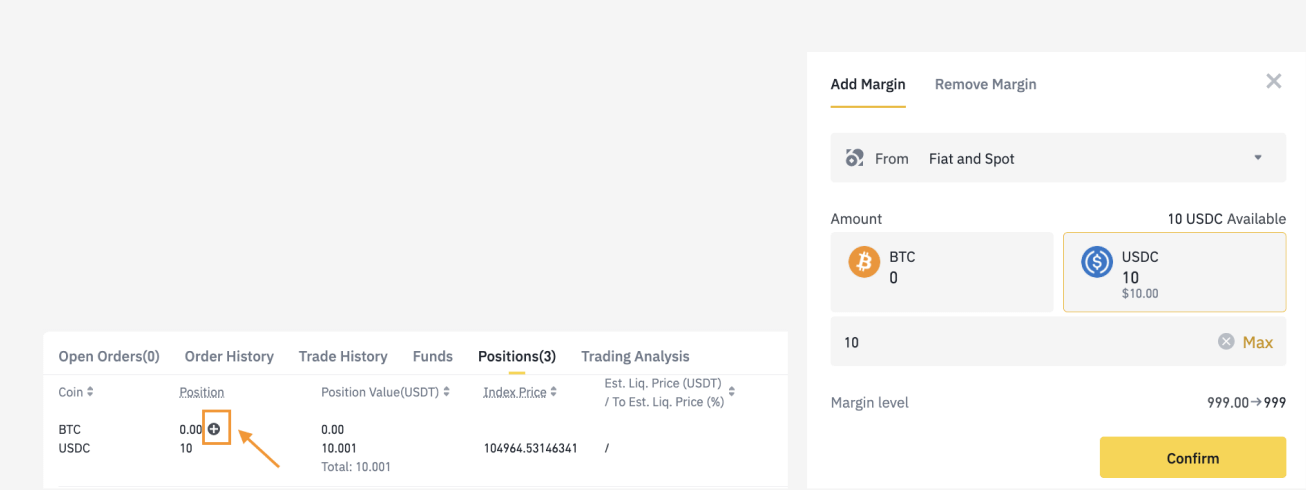
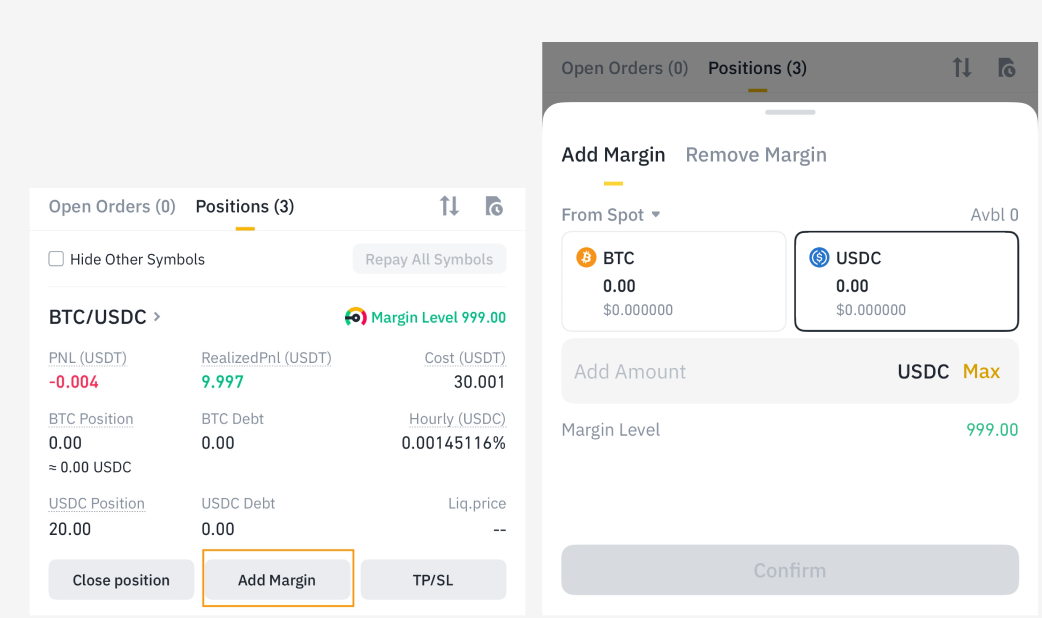
4. Add and/or remove margin to maintain a healthy margin level
Cross Margin:
Isolated Margin:
Please note: Due to extreme market movements, the margin level might hit the liquidation ratio immediately after touching the margin call ratio. Your positions might get liquidated before Auto Top-up can be performed in this case. You are strongly advised to monitor the margin level closely to avoid losses. Binance shall not be liable for any loss incurred.
Binance will use reasonable endeavors (but has no obligation) to send margin call and liquidation call notifications by email and internal messages. Binance has no responsibility for and does not in any way guarantee the timely delivery of such messages. The notifications serve as a risk warning and it is solely the trader’s responsibility to take appropriate action and avoid the liquidation of their positions. Please note that due to extreme market movements, the margin level might hit the liquidation ratio immediately after touching the margin call ratio, the margin call notification will be automatically canceled by the system and only a liquidation call notification will be dispatched.
Disclaimer and Risk Warning: This content is presented to you on an “as is” basis for general information and educational purposes only, without representation or warranty of any kind. Digital asset prices are subject to high market risk and price volatility. The information provided does not constitute, in any way, a solicitation or recommendation or inducement to buy or sell the products. The value of your investment may go down or up, and you may not get back the amount invested. Cross-margining contributes to providing greater leverage than a regular margin account, and greater leverage creates greater losses in the event of adverse market conditions. There is increased risk that a user's cross-margin positions will be liquidated involuntarily, causing possible loss. Comments and analysis do not constitute a commitment or guarantee on the part of Binance. You are solely responsible for your investment decisions and Binance is not liable for any losses you may incur. Past performance is not a reliable predictor of future performance. You should only invest in products you are familiar with and where you understand the risks. You should carefully consider your investment experience, financial situation, investment objectives and risk tolerance and consult an independent financial adviser prior to making any investment. This material should not be construed as financial advice. This product may not be available in certain countries and to certain users. This content is not intended for users/countries to which prohibitions/restrictions apply. For more information, see our Terms of Use and Risk Warning. To learn more about how to protect yourself, visit our Responsible Trading page.
