
Vanar is easiest to understand when you stop looking at it like “another fast L1” and start looking at it like a deliberately stacked system that is trying to make Web3 feel practical for everyday products, especially the kind that live in entertainment, games, brands, and consumer apps, where users do not care about chains but do care about smooth experiences, predictable costs, and apps that feel smart rather than brittle. On Vanar’s own framing, the end-goal is not simply to run transactions, but to make onchain applications intelligent by default, which is why the project keeps repeating the same core idea across its site: it wants to turn Web3 from programmable to “thinking,” meaning the chain should not just store data and execute rules, but also keep context, interpret what the data represents, and help automate what happens next.
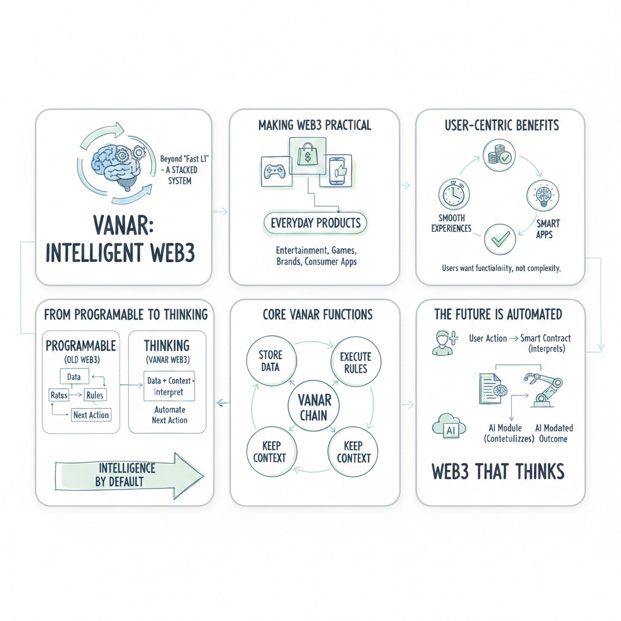 That “why it matters” piece becomes clearer when you look at what they are actually building behind the branding, because Vanar is not selling one product, it is selling a layered architecture where each layer is meant to remove a real bottleneck that blocks mainstream adoption. The base is Vanar Chain itself, described as an AI-powered L1 designed for PayFi and tokenized real-world assets, with the usual performance promises, but also with very specific language about AI workloads, semantic operations, vector-style storage, and “verifying truth inside the chain,” which is basically their way of saying that the chain should be able to work with meaning and context rather than treating everything as dumb bytes.
On top of that base layer, the project spotlights two pieces as the “brain and memory” of the stack, and they keep showing up everywhere in the official materials: Neutron and Kayon. Neutron is presented as a semantic compression and memory layer that takes real documents and files and restructures them into “Seeds,” which are supposed to remain fully onchain, verifiable, and queryable, and Vanar goes as far as giving a concrete compression example of turning 25MB into 50KB using a mix of semantic, heuristic, and algorithmic techniques, which is clearly aimed at the pain-point of “we want to keep proof and data available without relying on links that rot or storage layers that become fragile.” Kayon is then positioned as the reasoning layer that sits on top of those Seeds and other backends, allowing natural-language querying and contextual interpretation, and the pitch here is very enterprise-friendly because they emphasize compliance automation, insights, and the ability to connect to real systems rather than trapping everything in crypto-only workflows.
What makes the roadmap feel more like a product company than a pure protocol lab is that Vanar openly maps the next steps as additional layers, with Axon and Flows marked as “coming soon,” and the intended direction is obvious even if you ignore the hype: once you have data that is stored as usable memory (Neutron) and you have a reasoning layer that can interpret and validate it (Kayon), the next logical move is automation and repeatable, industry-specific templates that let builders ship real solutions faster, which is exactly how Vanar describes those upper layers in its stack narrative.
The token story fits this architecture in a fairly straightforward way, because VANRY is meant to be the fuel and the coordination mechanism rather than some separate meme economy. On the market-facing side, VANRY exists as an ERC-20 token on Ethereum at the contract you shared, and Etherscan confirms it uses 18 decimals while labeling it as the official token tied to the Vanar blockchain. On the protocol-facing side, Vanar’s own whitepaper frames VANRY as the network’s core token, with the broader intention of providing fast transactions, fixed low costs, and easier onboarding, which is basically the token’s role in helping the chain function as a predictable platform instead of a fee-chaos experiment. Vanar’s documentation also describes VANRY as more than “just gas,” pointing at governance, community participation, and network security, and their staking documentation describes the staking dApp as the central hub where users can stake, unstake, and claim rewards while viewing validator parameters like APY and commission, which is the practical “how it benefits users” side for anyone who wants to participate beyond holding.
If you want the cleanest, most official explanation of how VANRY “exists” across environments, Vanar’s own historical swap announcement makes it explicit that VANRY existed as an ERC-20 token until mainnet launch and that users would have the option to migrate, which is a useful detail because it explains why you see a significant ERC-20 footprint even while Vanar also speaks about its own mainnet. At the same time, Vanar’s own mainnet explorer publicly reports large-scale chain activity with totals such as blocks, transactions, and wallet addresses, which helps ground the project in “this chain is running and being used,” even if the specific nature of that usage still depends on what apps are driving it.
When people ask what Vanar is “really doing behind the scenes,” the most tangible signals are the things the team keeps investing in publicly: developer infrastructure and ecosystem pathways that make it easier for builders to actually ship on Vanar rather than just talk about it. The official documentation and developer pages lean hard into familiar Ethereum tooling and EVM compatibility, because their adoption thesis requires developers to feel at home immediately instead of learning a new universe, and the staking, hub, explorer, and docs links are all presented as first-class parts of the ecosystem rather than afterthoughts. Vanar also runs a “Kickstart” style ecosystem program where they showcase partner perks and builder-facing collaborations, which is a very practical “adoption lever” because it turns the chain into a place where projects can get distribution and commercial support rather than only technical hosting.
On “latest updates,” there are two categories that matter if you want to stay honest: verifiable activity and narrative momentum. For verifiable activity in the last 24 hours, CoinMarketCap currently shows VANRY trading around the $0.006 range with roughly $2.1–$2.25M in 24-hour volume and a mid-single-digit 24-hour gain, which tells you there is still meaningful liquidity and short-term attention even if the token is not in a headline cycle. Etherscan’s token page also displays a 24-hour market panel and the token’s live onchain visibility, which is useful for sanity-checking that transfers and market activity are not purely theoretical.
For narrative momentum, the most recent public-facing angle from Vanar itself is the continued push into an “AI-native infrastructure” identity for PayFi and real-world assets, which keeps showing up in their core product pages rather than only in marketing posts, and that consistency matters because projects that constantly reinvent their identity tend to lose builders. There are also recent community posts circulating about a 2026 roadmap and governance upgrades, but those are third-party commentary rather than binding protocol commitments, so they are better treated as a temperature check of what the community expects next instead of a guarantee of what ships.
So what’s next, in a grounded and project-focused way, is basically this: Vanar has to convert the “chain that thinks” idea into repeatable outcomes that builders can touch, meaning Neutron has to move from a compelling concept into a widely used data layer for real documents and proofs, Kayon has to become the layer people actually rely on for querying and compliance logic rather than a demo, and the “coming soon” layers such as Axon and Flows have to arrive as products that reduce time-to-market for teams that want automation and industry-ready app patterns. If they execute that ladder well, Vanar becomes less like a speculative L1 and more like an application platform where data, reasoning, and automation come bundled, and that is exactly the kind of packaging that can make sense to brands and consumer teams who want Web3 benefits without the usual fragmentation.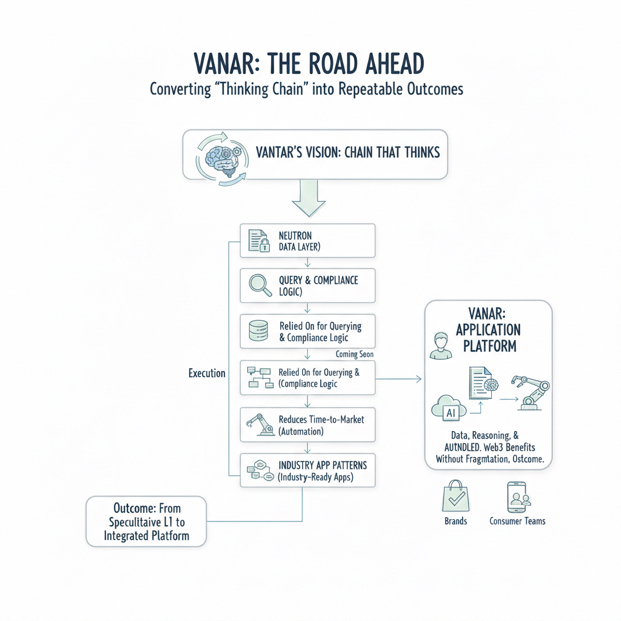
My takeaway, keeping it human and simple, is that Vanar’s most interesting bet is not speed, it is coherence, because they are trying to build a single narrative where storage becomes memory, memory becomes reasoning, and reasoning becomes automated action, and that is a natural arc for the next wave of Web3 apps where AI agents, real-world proofs, and compliance-friendly workflows are becoming table stakes rather than exotic features. The project will be judged less by how poetic the slogans are and more by whether developers and partners keep choosing Neutron and Kayon as the default way to store and interpret meaningful data onchain, because once that happens, VANRY’s utility story becomes organic, since fees, staking, governance, and ecosystem usage start feeding each other without needing constant external hype.