
As Brent crude eyes triple digits on escalating Iran strikes and Hormuz disruptions, Bitcoin quietly rewrites the macro playbook — and I'm watching every move.
By Dr. Crypto | Binance Square | March 16, 2026 |
"In a world where oil barrels and Bitcoin blocks compete for the title of 'ultimate store of value,' the geopolitical scoreboard just flashed red — and Bitcoin is taking notes."
Markets are sending a clear signal: when the world catches fire, money moves.
This weekend, that money — at least a meaningful slice of it — moved into Bitcoin.
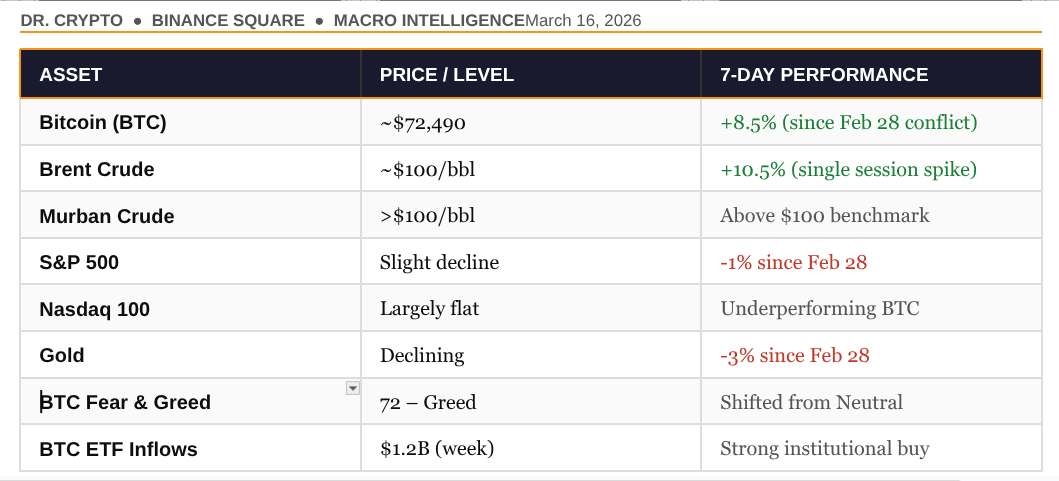
As further strikes rocked the Middle East and Brent crude climbed sharply back toward $100 per barrel, BTC posted a 2% gain to trade at $72,490, rebounding sharply after briefly dipping toward $70,500 during volatile weekend sessions.
This is not a coincidence. This is the new macro architecture unfolding in real-time — and every serious market participant needs to understand what it means.
I. The Oil Shock: A Timeline of Disruption
The conflict, which officially escalated on February 28 when the U.S. and Israel launched joint strikes against Iran, has set off one of the most consequential commodity shocks in recent memory.
Within hours of the initial strikes, Bitcoin dropped from $70,000 to below $63,000 — a knee-jerk risk-off response.
But the story didn't end there.
Iran retaliated swiftly, targeting the Strait of Hormuz — the maritime chokepoint that carries roughly one-fifth of the world's oil supply and facilitates over $500 billion in annual energy trade.
Crude spiked briefly above $119 before settling near $100. Meanwhile, Murban crude — the UAE benchmark for barrels that can bypass Hormuz entirely — blew through the $100 level, a stark signal that the physical oil market is pricing in genuine supply disruption, not just geopolitical noise.
Fast-forward to this past week: oil tanker attacks in Iraqi territorial waters sent Brent surging as much as 10.5% in a single session.
Iran's Islamic Revolutionary Guard Corps has now declared a strategic shift from 'reciprocal hits' to 'continuous strikes,' threatening to push oil toward $200 a barrel.
The IEA's proposed 400-million-barrel reserve release has done little to reassure physical markets.
II. Bitcoin's Resilience: The New Safe-Haven Argument
Here is the number that should stop every traditional finance analyst in their tracks: since the Middle East conflict erupted on February 28, Bitcoin has gained approximately +8.5%.
In that same period, the S&P 500 dropped ~1%, Gold fell ~3%, Silver declined ~9%, and tech benchmarks largely stagnated.
Bitcoin — the so-called 'risk asset' — outperformed them all.
Let that sink in for a moment. In the middle of a hot war, with oil tankers on fire in the Persian Gulf and the Strait of Hormuz effectively weaponized, Bitcoin held its ground while the assets that traditional wealth managers have long labeled 'safe havens' quietly bled out.
This is not an accident. Institutional flows are returning. BlackRock's iShares Bitcoin Trust (IBIT) traded 1% higher even on sessions where the S&P 500, Nasdaq 100, Russell 2000, and the Dow were all in the red.
Bitcoin ETFs recorded $1.2 billion in net inflows in the week ending March 15. On-chain data confirm whale accumulation — large holders added over 10,000 BTC to their wallets during the same period.
Trading volumes on BTC/USD pairs surged 15% to approximately $45 billion across spot and derivatives markets.
Dr. Crypto's Read: The market is telling us something fundamental.
When geopolitical risk goes parabolic, Bitcoin is no longer being sold alongside tech stocks — it's being bought alongside the narratives of monetary debasement and energy-backed value.
III. The Oil-Bitcoin Nexus: Two Sides of the Same Coin
The relationship between oil and Bitcoin is nuanced — and often misread by retail traders who treat every correlation as causation.
Let me break it down clearly.
The Bear Case from Oil:
Rising oil fuels inflation, which makes the Fed's rate-cut path even narrower.
No rate cuts = tighter financial conditions = pressure on risk assets.
Elevated energy costs increase Bitcoin mining expenses in oil-linked electricity markets (mainly UAE and Oman — roughly 8-10% of global hash rate).
Stagflation fears — the worst combination of slow growth + high inflation — historically drag all risk assets lower, Bitcoin included.
The Bull Case from Oil:
Oil above $100 erodes confidence in fiat purchasing power — the single most powerful narrative in Bitcoin's entire value proposition.
Geopolitical instability drives capital out of the traditional financial system into censorship-resistant, borderless assets. Bitcoin leads this category.
The DXY (U.S. Dollar Index) has dipped 2.5% over the last 48 hours — historically, a weaker dollar is rocket fuel for BTC.
Historical data shows that strong oil price rallies often coincide with the late stages of the BTC market cycle — the setup for the next leg up.
IV. The Fed Factor: The Wildcard Nobody Wants to Talk About
Let's address the elephant in the room: the Federal Reserve's March 17–18 meeting.
With oil firmly above $100, inflation expectations are re-anchoring higher.
The probability of near-term rate cuts — already slim — has now shrunk to near zero.
This matters for Bitcoin because high interest rates mean higher opportunity cost for holding non-yielding assets.
It's the same argument bears have been making for two years.
But here's the counter-argument that the bears consistently miss: in a world where the U.S. dollar is being actively weaponized, where geopolitical risk is structurally elevated, and where central banks have already debased their currencies by extraordinary amounts — the 'risk-free rate' argument is increasingly losing its persuasive power.
Bitcoin's RSI currently sits at 62 — room for further upside without entering overbought territory.
The MACD shows bullish crossovers on the daily chart. The technical structure is not broken.
But the $73,000–$74,000 resistance range has repeatedly acted as a ceiling.
Breaking above it decisively — especially if oil reverses or the Fed signals a dovish pivot — could ignite the next explosive move.
V. Looking Ahead: Catalysts & Risk Scenarios
What happens next will likely be determined by one or more of these critical catalysts:
Ceasefire Signal: Any credible move toward de-escalation in the Middle East could take $20-$30 off the oil price overnight, relieve macro pressure, and potentially ignite Bitcoin's next leg toward $80,000+.
G7 Strategic Reserve Release: The proposed 300–400 million barrel SPR release, with support from the U.S. and two other G7 nations, could meaningfully cool oil prices and remove a key headwind for risk assets.
Fed Pivot: Even a hint of rate cuts — triggered by growth concerns overriding inflation fears — would be extraordinarily bullish for BTC.
Escalation Risk: If the conflict widens or the Strait of Hormuz is fully closed for an extended period, stagflation becomes a genuine macro regime — and Bitcoin's near-term downside toward $60,000 becomes a real conversation.
Trump's Oil Diplomacy: President Trump stated oil prices 'will drop rapidly' when the 'Iran nuclear threat is over' — characterizing the current spike as 'a very small price to pay.'
If Washington succeeds in resolving the conflict diplomatically, the macro backdrop could shift dramatically within weeks.
⚡ DR. CRYPTO'S VERDICT
Bitcoin is not flying because of oil. Bitcoin is flying despite oil — and that distinction is everything.
The narrative that Bitcoin is a pure risk-on asset that collapses with every macro shock is being systematically dismantled by the data.
Yes, the $73,000–$74,000 range is a wall. Yes, stagflation risks are real. Yes, the Fed is in a bind.
But Bitcoin's structural demand — institutional ETF inflows, whale accumulation, and its role as a geopolitical hedge — is growing faster than the macro headwinds.
My positioning: Watching $73,500 as the key breakout level.
A weekly close above it — especially accompanied by declining oil and a dovish Fed signal — would be my trigger for the next major accumulation phase.
Until then, I'm sizing for volatility and staying patient.
The war for $100K is not over. It's just getting interesting.
DISCLAIMER: This article is authored by Dr. Crypto for Binance Square and is intended for educational and informational purposes only.
Nothing herein constitutes financial advice, investment advice, or a solicitation to buy or sell any asset.
Cryptocurrency markets are highly volatile. Always conduct your own due diligence. Past performance is not indicative of future results.
All market data referenced was accurate at time of publication, March 16, 2026.
Follow Dr. Crypto on Binance Square