Every transaction on a public blockchain leaves a permanent trail—wallet addresses, amounts, timestamps, and counterparties. This radical transparency powers trust and verification, but it also creates a quiet problem: there is no real concept of data ownership. Once your data is on-chain, it belongs to everyone—and no one.
For casual crypto use, this tradeoff feels acceptable. But the moment blockchain meets real-world industries—healthcare, finance, supply chains—the model breaks down. Sensitive data cannot live on a fully transparent ledger without violating regulations and basic privacy expectations.
That’s the gap is designed to solve.
The Real Problem: Proving Without Revealing
Traditional blockchains force a choice: transparency or privacy. You either expose everything or hide everything. Neither works for serious applications.
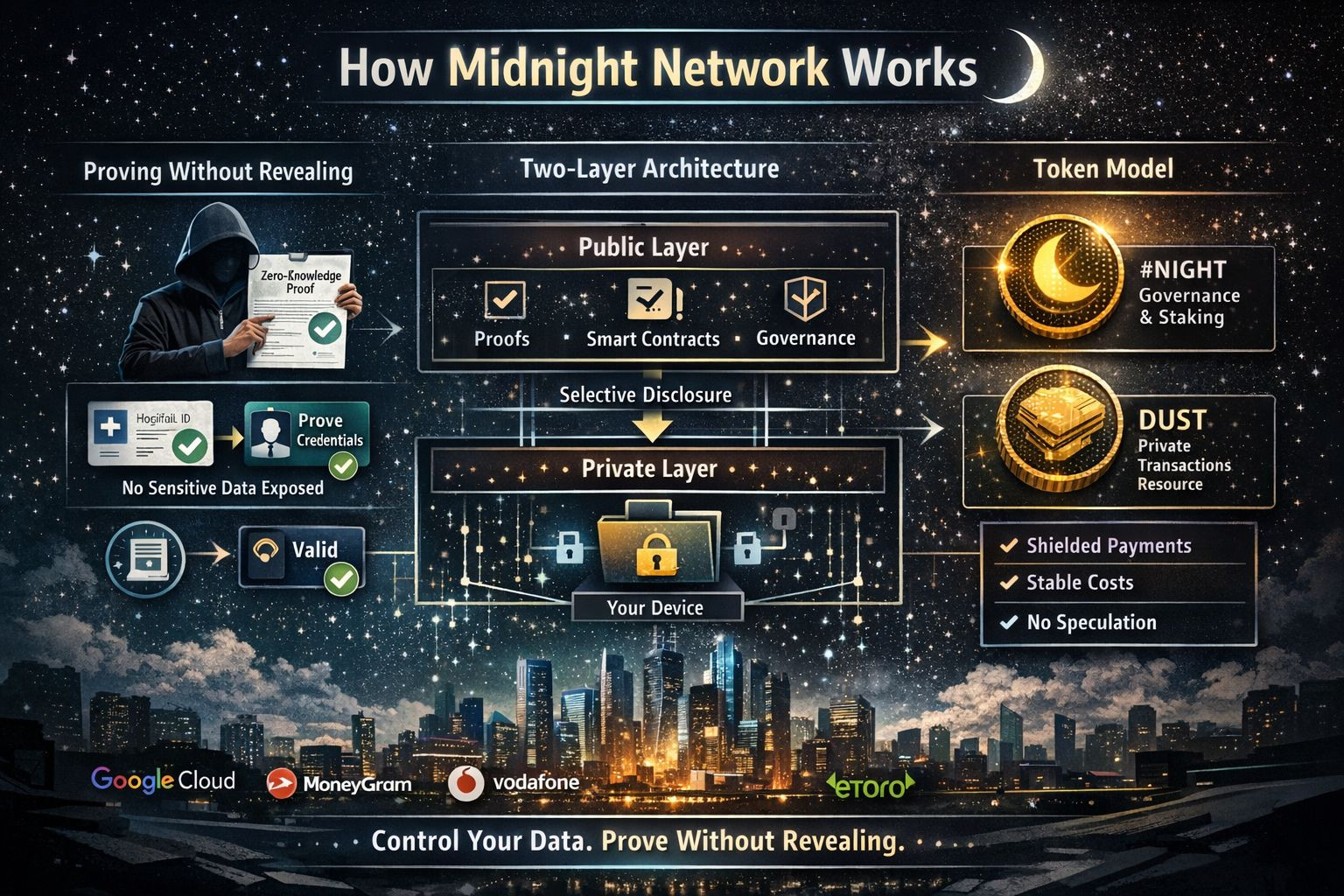
Midnight introduces a better approach using zero-knowledge proofs—specifically zk-SNARKs. These allow users to prove something is true without revealing the underlying data.
Imagine proving you’re eligible for a financial service without sharing your identity documents. Or verifying medical eligibility without exposing health records. Midnight makes this possible by design.
A Two-Layer Architecture That Changes Everything
Midnight separates its system into two distinct layers:
Public Layer: Stores proofs, smart contracts, and governance data
Private Layer: Keeps sensitive user data encrypted and off-chain
Zero-knowledge cryptography acts as the bridge. You control what moves between these layers—deciding exactly what gets revealed and when.
This concept, called selective disclosure, transforms privacy from an afterthought into a core feature.
A Developer Experience Built for Privacy
Most privacy-focused systems are notoriously difficult to build on. Midnight tackles this with Compact, a TypeScript-based smart contract language.
What makes Compact unique is its philosophy:
Private data is confidential by default
Any attempt to expose it triggers a compiler error
Developers must explicitly use disclose() to reveal data
This flips the traditional risk model. Instead of worrying about hiding sensitive data, developers are forced to justify revealing it.
The language has even been contributed to the as Minokawa, signaling a push toward open standards. Security libraries from further strengthen the ecosystem.
Rethinking Blockchain Economics
Midnight also reimagines how transaction costs work.
Instead of a single volatile token model, it introduces:
NIGHT: A public token used for governance and staking
DUST: A private, non-transferable resource used for transactions
Holding NIGHT generates DUST over time. This means:
Predictable costs for businesses
No exposure to token price volatility
Private transaction metadata
It’s a system designed for usability—not speculation.
Backed by Real-World Infrastructure
Midnight isn’t building in isolation. Its early network includes major players like , , , and .
Launched via , it also plans cross-chain connectivity through , positioning itself as a privacy layer for the broader blockchain ecosystem.
A New Standard for Data Ownership
Midnight Network represents a shift in thinking. Instead of asking how to make blockchains more private, it asks a deeper question:
What if users actually owned their data?
By combining zero-knowledge proofs, privacy-first development tools, and a practical economic model, Midnight moves blockchain closer to real-world adoption.
It doesn’t just protect data—it gives control back to the people who generate it.