
There’s one thing the $ROBO narrative quietly depends on that I don’t think gets enough attention.
Friction.
The Fabric Foundation only becomes necessary if coordination between machines becomes difficult enough to justify a shared layer.
Not interesting.
Not innovative.
Necessary.
And necessity doesn’t come from possibility — it comes from pain.
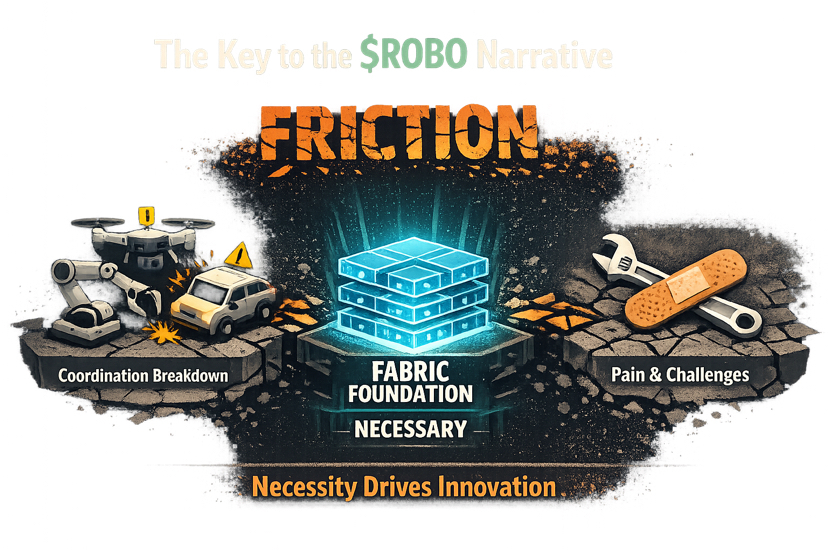
Right now, I’m not convinced that pain exists at scale.
Most autonomous systems still operate in environments where coordination is controlled and predictable.
Internal workflows.
Single-entity ecosystems.
Tightly managed infrastructures.
In those conditions, friction is minimal.
And without friction, coordination layers remain optional.
This is where the thesis starts to feel slightly unstable.
Not because the idea is weak.
But because it relies on a future where systems begin to collide in ways that create real inefficiencies.
Different standards.
Different identities.
Different economic rules.
That’s when things break.
And when things break, infrastructure gets built.
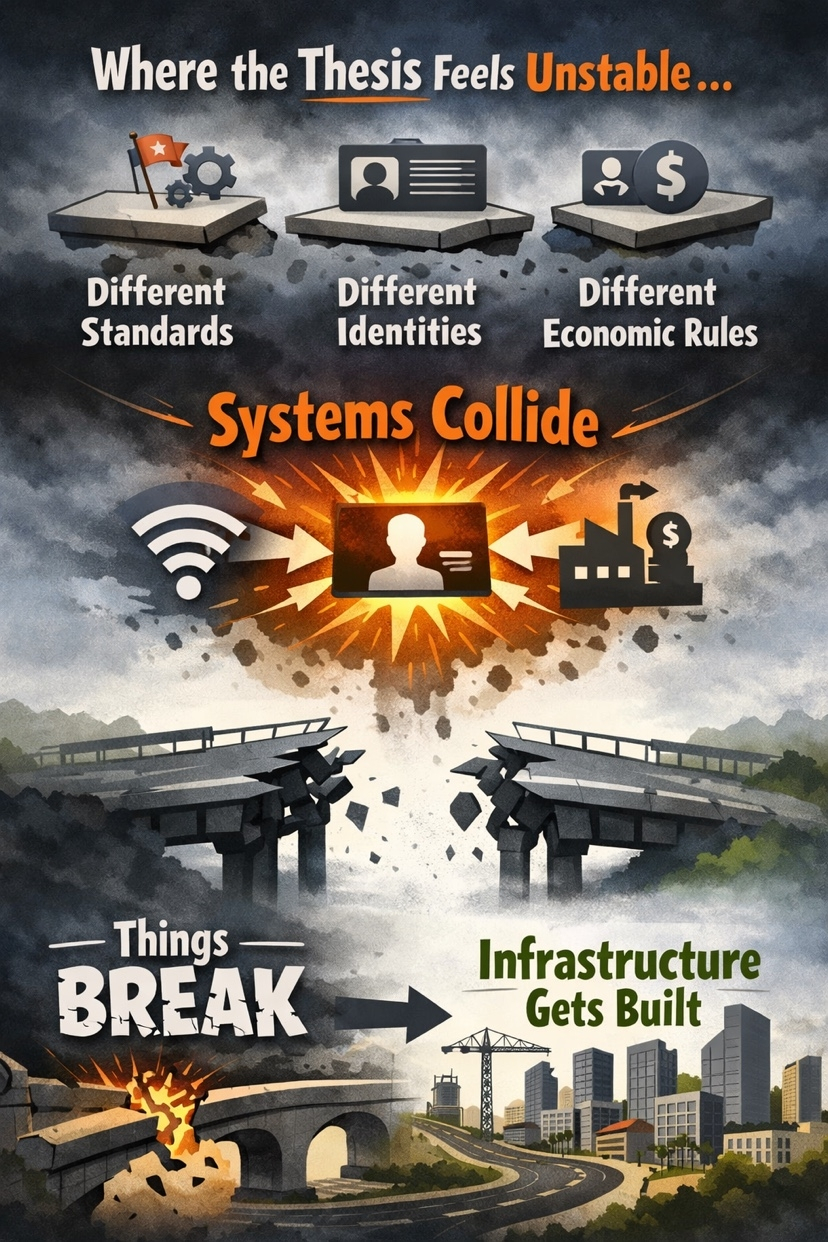
But we’re not clearly in that phase yet.
We’re still in the phase where systems are being optimized internally.
Which usually delays the need for external coordination.
I’ve noticed something about how technology evolves.
People don’t adopt new layers because they’re elegant.
They adopt them because something stops working.
Until that happens, the default behavior is to stay with what’s already functioning.
And right now, a lot of machine ecosystems are still functioning just fine on their own.
That’s why I keep coming back to this uncomfortable question:
Where is the friction that forces Fabric into relevance?
Not theoretical friction.
Real, operational pain.
Because that’s the only thing that turns infrastructure from optional to unavoidable.
Maybe that friction is already forming quietly.
In edge cases.
In early integrations.
In systems starting to interact in ways we don’t fully see yet.
Or maybe it hasn’t arrived at all.
And if it hasn’t…
Then the entire thesis sits in a kind of suspended state.
Architecturally sound.
Strategically interesting.
But waiting for a trigger that hasn’t clearly appeared.
I don’t think this is something you can predict cleanly.
Friction doesn’t announce itself in advance.
It builds slowly, then suddenly becomes obvious.
So for now, I’m not trying to force a conclusion.
I’m just watching for signs that coordination between autonomous systems is starting to break down at the edges.
Because when that happens, solutions like Fabric stop feeling experimental.
They start feeling inevitable.
And right now…
I’m not sure we’re there yet.
#ROBO @Fabric Foundation $ROBO
