


In this world every one need financial freedom also #ROBO thinks for a Blockchain for robots so they made it.
Most people arguing about the future of robotics are focused on the wrong thing. Speed, precision, job displacement. Fine questions. But there is a more foundational one almost nobody is asking.
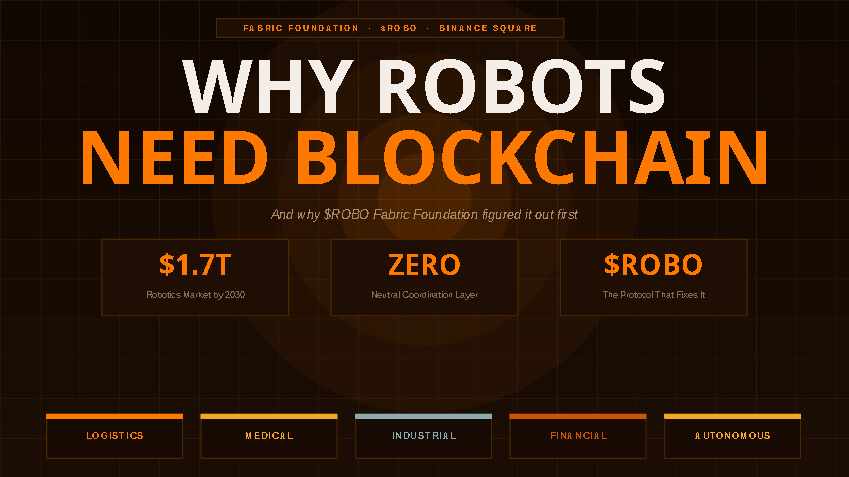
How does one robot know it can trust another robot?
We are moving toward a world where autonomous machines execute real tasks with real consequences. A logistics bot dispatching a shipment. A drone completing a delivery. An AI agent coordinating with three other agents to fulfill a contract. None of these interactions happen between humans anymore. They happen machine to machine, at speeds no human can monitor in real time.
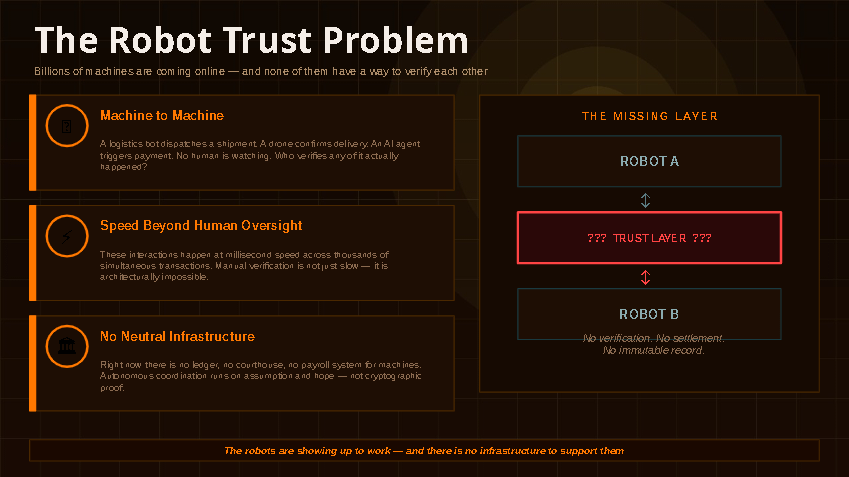
And right now there is no neutral infrastructure letting those machines verify each other, coordinate actions, settle outcomes, and record everything in a tamper-proof way. The robots are showing up to work and there is no ledger, no courthouse, no payroll system. Just assumption and hope.
This is exactly the gap Fabric Foundation built $ROBO to fill.

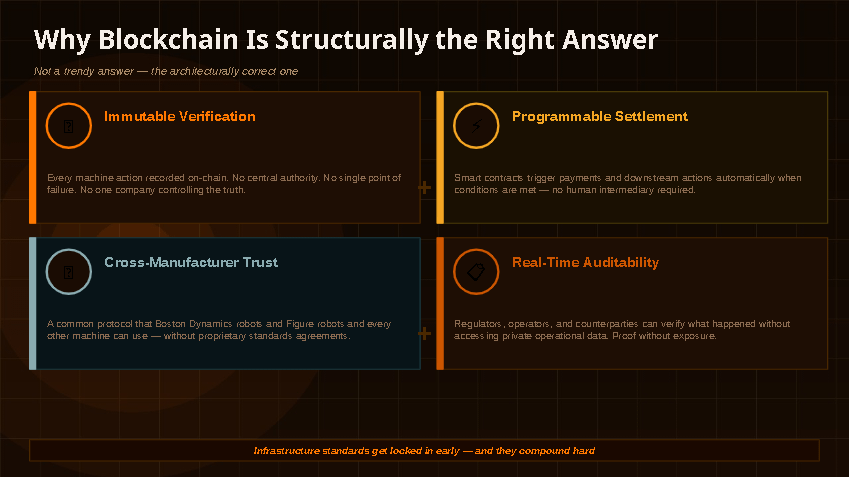
The project is not trying to build a better robot. It is not competing with hardware players. What it is building is the coordination layer that all autonomous machines will eventually need to operate inside an economy together. When a machine completes a task, something needs to verify it happened, record it immutably, trigger payments, and make the whole sequence auditable without relying on a centralized server owned by a company with its own agenda. Blockchain is not a trendy answer here. It is structurally the correct one.
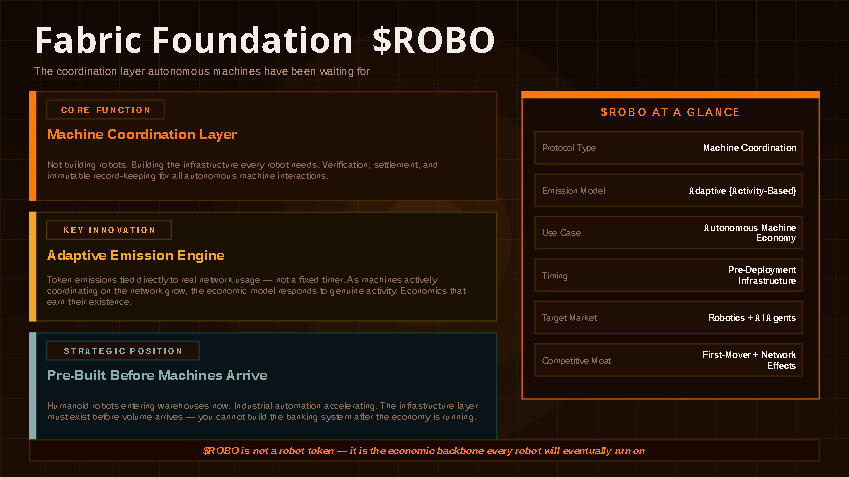
What separates $ROBO from generic infrastructure plays is the Adaptive Emission Engine. Most token projects run fixed emission schedules completely disconnected from whether anyone is actually using the network. Fabric Foundation tied its emissions directly to real network activity. As machines actively coordinating on the network grow, the economic model responds to that growth. That one design decision signals how the team thinks. They are building something that earns its economics rather than just printing them.
The timing is not accidental either. Humanoid robots are moving from labs into warehouses right now. Industrial automation is accelerating. All of these machines will need to interact with each other and with economic systems within the next several years. Infrastructure needs to exist before the machines arrive in volume. You cannot build the banking system after the economy is already running.
The core thesis is genuinely sound. At any meaningful scale of autonomous machine coordination, a shared neutral protocol is not optional. It is inevitable. The only real question is who gets there first and whether major robotics players plug into a shared layer or waste years building proprietary solutions that cannot talk to each other.