

The blockchain industry has long been a theater of "solutions looking for problems." We build cathedrals of code, only to find the congregation is still stuck at the gates, fumbling with a dozen different keys. When I look at the current state of on-chain operations, I don’t see a revolution; I see a bureaucratic nightmare dressed in decentralization’s clothing. Every new project is a silo. Every dApp is a fresh interrogation.
We are living through the "Verification Fatigue" era. If you’ve spent any time in the trenches of DeFi or Web3 governance, you know the drill: re-verify your wallet, re-submit your KYC, re-prove your credentials. It’s a redundant waste of developer cycles and a jagged shards-of-glass user experience. This is where Sign Protocol enters the frame—not merely as another identity layer, but as a fundamental shift toward Reusable Claims.
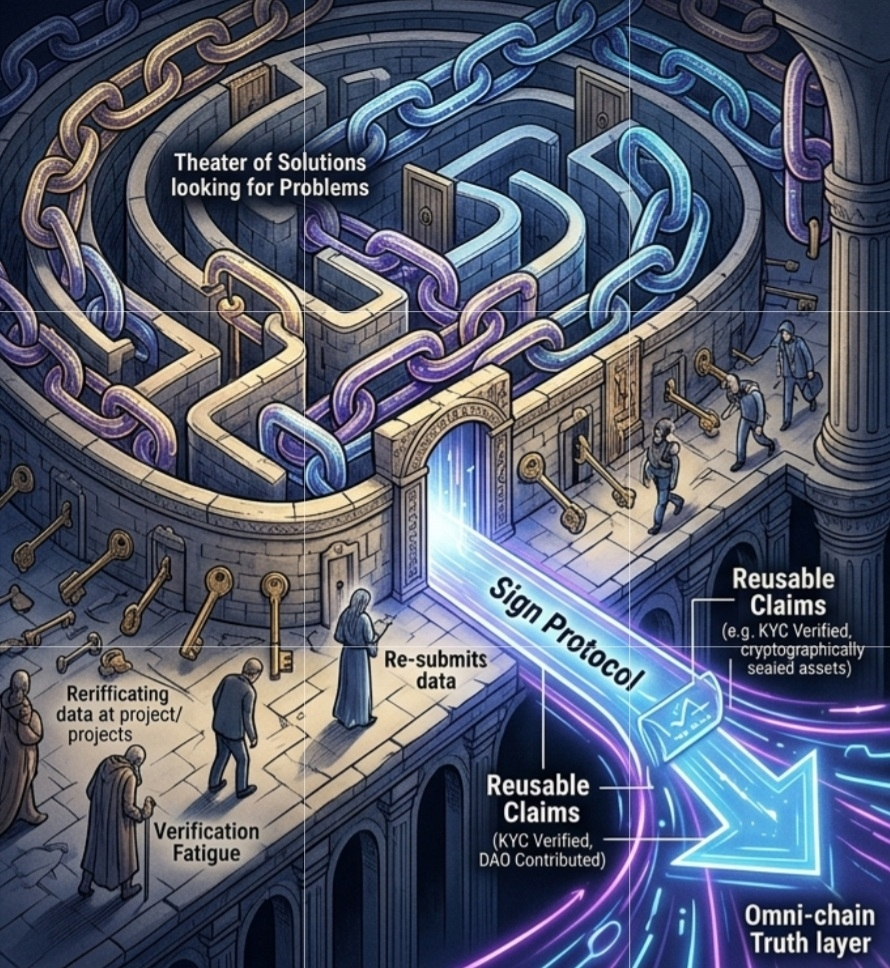
The Architecture of Truth: From Silos to Shared Reality
The core genius—and the core gamble—of Sign Protocol lies in its departure from the "Identity Wallet" trope. Instead of trying to own your persona, it focuses on the Claim. Once a piece of data is verified—be it a credit score, a DAO contribution, or a simple "not-a-bot" check—it becomes a portable, on-chain asset.
By utilizing an Omni-chain framework and Zero-Knowledge Proofs (ZKP), Sign attempts to build a "Shared Layer of Truth." This isn't just about convenience; it’s about fixing the systemic failure of smart contracts that rely on static, fragile spreadsheets. Tools like TokenTable are the first practical manifestation of this—replacing messy manual distributions with automated flows tied to live, verifiable claims.
But as I dig deeper into the actual implementation of this tech, specifically its recent foray into the realm of Central Bank Digital Currencies (CBDCs), the narrative shifts from technical elegance to a profound philosophical dilemma.
The Kyrgyzstan Milestone: A Double-Edged Sword
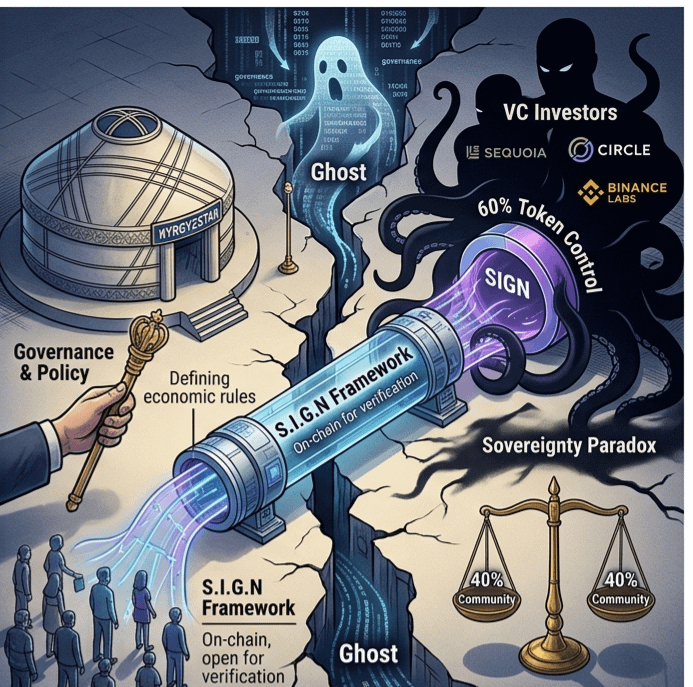
Recently, Sign Protocol inked a deal with the National Bank of the Kyrgyz Republic. In a world of "vaporware," this is a tectonic shift. We are talking about the S.I.G.N Framework being used to underpin a nation’s sovereign currency.
The framework cleverly bisects the system:
Governance & Policy: Remains in the hands of the State.
Technology: Remains transparent and verifiable on-chain.
On paper, it’s a masterstroke of "Digital Sovereignty." But here is where my skepticism, honed by years of watching financial cycles, starts to itch.
The Illusion of Autonomy: The Investor Shadow
We talk about sovereignty, yet we must look at the cap table. Sign Protocol is backed by the titans of global venture capital: Sequoia, Circle, Binance Labs, and IDG Capital. The tokenomics reflect a familiar, albeit unsettling, pattern. With a total supply of 10 billion SIGN, 40% is earmarked for the community, while a staggering 60% is concentrated among investors, the team, and the foundation. Herein lies the Sovereignty Paradox:
If a nation builds its financial future on a protocol where the underlying economic incentives and "governance power" are held by a handful of Silicon Valley VCs and global exchanges, is that nation truly sovereign?
We are essentially seeing a 21st-century version of the SWIFT system evolution. In the 80s, global messaging systems promised efficiency. They delivered it, but they also created a leash. If a state adopts Sign Protocol, they aren't just adopting "code"; they are entering a long-term dependency on a specific token economy.
The Critical Questions for the Future
As an observer of this space, I find myself oscillating between admiration for the tech and a deep-seated worry about the power dynamics. When the next financial crisis hits, or when a massive "Token Unlock" occurs, who holds the steering wheel?
The Exit Strategy: Can a state like Kyrgyzstan truly "fork" the protocol if the interests of the $SIGN holders diverge from the interests of the Kyrgyz citizens?
The Incentive Gap: What happens when the "Shared Truth" of the protocol is manipulated by the economic weight of its largest stakeholders?
Sign Protocol is undoubtedly a piece of "Real Infrastructure"—the kind the crypto space desperately needs to move past the "Meme Coin" phase. It solves the chaos of redundant verification and replaces spreadsheets with cryptographic certainty.
However, the transition from "Code as Law" to "Code as State Infrastructure" is fraught with philosophical landmines. We are building the rails for the future of global finance, but we must ask: Who owns the land the tracks are laid upon?
My Perspective
I believe Sign Protocol will succeed in its technical mission because the current "chaos" is unsustainable for developers. But its true test won't be in its code—it will be in its ability to prove that it isn't just a new, more efficient form of financial colonialism.
#SignDigitalSovereignInfra @SignOfficial
